Why do tennis players keep two balls in their pockets? The story behind one of tennis's most familiar rituals
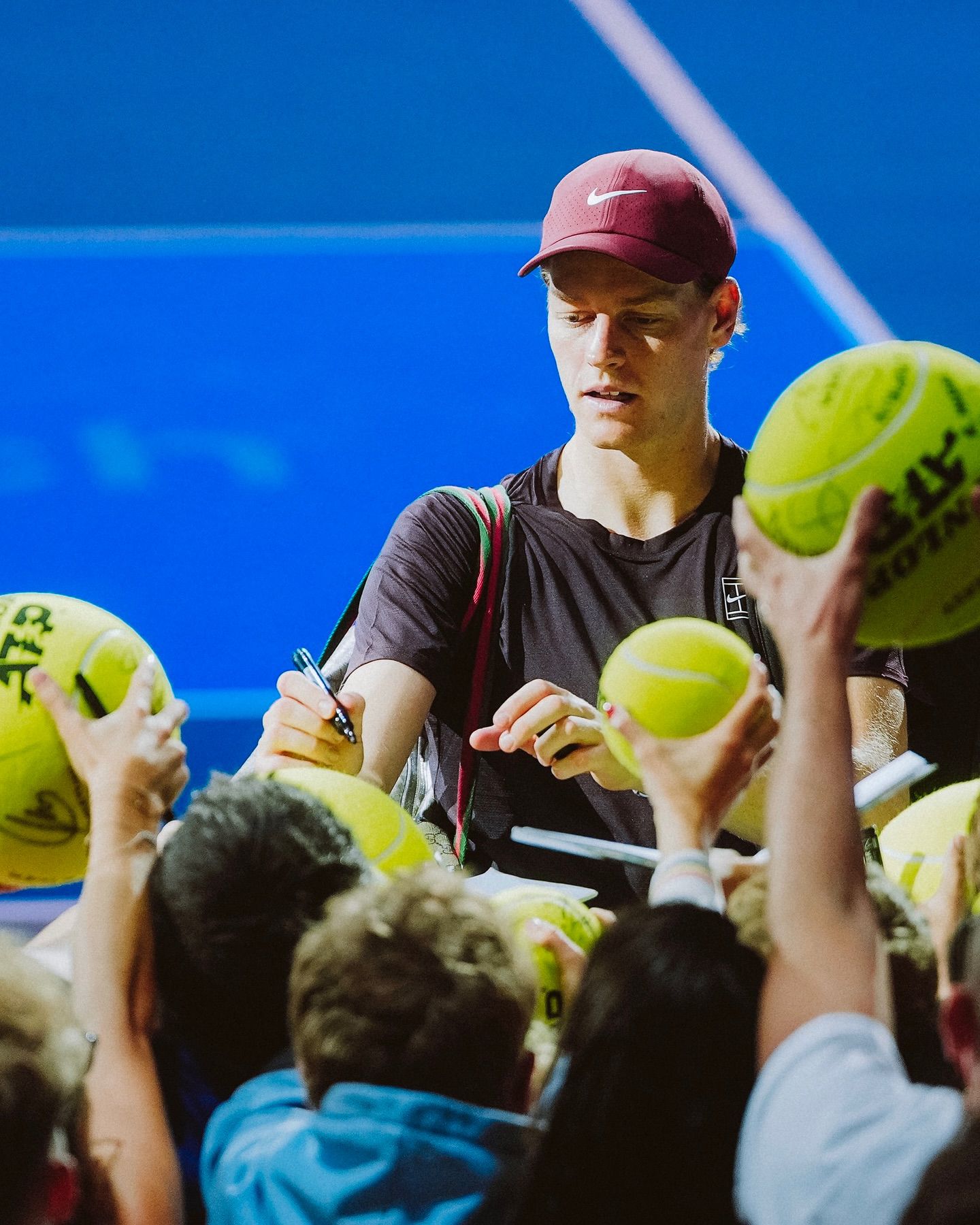
This end to the tennis season will be particularly important for Italy, with the Davis Cup Final 8 in Bologna followed by the Nitto ATP Finals in Turin. Although the Jannik Sinner effect is currently on hold due to the much-discussed knee injury, expectations are high for a significant audience, both in person and on television, potentially bringing new fans to the sport. After all, even recent figures from CONI confirm this trend: the Italian Tennis and Padel Federation has overtaken the FIGC in terms of registered members, marking the end of a historic record that had seemingly been untouchable in Italy.
Given the enormous popularity tennis is enjoying and the major events coming up, anyone discovering the sport for the first time would do well to familiarise themselves with a few basic rules. There is a rectangular court, which can come in different colours, a very specific scoring system and, going back to the basics, every tennis player is equipped with a racket and a ball. Perhaps the first unusual detail that catches the eye is the fact that players often step up to serve carrying more than one ball. A gesture that might prompt a simple question from anyone who has never watched a tennis match before: why?
The curious case of Taylor Fritz
Taylor Fritz, the American currently ranked twelfth in the ATP rankings, has competed at the Turin Finals three times, reaching the final against Jannik Sinner in 2024. This year, qualifying looks unlikely, considering his current thirteenth position in the Race and his inconsistent results. Among them was his third-round exit at the Shanghai Masters 1000 in China, held in mid-October.
Fritz lost to Stefanos Tsitsipas, whose career has been on a downward trajectory since reaching world number three in 2021, but it was the way the defeat happened that really caught people's attention. In a best-of-three-set match, with the Greek having won the first set and leading 5–2 in the second, Fritz was serving to stay in the match at 30-all when, after hitting a shot that subsequently went out, a ball slipped out of the American's pocket. An unusual scene, which was repeated on the very next point, creating an extraordinary one-off occurrence.
It was such an unprecedented and virtually unrepeatable situation that it produced two different outcomes. In the first instance, since Fritz had already hit the ball out of court before the second ball fell to the ground, the point was awarded to Tsitsipas. In the following instance, an even more delicate situation as it occurred on a crucial point, Fritz's second ball fell during the rally, prompting Tsitsipas to complain about the distraction and the umpire to call for the point to be replayed. In the end, the Greek lost the game but won the match, celebrating in his own way. What really stuck in people's minds, however, was the surreal nature of the whole episode.
Where the second ball is kept and why
The term second ball refers to the spare ball available to the server in the event of a fault on the first serve. Since serving is a mechanical action, a certain degree of continuity is essential, not to mention the fact that players only have a brief window of around twenty seconds between one point and the next serve. To avoid having to go through the ball boys and girls after every first-serve fault, or having to collect two balls again after every point, players gradually started keeping the second ball in their pockets.
For men, due to the construction of their shorts, understanding how this works is fairly straightforward. With the outfits and skirts sometimes worn by female players, however, things might seem a little more complicated. And indeed, although the ergonomic differences between men's and women's tennis clothing have gradually narrowed, the most common solution has not been to alter the garments themselves, largely for aesthetic reasons, but rather to wear spandex ball shorts with a pocket, often built into the dress or skirt. That is not to say there are no more convenient alternatives: elastic bands worn between the fabric and the skin are also available, while wearing shorts with side pockets has simply become an accepted option. It was not always this way, though.
Holding two balls in one hand
A US patent filed in 1978 and granted in 1981, under the name of Arlen E. Ingram, explains how it was once common practice to hold two balls in the non-racket hand, toss the first one and, if the serve was successful, immediately discard the second. The patent itself also includes a list of drawbacks, such as the second ball interfering with the toss, the risk of dropping it onto the playing area and the unsightly bulge it created in players' shorts.
This account helps us understand just how recent this change is, particularly the gradual abandonment of holding two balls in the palm of one hand, a shift also partly connected to the widespread adoption of the two-handed backhand. Although this style had already been developed in the 1930s by Australians Vivian McGrath and John Bromwich, and regularly used by Cliff Drysdale during the 1960s, it was Jimmy Connors, Björn Borg and Chris Evert who ultimately made it popular and distinctive of the Open Era. That does not mean there were no old-school exceptions, with players still serving while holding two balls in one hand. The most notable examples were Rod Laver, who retired in 1979 after twenty-three years of professional tennis, and Steffi Graf, whose tendency to do so can still be seen in video footage from as late as 1988.
Alternative solutions
Going back to Ingram's patent, his mechanism was designed to be attached to the body using a clip or belt and release the ball after a light press. It was an upgrade on the first rigid plastic clips actually used to hold tennis balls between the 1970s and part of the 1990s: simple cup-shaped devices that gripped the ball and could be attached to a skirt or pair of shorts. Another slightly earlier patent, dating back to 1975, proposed a pair of tennis underwear for women with a dedicated space to hold the ball.
Although these clips were designed to be unisex, once again the biggest differences concerned women's clothing, which had been less practical than men's from the very beginning. From the earliest days of tennis in the nineteenth century until the 1910s, women were expected, as a matter of etiquette, to wear long, voluminous Victorian-style skirts, outfits that made both moving around and bending down particularly difficult. For this reason, tennis aprons became a common solution: embroidered garments featuring large pockets for holding balls, which were extremely fashionable among female players towards the end of the nineteenth century.
The move away from this style at the beginning of the following century was largely driven by Gabrielle 'Coco' Chanel, in the wake of the Olympic Games held in Paris in 1900, where tennis was among the first sports open to women, and by French tennis player Suzanne Lenglen. In 1919, she shocked the world by winning Wimbledon wearing a sleeveless shirt and a skirt that reached only halfway down her calves. The first women's shorts, on the other hand, would not arrive until the 1930s, while the following decade saw the introduction of shorter skirts. These were the revolutions that paved the way for the tennis outfits we see today.
What happens when a ball falls out of a pocket?
The Fritz incident, with two separate balls falling out of his pocket, illustrates how the rules allow the umpire to deal with two different scenarios. When Tsitsipas complained about the distraction, the chair umpire correctly called a so-called let, meaning the point had to be replayed. This was because it was an involuntary hindrance, raised by the opponent rather than the player in control of the situation, namely the server, Fritz. Had the same thing happened again on the following point, the chair umpire would have classified it as a deliberate hindrance by Fritz, automatically awarding the point to Tsitsipas. When, on the other hand, as in the first rally, the ball falls after the final shot has already been played, the point can be awarded without any consequences, as if nothing had happened. This is why the following rally was replayed without any immediate penalty.
Of course, things are not always quite so straightforward. At the beginning of 2026, during a United Cup match against Stan Wawrinka, Flavio Cobolli stopped in the middle of a rally after a ball fell out of his pocket, effectively conceding the point to his opponent. This led to a heated discussion, which was eventually resolved once the concept of self-hindrance had been clarified: a tennis player cannot claim interference when the issue is entirely within their own control. In this case, it would have been Wawrinka who could have requested a let.
A similar situation involved Jannik Sinner at last year's Wimbledon, when his opponent Jan-Lennard Struff dropped a ball from his pocket during a rally, with Sinner in control of the point and facing a break point. The German did not stop playing completely, probably aware of the rule, and neither did Sinner. The chair umpire, however, called a let while the point was still in progress, a more unusual scenario than the standard one, in which at least one of the two players stops playing.
Finally, perhaps the most dramatic outcome involves repeated hindrance incidents at different moments during the same match. A case like this once again involved Cobolli, specifically in his first-round match against Nicolás Jarry at the 2024 Australian Open. During a four-hour marathon, with the Chilean leading 30–0 and serving for the match in the deciding fifth set, a ball fell out of his pocket. Since Jarry had already dropped a ball earlier in the match, the umpire penalised him by awarding the point to Cobolli. The Italian seized the opportunity to fight his way back into the match, complete the break and shift the momentum in his favour, winning three consecutive games and eventually the match. His Chilean opponent, fully aware that he had probably come within one dropped ball of achieving a major victory, furiously smashed his racket against the ground after the match.
What to read next
Is the world of sport boycotting influencers?
What recent measures introduced by clubs and major events tell us
The ATP's plan for the future of tennis
A letter from Andrea Gaudenzi has outlined several changes that could reshape the tour from 2028