The strange exercises footballers use to train vision and perception From videos of Godo to Mertesacker’s pencil: how do footballers train their ability to read the game visually?
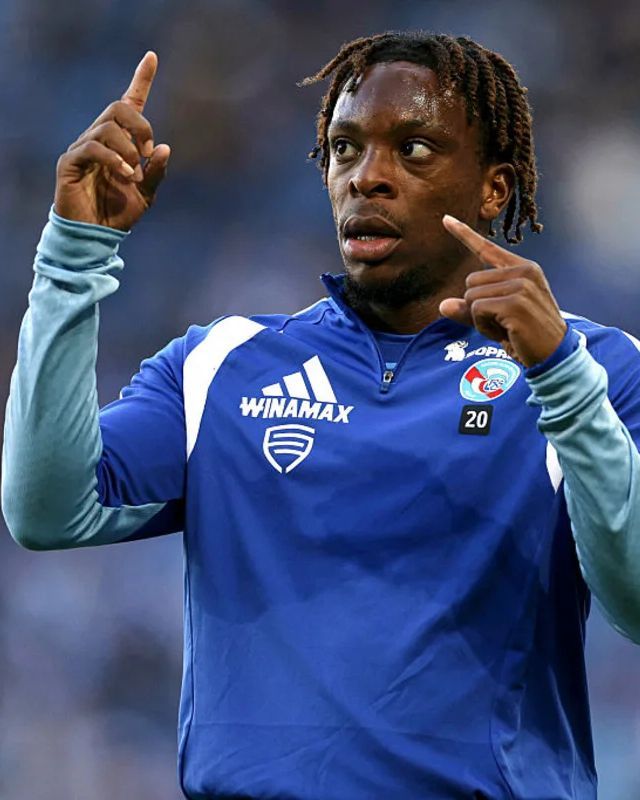
In recent weeks, several clips of Martial Godo, a forward for Strasbourg, have circulated on social media. During his warm-up, he brings his fingers in front of his face, shifts his gaze from side to side, closes one eye and then the other, and rotates his head. The sequence has intrigued - and amused - many viewers confronted with unfamiliar and apparently rather absurd gestures. Prompting a flood of questions about what exactly he was doing and training at that moment.
La routine étonnante de Martial Godo à l'échauffement L'international ivoirien teste sa vision avec un exercice bien précis #RCSAAJA https://t.co/k0YeBkutSh
— L1+ (@ligue1plus) November 1, 2026
A few weeks earlier, Wout Weghorst had attracted attention after being caught on camera making a similar series of gestures just before the start of the second half of a Twente match. Going back a few more months, Reo Hatate - then at Celtic and now at Burnley - had also been filmed shifting his gaze between his two index fingers, tracing unusual paths with his hands and eyes.
This is so interesting to me. Apparently this is one of the ‘exercises’ of Celtic FC’s Reo Hatate in his warm up routines before games. https://t.co/Hik3X2J9Er
— CHIEF (@tailorMARIQUE) December 13, 2025
These sequences have drawn attention to an aspect of athletes’ preparation that has existed for years but remains largely unknown to the wider public: training perception, attention and visual skills. Among those who have explained what it involves and described its benefits is Mertesacker, the former Arsenal defender who used to perform exercises with a pencil as part of his pre-match routine.
Mertesacker’s pencil
In 2018, in an autobiographical extract published by The Guardian, Per Mertesacker described the work he began after his 2012 injury with Lars Lienhard, a German sports scientist and former athlete recognised as one of the pioneers of neuroathletics. “We always assume that we can run and see properly because we don’t feel any pain”, Mertesacker said. “But that’s a mistake. Lars showed me that the eyes play an important role in everything, especially timing”.
The defender had noticed a difference between the two sides of his body: when looking to his left, he tended to turn his neck and use his dominant eye, the right one. Lienhard devised a programme to address this difficulty, with the aim of helping him read the trajectories of the ball and his opponents more effectively and quickly, and move accordingly. “I did exercises with a patch over my right eye, forcing the left one to focus on objects. After a few weeks, I could really notice the difference during matches: if a high ball came in from the left, I had a much better perception of where it would land”.
One of the exercises was what he described as a kind of press-up for the eyes: “Bringing a pencil towards your nose and forcing your eyes to converge towards the centre”. He developed the habit of setting aside time every day for six or seven exercises of this kind, at home, in hotels and sometimes in the dressing room before matches. “I didn’t care what the others thought, or whether they laughed”, he explained. The reaction of some of his teammates, however, stayed with him: “It was something new and unfamiliar, and it only prompted laughter instead of making people wonder what I was doing”. It is hardly surprising that after retiring in 2018, he became an advocate for neuroathletics applied to football, starting with Arsenal’s academy, where he worked until a few months ago.
Training vision and perception
Tracking a moving object, shifting the gaze quickly, stopping it precisely on a target and adjusting focus: visual training works on a wide range of skills. On the pitch, these abilities can influence certain reads - and therefore reaction times - more than we might imagine. For a defender, for example, they can be crucial for timing an interception correctly or positioning themselves for a cross into the penalty area; for a forward, they can help them lose their marker or produce the decisive movement in front of goal.
Wout Weghorst lijkt klaar voor de tweede helft https://t.co/xgS4tfBqNZ
— ESPN NL (@ESPNnl) September 20, 2026
The processes being challenged are visual intake and information processing, which can be trained through different practices. Weghorst’s sequence, for example, involves his fingers, clapping his hands and moving his arms. Dutch neuropsychologist Erik Scherder explained that this is a way of increasing the state of activation, through the stimuli that hand coordination transmits to different areas of the cerebral cortex.
In Lienhard’s neuroathletic approach, vision is considered a starting point alongside balance and awareness of one’s own body. Several major figures in German sport have worked with him over the past fifteen years, including Mario Götze, Serge Gnabry, sprinter Gina Lückenkemper and the current world No. 1 in tennis, Alexander Zverev, whose programme also included exercises using a virtual reality headset.
Another method that works on the relationship between perception and action - in this case during the phase immediately following the acquisition of information - is the so-called Constraints-Led Approach (CLA). It is based on modifying the context surrounding an action and aims to improve an athlete’s ability to adapt and find solutions instinctively. Following this method, a coach might alter the space and rules of a game, or the equipment and tools being used. In other words, they shuffle the deck and test how the player adapts at an unfamiliar table. Among those who have recently discussed the approach are Kenny Atkinson and Alex Sarama, founder of the Transforming Basketball programme and head coaches of the Cleveland Cavaliers in the NBA and the Portland Fire in the WNBA, respectively.
From fingers and pencils to glasses
As the words of many athletes and coaches suggest, a wide range of objects can be used to train an athlete’s vision, sometimes introducing conditions that alter what they can see. In a 2024 interview, former Inter goalkeeper Yann Sommer described focusing exercises involving his thumb, moving it closer to and further away from his face, as well as a string fitted with balls positioned at different distances. These were accompanied by stroboscopic glasses, also used by Jamal Musiala during his work with coach Steffen Tepel. The lenses alternate between transparency and opacity, interrupting vision at irregular intervals with the aim of training anticipation.
Switzerland goalkeepers have been wearing battery-powered Japanese glasses in training to try and boost reflexes...
Other visual constraints have appeared, for example, during training sessions involving Silvio Baldini’s Italy Under-21 team. In 2025, images circulated of the Azzurrini training on the pitch with one eye covered: another case that attracted curiosity and some irony on social media.
#Nazionale #Azzurri #VivoAzzurro https://t.co/NFYMQGFQWX
— Nazionale Italiana (@Azzurri) June 4, 2026
At Liverpool, goalkeeping coach Fabian Otte has introduced exercises using glasses that restrict peripheral vision, while Trent Alexander-Arnold followed a programme with ophthalmologist Daniel Laby as part of the Trent’s Vision project. It involved lights and illuminated targets, virtual reality activities and other perception exercises. “Vision is the foundation of every decision you make on a football pitch”, Alexander-Arnold said.
There is an entire world behind these curious images coming from training grounds - whether they show brief visual exercises such as Godo’s or more extensive neuroathletic programmes. According to Mertesacker, there are athletes whose careers they have “completely changed”. Lars Lienhard summarises the reason simply: “If the brain doesn’t control the body properly, you cannot perform to your full potential”.
What to read next
Ravenna builds special stand for Ronaldinho's return to football
Everything is ready for his comeback
The aesthetics of football manager sackings
From TV interviews to thank-you posts on social media, and much more: how are managerial sackings portrayed?