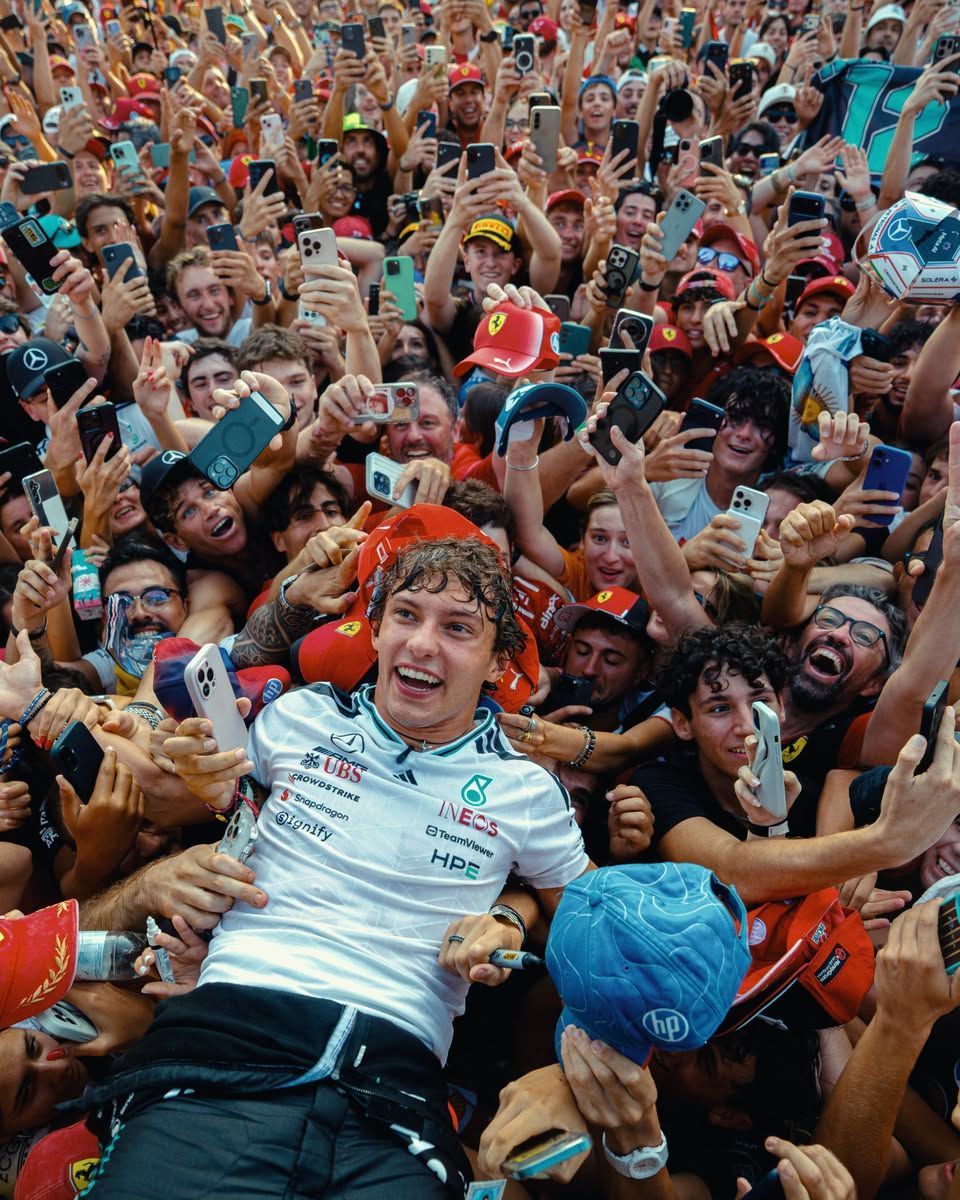
You can root for Kimi Antonelli and still love Ferrari How the Mercedes driver is challenging the Prancing Horse's grip on Italian F1 fans
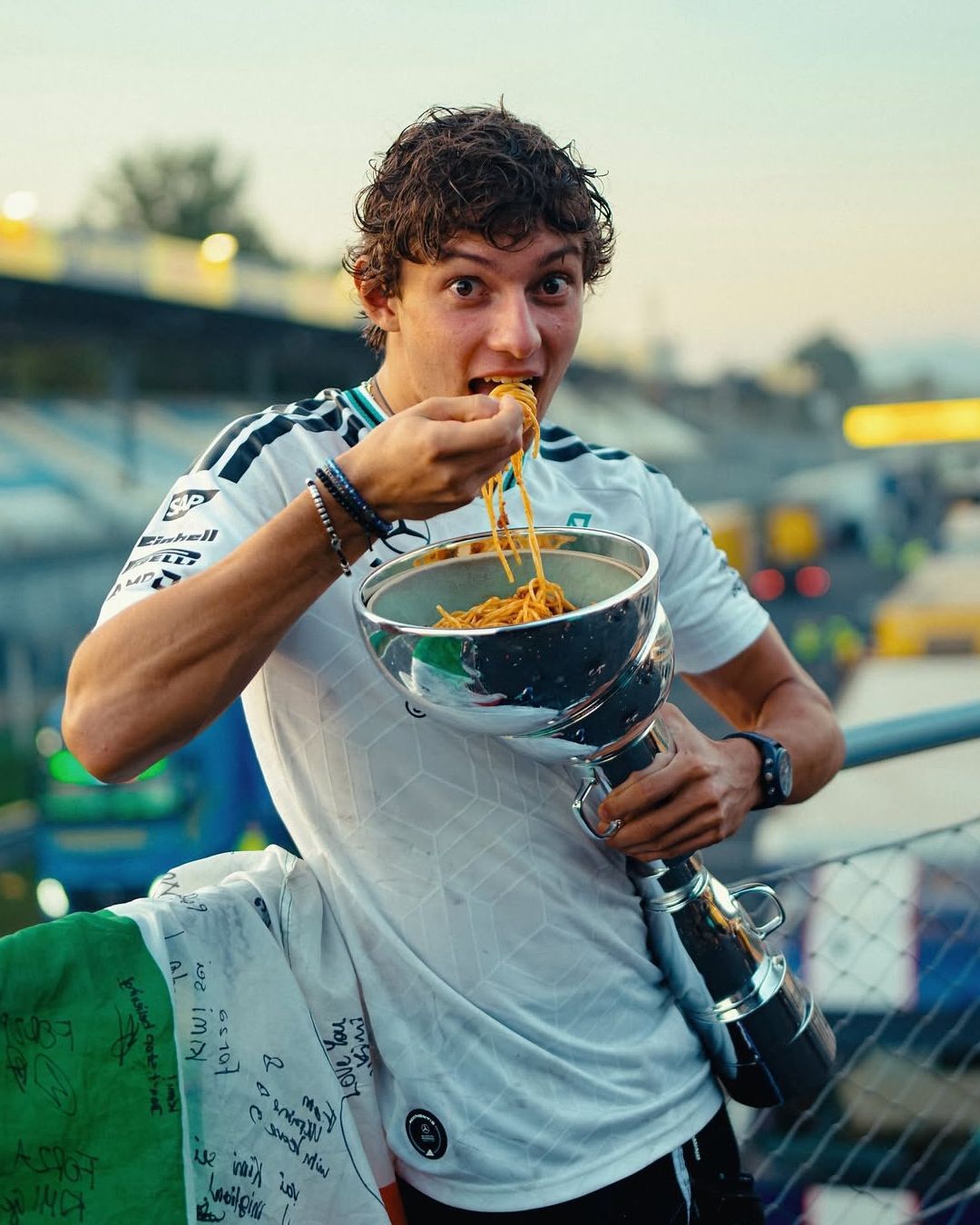
Perhaps for the first time in its history, all of Italy is rooting for a Formula 1 victory that doesn't belong to Ferrari. In Austin, Texas, Andrea Kimi Antonelli could already clinch the current Drivers' Championship, becoming the third Italian world champion in history, after Alberto Ascari — who won back-to-back titles with the Prancing Horse in 1952 and 1953 — and Nino Farina, who claimed the inaugural championship in 1950 with another Italian team, Alfa Romeo.
When Can Kimi Antonelli Become F1 World Champion?
That doesn't mean it will happen straight away. Antonelli would need to turn his current 102-point lead over team-mate George Russell into 125 points or more — by finishing first while the Briton doesn't, for example — to mathematically secure the title with five Grands Prix still to go. Nor does it mean he'll necessarily pull it off in the weekends following Mexico City or Brazil — perhaps this only needs spelling out for the sake of superstition — but there's no denying he has a very healthy advantage.
And yet, it's hard to deny there's something slightly strange about doing the maths and realising that we might soon be celebrating a Mercedes crossing the finish line beneath the chequered flag. It's a fascinating media paradox, worthy of a textbook on reception aesthetics: a perfect example of the artificial constructs that shape an audience which feels somehow conflicted because the car in question isn't a Ferrari.
Why Doesn't Kimi Antonelli Race for Ferrari?
Let's start with a simple point: Andrea Kimi Antonelli is Italian, but he has no real connection to the Prancing Horse. The only genuine link dates back to the driver's childhood. Piecing together several accounts of Antonelli between the ages of eight and ten, the first prominent figure to recognise his talent was Giovanni Minardi of Minardi Management, the son of entrepreneur Gian Carlo Minardi, who founded the team bearing his name in the 1980s.
Speaking to Gazzetta dello Sport, Minardi junior recalled discovering Antonelli at the Sarno circuit during the 2014 Kart Summer Camp, when the young driver was just eight years old. He immediately brought him to the attention of Massimo Rivola, then Ferrari's Sporting Director, who was on good terms with Minardi, having begun his own career at the latter's father's company. When Rivola subsequently became head of the Ferrari Driver Academy, an attempt was made to recruit Antonelli around 2018, while he was still racing for Tony Kart Racing Team, whose iconic chassis and racing suits also carried the Ferrari badge. That, however, was the only time he ever wore Ferrari colours.
According to Antonelli's father, his son had even completed simulator tests at the Academy's headquarters in Maranello. Nevertheless, Ferrari's then Team Principal and Managing Director of Gestione Sportiva, Maurizio Arrivabene, put a stop to the process for two reasons, which he later revealed to Quotidiano Nazionale: the team's logistical limitations, as it did not yet have the resources and facilities to develop a driver who was not even twelve years old, and the attention Ferrari was devoting at the time to bringing Charles Leclerc into the team, a move announced in September 2018. This account was also confirmed by former Ferrari President Luca Cordero di Montezemolo, among others. He described it as a “missed opportunity”, while suggesting that it may ultimately have been the best outcome for Antonelli, sparing him the burden of excessive pressure at such an early stage of his career.
Mercedes and the Strategy Behind Antonelli's Rise
In an interview with Fanpage, Gian Carlo Minardi also claimed that Antonelli would never have made it to Formula 1 had he joined Ferrari. While there is no factual evidence to prove this counterfactual, Mercedes' pioneering approach cannot be overlooked. By 2018, the German manufacturer had built a network of programmes and partnerships capable of winning both the Formula 1 World Championship with Lewis Hamilton and the Formula 2 title with George Russell. Meanwhile, Mick Schumacher won the Formula 3 championship with PREMA Theodore Racing, driving a single-seater powered by Mercedes-AMG. To round things off, Gary Paffett won the Deutsche Tourenwagen Masters with HWA, a Mercedes-affiliated team. It was the German outfit's final appearance in the series after nineteen years of participation, as its departure was prompted by the move into Formula E.
It comes as little surprise, then, that a programme of this kind would welcome and nurture a young talent like Andrea Kimi Antonelli, who was taken under the wing of Toto Wolff, Mercedes' celebrated Team Principal and CEO. In 2022, Wolff had already overseen the promotion to Formula 1 of another graduate of the Mercedes-AMG F1 Junior Programme, George Russell. His decision to back Kimi Antonelli carried even greater significance, however, as the Bologna-born driver replaced Lewis Hamilton in 2025, following the Briton's move to Ferrari. When asked to justify his choice, including the decision not to pursue the widely rumoured signing of Carlos Sainz, Wolff explained that Mercedes' future lies with young drivers like Kimi Antonelli. It is a philosophy that dates back to the 1990s, when Jochen Neerpasch, Mercedes' head of motorsport, established the Mercedes Junior Team within Sauber-Mercedes in the World Sportscar Championship. The initiative featured three young drivers who would soon make their way into Formula 1: Karl Wendlinger, Heinz-Harald Frentzen and, above all, Michael Schumacher.
Why Are Driver Academies So Important?
Putting the Antonelli-Ferrari question aside for a moment, it is worth highlighting one of the key advantages of joining a structured development programme. From a logistical standpoint, becoming part of a Formula 1 junior programme gives a driver access to better preparation and development, cutting-edge technology and simulators, as well as media support and assistance with sponsor management. Above all, however, it helps drivers cope with the enormous financial burden of competing, which would otherwise include all the costs associated with these benefits.
Mercedes is ahead of the curve in this respect, too. In September 2025, a partnership with ADAC — the German Automobile Club and the country's largest motoring organisation — was announced to support young talents looking to pursue a career in motorsport. Mercedes offered to assist ADAC in identifying promising drivers from the age of ten, with those selected receiving full financial support to cover the enormous costs of competition.
This is far from the industry standard, as financial support often covers only part of the expenses. Toto Wolff himself admitted that rising costs were the reason behind the initiative with ADAC, with figures currently reaching around €250,000 per season in karting and ranging from €500,000 to €1 million in Formula 4. Costs can comfortably exceed €1 million in Formula 3 and double that amount in Formula 2. George Russell, a Mercedes graduate who comes from a well-off family, admitted that even £1 million would not have taken him halfway through the journey to Formula 1, despite being part of a structured programme. Lewis Hamilton, whose background was considerably less privileged, has spoken about how his father worked three jobs to fund his karting career, before the McLaren Young Driver Programme took over almost all of the subsequent costs.
A study prompted by Hamilton's own comments in 2019 explained how the total cost of reaching Formula 1 could amount to around £10 million, including training, equipment, entry fees and travel expenses. One of the most recent casualties of this system was Zak O'Sullivan, who withdrew from the 2024 Formula 2 season due to a lack of funding, despite being a member of the Williams Driver Academy and having won two of the three races preceding his departure. Progress is being made — the F1 Academy's support for women seeking to compete in motorsport is one example, particularly given the prejudice they face on top of the financial barriers — but pursuing a career at this level without the backing of a development programme remains almost unthinkable.
Kimi Antonelli and Ferrari: Why Italian Fans Can Support Both
Returning to the concept of reception aesthetics mentioned at the beginning, this approach seeks to recognise the active role audiences play in constructing meaning. In this particular case, support for Ferrari has become so deeply rooted and so radicalised that, for a large section of the public, it has turned into something closer to extremism than faith. It is a mental and communicative construct that is as artificial as it is contrived, to the point of obscuring the original reason for supporting Ferrari in the first place: it is an Italian team, just as Kimi Antonelli is an Italian driver.
And yet, the paradox persists. A Sportweek poll published by Gazzetta dello Sport, involving more than 1,800 respondents, revealed a dead heat, with 33.1% supporting Ferrari and the same percentage backing the Bologna-born driver. More specifically, Antonelli is the preferred choice among those aged between 14 and 34, while Ferrari is favoured by the 35–54 age group, with the two almost level among those aged 55 to 64. As is often the case, this is a generational divide, largely shaped by the contrast between Antonelli's fresh, youthful and viral image, better suited to Formula 1's new mainstream audience, and Ferrari's tradition, steeped in memories of past glories and carried forward by the old guard. For those who have been bombarded by the media with the mythology of the Prancing Horse, and who see Formula 1 as a team sport in which the constructor carries far greater prestige and significance than the driver, supporting Kimi Antonelli can feel like a betrayal of their values.
In the past, in motorsport, Valentino Rossi was loved unconditionally, regardless of which bike he raced. The same unconditional affection has been extended to figures such as Jannik Sinner today and Alberto Tomba in the past, albeit in different sports. For some reason, however, everything becomes more complicated when Ferrari is involved. The media are constantly looking for artificial connections between an Italian driver and an Italian team, in an attempt to persuade the very audience they have helped radicalise to buy into a narrative that offers a convenient way to reconcile the two. For instance, it is often pointed out that Kimi Antonelli is from Bologna and grew up in Casalecchio di Reno, both around forty minutes from Maranello, the Prancing Horse's headquarters. Yet the only reason he has ever set foot there was to test a simulator. Even his name, Kimi, is frequently linked to Kimi Räikkönen, the last driver to win a World Championship with Ferrari, back in 2007. Yet no official connection to the Finnish driver has ever been confirmed — and Antonelli was born in 2006, when Räikkönen was still racing for McLaren-Mercedes.
The point is simple: Kimi is Kimi, Ferrari is Ferrari. They are two distinct entities that may cross paths in the future, but for now remain separate. Very separate, in fact, considering Antonelli's 111-point lead over Hamilton and 125-point advantage over Leclerc, as well as Mercedes' 134-point lead over Ferrari in the Constructors' Championship. It is proof that, at present, there is not even a competitive rivalry between the two sides that should prevent fans from supporting either one unconditionally. The real crisis, if anything, would come if the two were to go head-to-head for something meaningful in the future. At that point, even the most devoted extremists would have to choose sides, much like when Jannik Sinner faces another Italian player in the latter stages of a tennis tournament — only amplified by three-quarters of a century of tradition. Cheering for an Antonelli victory, however, does not make anyone less Italian, less of a Ferrari fan or any less deserving of a peaceful night's sleep, with a completely clear conscience.
What to read next
The history and future of the relationship between the America’s Cup and Formula 1
Two worlds with much in common, from engineering to their commercial and organisational models