Luciano Spalletti's increasingly melancholic aesthetic Juventus' poor results are casting an increasingly dark shadow over his public image
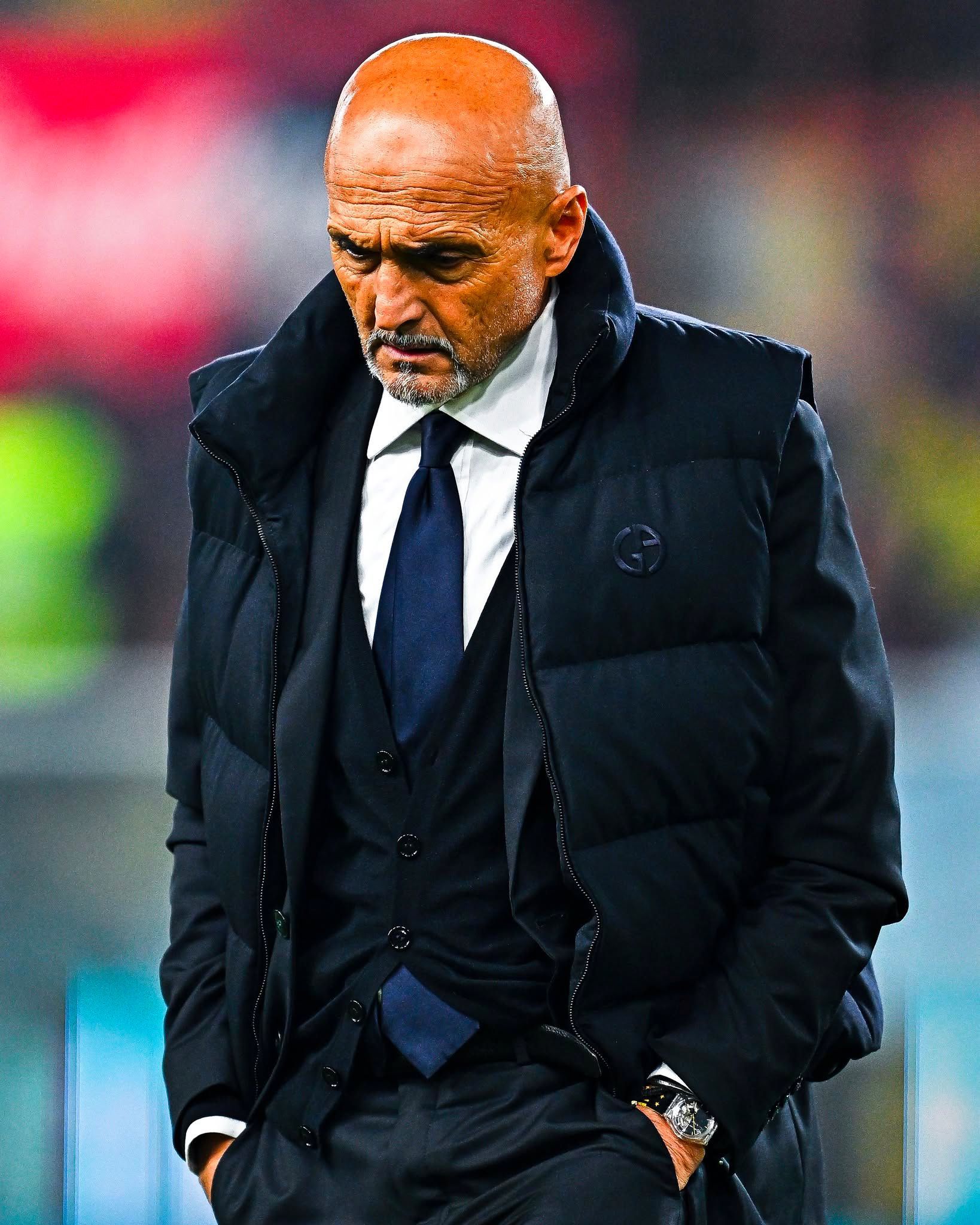
Every manager has a distinct aesthetic of their own, and Luciano Spalletti is no exception. A shaved head, so shiny it commands respect, almost like that of a drill sergeant. Eyes that seem capable of looking right through you, thanks to a gaze of rare depth. Impeccably fitted suits, always tailored to a lean yet toned physique. A strength that, as he proudly claims himself, does not come from hours spent in the gym, but from a lifetime of working the land and raising animals. And then there is that Tuscan accent, which would allow him to get away with a smile even after saying the most vicious things.
From Italy to Juventus, the way we see Spalletti is changing
There is, however, a recurring theme throughout Spalletti's career: we have rarely seen him smile. Or rather, he always seems happy at the beginning of his time in charge of a team, but once the work gets underway, it becomes genuinely difficult to catch him in a moment of carefree joy. It has happened, of course. In St Petersburg, he ran onto the pitch shirtless, despite the freezing cold, to celebrate the first title of his career. It happened again in 2018, when he took Inter back into the Champions League, and in 2023, when he brought the Scudetto back to Naples. For the most part, though, what sticks in our minds are his memorable quotes, his arguments with players, his post-match rows with opposing managers, his cringe moments and his television controversies. These are the occasions when Spalletti refuses to back down and, with the eloquence of a poet, derails any attempt to stick to the script. He gets lost in lengthy monologues, appears to lose his train of thought for several minutes, only to find a way to bring it all to a conclusion. In his own way, of course.
Today, at Juventus, his melancholic aesthetic is becoming increasingly apparent. The results are to blame, of course. Since replacing Igor Tudor in the Bianconeri dugout, Spalletti has yet to restore the greatness and nobility that have always been part of the club's history. Juventus missed out on Champions League qualification last season, and their results in the opening stages of the current campaign have fallen short of expectations. A year has passed since the club officially announced his appointment and, looking back at the excitement surrounding that moment, it seems almost unbelievable that typing his name into Google now brings up “sacking” as the first suggested search. Spalletti is increasingly caught in an image of sadness, made up of vacant stares, conversations with himself and inner reflections that seem to tear at his soul. All while wearing Armani tailoring with the ease of someone who has never worn anything else. He has become a style icon in football, not least for bringing long coats back to the touchline, but also for leading the queue of managers obsessed with adidas Copa Mundial boots.
Spalletti has not changed. Our perspective has
Melancholy has always been part of Spalletti's aesthetic, but recent years have only intensified it. His time with the Italian national team was traumatic, ending with him alone at a press conference, announcing his own dismissal. Juventus was supposed to represent a fresh start, an opportunity to reaffirm his status as a manager for a top club. So far, that has yet to materialise. Inevitably, his image has suffered as a result. Or, more precisely, the way we perceive him has changed. His furrowed eyebrows now bring to mind Uncle from Scuola di ladri more than a man capable of striking fear into others. His greying beard looks increasingly unkempt, even though it has always been there, left to grow naturally alongside a goatee with a minimalist moustache and a narrow soul patch.
And yet Spalletti is still the same man, even before he is the same manager. Today, he seems different because he resembles a character defeated by events, forced by the results of his own work to walk with his head bowed. But that is not necessarily the case. Football, after all, is not an exact science, and everything we have written so far could be overturned in the space of a week if Juventus were to win their next few matches. At that point, Spalletti's melancholy would once again be seen as a positive trait. His vacant stare would become the mark of a thoughtful man, capable of finding the right solution through calm reflection. His touchline intensity would be celebrated as proof of his commitment to the project. And then we would have to remind ourselves that Spalletti has not changed. Only the way we see him has.
What to read next
Hertha Berlin have introduced a Manifesto for their kits
A set of rules to balance tradition, identity and the protection of the club's iconic symbols
The role of football in Brazil’s presidential election
How the world of futebol played its part in Lula’s re-election