
The essential terms of the America’s Cup Everything you need to know ahead of Naples 2027
The Road to Naples 2027 now comes to Naples itself. From 24 to 27 September, the city’s Gulf will host the second Preliminary Regatta of the 38th America’s Cup, following the opening event held in May in Cagliari’s Gulf of Angels. A free Race Village will also be set up along the Caracciolo seafront, alongside fan zones and large screens, giving Naples a preview of the oldest international sporting competition’s first-ever edition in Italy. To better understand an event with such a long and prestigious history, which from this edition will seek to attract new Italian audiences in the wake of Luna Rossa, we have created a technical dictionary of the America’s Cup.
The America’s Cup format
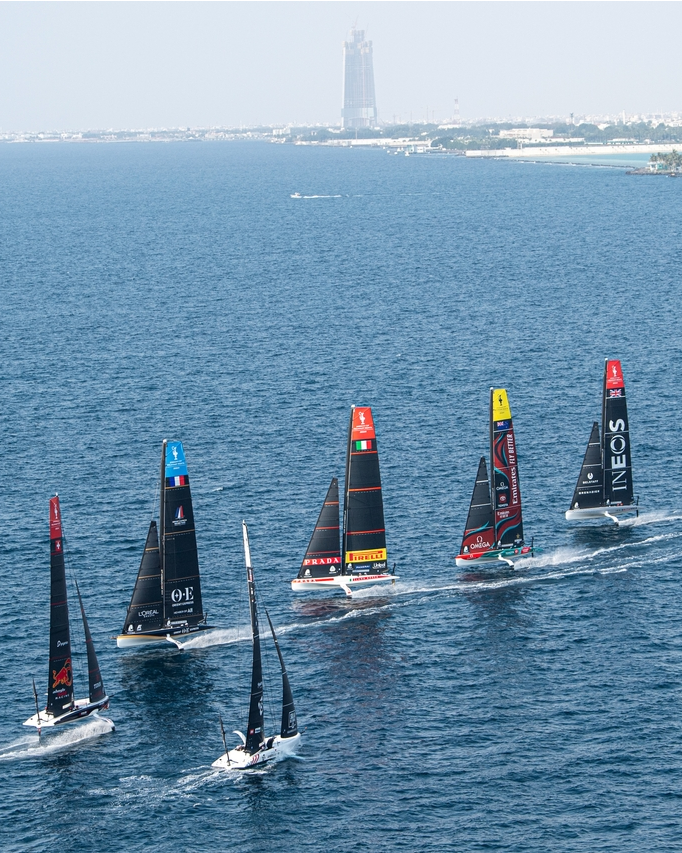
The Preliminary Regatta is part of the America’s Cup, but does not count towards the official standings. The event will use AC40s and feature six teams: defending champions Emirates Team New Zealand and Challenger of Record GB1, representing the Royal Yacht Squadron through Athena Racing, followed by Luna Rossa, Switzerland’s TUDOR Team Alinghi, France’s La Roche-Posay Racing Team and American Racing Challenger Team USA. The American team will make its Road to Naples debut after replacing Team Australia, which remains part of the competition but will not take part in this event. Nine boats will compete in Naples, as Luna Rossa, GB1 and Team New Zealand will each enter a second boat crewed by leading members of their youth and women’s teams. The opening fleet races will award points towards qualification for the final Match Race, the traditional head-to-head contest between two boats.
The official competition will begin in May 2027 with the new Fleet Racing Opener, a series of fleet races – three per day and six across the weekend – in which all seven AC75s will compete together. Although this phase carries no competitive weight for the defending New Zealand champions, who will mainly use it as a test and an opportunity to assert themselves, it will award the six Challengers their first points. These will be added to those earned during the subsequent triple Round Robin, in which every crew will face each of the others three times in head-to-head races. This phase will be divided into three three-day rounds, each consisting of twenty-one races. Once again, the Defender’s results will not count, while the combined standings will determine the top three Challengers advancing to the Louis Vuitton Cup semifinals. The fourth crew will qualify through the Repêchage, an additional series of races between the bottom three teams from the Round Robin.
The Challenger that emerges victorious from this final phase – with the first team to claim five wins in the semifinals and seven in the final advancing – will lift the Louis Vuitton Cup and earn the right to face Emirates Team New Zealand in the America’s Cup Match, the competition’s main event, with the prestigious Auld Mug at stake. Under the traditional structure, this final stage would establish the Defender, the team to beat in the following edition, and the new Challenger of Record, the yacht club that formally submitted the first challenge shortly after the winner crossed the finish line, allowing the two parties to begin defining the details of the next edition. This mechanism, however, has been reworked through the America’s Cup Partnership. Each edition continues to be governed by the official America’s Cup Protocol, drawn up by the Defender and Challenger of Record as a supplement to the historic Deed of Gift, the set of rules dating back to 1857 and subsequently updated to accommodate the organisation of each event.
Boats, racecourse and penalties
The AC40s seen at the Cagliari Preliminary Regatta will return for this first event in the Gulf of Naples. These are single-hull sailing boats, or monohulls, capable of regularly exceeding forty knots. They are smaller than the AC75s and are generally used in the Youth and Women’s America’s Cup. The AC name comes from the America’s Cup, while the numbers indicate the hull’s length overall, or LOA, in feet: approximately twelve metres for the AC40 and twenty-three metres for the AC75 used in the final stages. Both models are foiling boats, meaning that they rise above the water as their speed increases by generating hydrodynamic lift.
The racing boats receive logistical support from Chase Boats powered by hydrogen, or eChase Boats in the case of predominantly electric models. Each team works independently to develop the most technologically advanced and environmentally sustainable solution possible within specific parameters, turning these support boats into both a practical resource and an opportunity to showcase innovation.
The boats race within a clearly defined electronic boundary containing marks placed at specific points. These are generally positioned in pairs to create a virtual area known as a gate, which competitors can pass through on either side according to their strategy and the wind conditions. This entire area is known as the racecourse. If a boat crosses its boundaries, the umpires issue a penalty, communicated through a signal light. The penalised boat must then slow down until its opponent has opened up a lead of seventy-five metres.
Other penalties can be issued for entering another boat’s virtual boundary, crossing the starting line early or failing to respect right of way. At sea, right of way is determined by the tack, which identifies the side of the boat from which the wind is coming. On starboard tack, the wind first reaches the boat’s right-hand side, while the opposite applies on port tack. Under the racing rules, a boat on starboard tack always has right of way when two boats are on a collision course. A serious breach of the rules or an accumulation of penalties can ultimately result in a black flag, meaning disqualification from the race.
Hull and sails
Starting with the basics, the rear of the boat is called the stern, while the front is the bow. To orientate yourself, face the bow: starboard is the right-hand side of the boat and port is the left. The upper surface of the hull is the deck, where the crew moves around, while its forward section is called the foredeck. Extending forward from it is sometimes the bowsprit, a nearly horizontal spar used to hoist larger headsails. Towards the stern is the cockpit, the recessed section of the deck where the crew is positioned while sailing.
The boat’s main steering device is the rudder, which is attached to the stern and submerged, controlling direction through a rotating movement. On the AC40 and AC75, the rudder system also includes a rudder elevator, a horizontal wing shaped like an inverted T that remains in contact with the water. It acts as a stabiliser during pitching, the oscillating movement caused when the boat rises above the surface. This lift is generated by the hydrofoils, two huge movable appendages positioned on the starboard and port sides of the hull. When deployed during flight, they lift the front of the boat and effectively turn it into a hydrofoil craft. Flaps, movable elements that can be adjusted independently, are used to alter the height and shape of these wings according to the manoeuvre being performed.
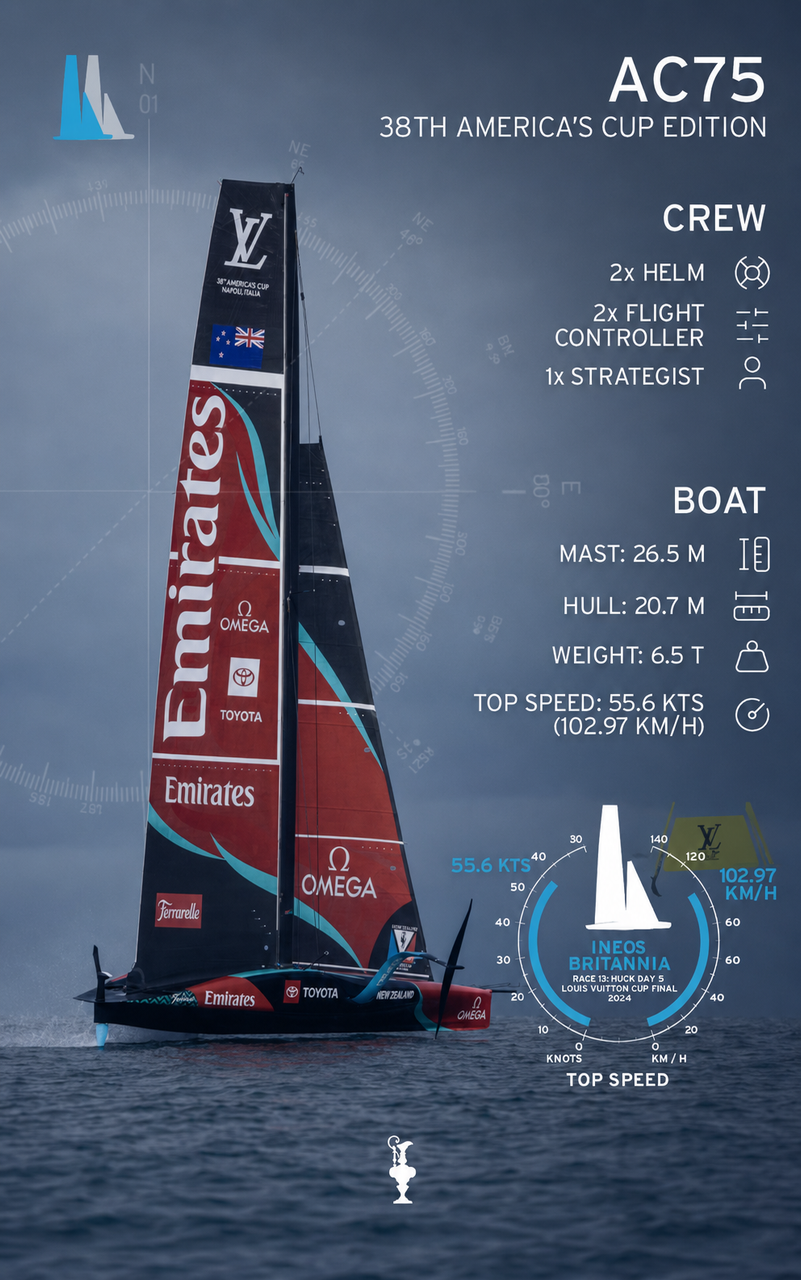
The boats are propelled primarily by the mainsail, the principal sail attached to the aft side of the mast, alongside the jib, the smaller sail at the bow. On the AC75, these have respective surface areas of 145 and 90 square metres, making them extremely complex to shape and trim, particularly in the case of the mainsail. For this reason, the traditional boom is absent, while a single rotating mast, generally made of carbon fibre, can change the angle of the mainsail to create the most effective aerodynamic setup. Although it is correct to speak of the mainsail in the singular, an AC75 crew can bring as many as ten different versions depending on wind and other conditions. The real innovation is the twin-skin mainsail: two overlapping, parallel skins that are almost independent of one another, shaped by the rotation of the mast and by carbon-fibre battens positioned along their profile. This double sail creates what is known as a soft wing, combining unusual flexibility during rotation with complete rigidity once set in its aerodynamic configuration.
This aerodynamic setup is also determined by the leech, the trailing edge of the mainsail and jib. Each reinforced corner of a sail is known as a cringle and plays an essential role because this is where the control lines are attached. Particular attention should be paid to the tack, the lower forward corner fixed towards the bow, and the clew, the lower aft corner to which the sheet is attached. The sheet is the line used to adjust the angle of the sails according to the wind. The mast, meanwhile, is held in place by the forestay, part of the standing rigging used for this purpose. Since 2024, the equivalent support at the stern, the backstay, has no longer been mandatory, improving the boat’s aerodynamics.
Wind and speed
The true propulsion of a sailing boat therefore comes from the flow of air between the mainsail and the jib. To use this mechanism effectively, the boat must sail in the right direction relative to the wind. Sailing upwind means heading towards the direction from which the wind is coming, while sailing downwind means moving away from it. When a boat sails as close as possible to the direction of the wind, it is said to be close-hauled. The most common downwind point of sail is running, when the sails are opened and the wind reaches them from behind.
When sailing with the wind from behind, the manoeuvre used to change direction is a gybe, which carries certain risks. If performed too aggressively, it can cause a loss of control or lift the stern too far, briefly forcing the bow beneath the water in what is known as a nose-dive. AC75s are designed to recover from incidents of this kind, but a particularly violent impact can cause the boat to roll onto its side and capsize, or what Italian sailors casually call a scuffiata.
When everything goes to plan, whether sailing upwind or downwind, the boat can follow the most efficient course towards its next waypoint. The fastest route is not necessarily a straight line and changes according to the wind. It can therefore be more effective to cover a greater distance, perhaps sailing in a zigzag pattern, in order to maintain the ideal speed. This calculation is known as VMG, or Velocity Made Good: the higher the VMG, the more efficient the course. Speed is measured in knots, with one knot corresponding to one nautical mile, or 1.852 kilometres, per hour. To put the figures into perspective, an AC40 can exceed fifty knots, while an AC75 has reached speeds of more than fifty-four knots, breaking the barrier of one hundred kilometres per hour.
The crew
Under the updated rules, five crew members will be onboard the AC75s during official races, including at least one woman. The official America’s Cup website also specifies the roles they will perform: two helms, two flight controllers – responsible for adjusting the boat’s ride height and foils through the flaps – and a strategic role filled by the navigation advisor, who oversees the course. These five sailors make up the racing crew, whose duties naturally also include trimming the mainsail according to the wind.
The cyclor, meanwhile, has disappeared as a consequence of automation. This crew member was responsible for generating the hydraulic power needed to control the sails’ electronic functions by pedalling at a dedicated station. Cyclors will be replaced by standardised batteries capable of producing power equivalent to that generated by four riders. The system will also replicate human factors such as fatigue, ensuring that crews must still make strategic decisions throughout the race.