


Zidane: the myth, the enemy Twenty years on from the 2006 World Cup final, Zizou remains a controversial figure
We live in a historical moment where even football is swept up in a powerful wave of nostalgia. What is being romanticised, in particular, is the football of the nineties and early two-thousands. Not only because many young fans spent their childhood during that period, but also because that era represents a precise threshold: it was the first fully televised football, yet the last that was still analogue. Football without YouTube highlights, without real-time social media commentary, without players doubling as content creators. It was already a globalised spectacle, but it remained somehow self-contained: once the match was over, there was no way to dissect it, share it, and relive it endlessly. In this context, certain players more than others have become symbols of that era: Paolo Maldini, Ronaldo "Il Fenomeno", Thierry Henry and, without doubt, Zinedine Zidane. It is no coincidence that all of them passed through Serie A, the league that in those years represented the pinnacle of European football. A detail that feeds a distinctly Italian nostalgia, often accompanied by a certain difficulty in accepting — and making sense of — the transformations of the contemporary game, as the national team's results also demonstrate.
The Zinedine Zidane told about on social media today is above all the one from legendary matches: the 2006 World Cup semi-final against Brazil, in which he toyed with the Seleção with otherworldly class, or the Real Madrid of the Galácticos era, author of the celebrated goal in the 2002 Champions League final against Bayer Leverkusen. But Zizou was also much more than that. Beyond his imagination, his vision and his extraordinary technique, he was a hard player, with a stern gaze, at times surly. He holds, after all, the record for the most sanctioned player in World Cup history, with six yellow cards and two red cards. Zidane was also a symbol. One of the first great champions to embody the condition of the diaspora: the son of Algerian immigrants, raised in La Castellane, on the outskirts of Marseille. He was the face of the so-called "Black, Blanc, Beur" France that won the 1998 World Cup, becoming a point of reference beyond the pitch as well. All of these aspects — the complexity, the contradictions, the political and social dimension — surface far less in contemporary narratives, which tend to deliver a smoother Zidane, reduced almost entirely to his technical elegance.
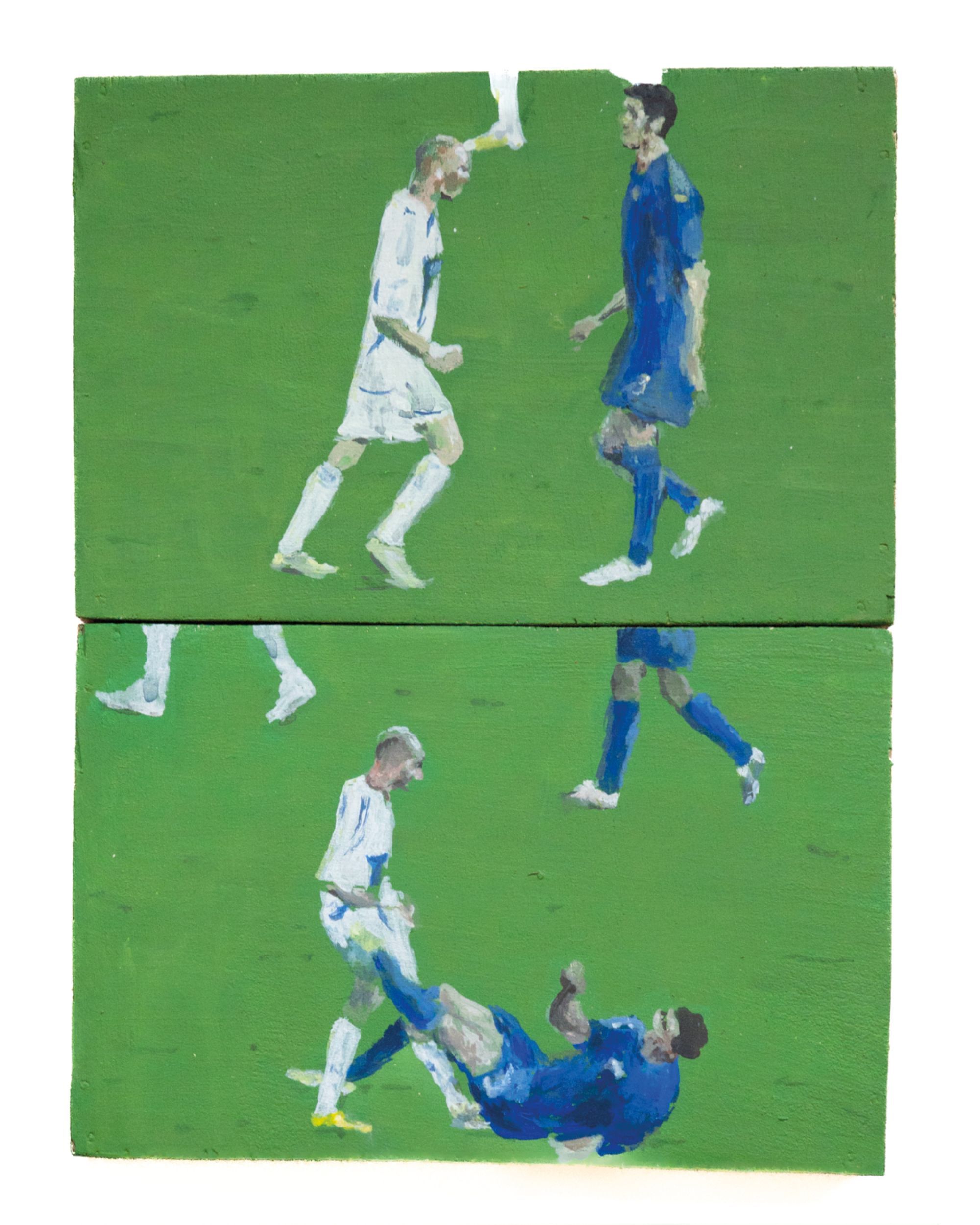
In Italy, the figure of Zinedine Zidane is tied almost inseparably to the famous headbutt delivered to Marco Materazzi during extra time in the 2006 World Cup final. That unsporting act marked the last professional match of Zidane's career and contributed to decisively swinging the outcome of the game in Italy's favour. In Italian popular culture, that episode has taken on a unique symbolic value that goes well beyond a single moment of play. Zidane was, after all, the face of a national team towards which Italy had harboured a growing rivalry throughout the nineties and early two-thousands. Backed by a more established footballing tradition, Italian football struggled to come to terms with France's rise. After the French triumph at the 1998 World Cup, Italy had already tasted the bitterness of defeat in the Euro 2000 final, lost to a golden goal courtesy of David Trezeguet.
The 2006 final — which, twenty years on, remains the last match played by the Italian national team in a knockout stage of a World Cup — therefore represents a cathartic moment for an entire generation of supporters. The image of the star player of "arrogant" France losing his composure in the face of that brand of cunning so often claimed as a defining trait by Italians is still imprinted on the country's collective imagination. To this day, fridge magnets depicting that moment can be found for sale on market stalls in major cities, and many people recall how the scene gave rise to a genuine musical earworm that marked the summer of 2006. "Materazzi fu ferito", an italo-disco track by the unknown DJ Fabio, recounted the episode over the notes of the Risorgimento song "Garibaldi fu ferito", going so far as to demand that the French "give us back the Mona Lisa, because we are the champions of the world."
But, as mentioned above, the figure of Zinedine Zidane is complex and lends itself to multiple readings. It comes as no surprise, then, that with the emergence in popular culture of rap music — which has also given a voice to North African diaspora communities in Italy — his image has gradually taken on new meanings. In this sense, even in Italy Zidane is now seen through a different lens, one shaped by the renewed centrality of the city of Marseille and the rap born there, which has become an important reference point in the imagination of contemporary urban culture. One example is that of Milanese rapper Philip, who in 2018 dedicated a track to the French superstar. But this is no isolated case: Zidane's style, elegance and biographical journey continue to exert a powerful pull on many young people, who recognise in his story a trajectory of redemption and personal achievement.
This article was originally published in French in the latest issue of Views.