The NBA taken over Europe’s streets The streets of London and Berlin provided the perfect backdrop for the 2026 NBA Global Games
The NBA, when it moves, rarely goes unnoticed. Since 2020, Paris has become the stronghold of the Global Games, and during last year’s double event at the Accor Arena, the Avenue des Champs-Élysées was covered with banners featuring players from the San Antonio Spurs and Indiana Pacers. This year it was the turn of two other important hubs, Berlin and London, marking the first time since 2017 that the event took place in two different cities. The reasons are primarily commercial, aiming to extend its reach simultaneously to two strategic European hubs. Yet the final result, despite the risk of communication being diluted by the dual locations, created an even stronger connection with the venues carefully selected for the occasion.
Ecosystem
A concept introduced, repeated, and emphasized by NBA commissioner Adam Silver in every press conference over the past twelve months during the Global Games in Europe—while responding to endless questions about the partnership with FIBA to form a new professional basketball league in the Old Continent, which could launch as early as October 2027—is that of ecosystem study. Economic, financial, but also social and communicative. In simple terms, the NBA’s success on this side of the Atlantic relies on understanding audience needs and deploying effective promotional strategies. This is not just theory but the operational approach revealed by Silver during a Berlin press conference, where he explained that "at least initially, the league’s funding would be covered by the member clubs", while the NBA would handle infrastructure, marketing, and promotion. All interconnected sectors, of course.
The strategies can be understood by observing the moves made during recent editions of the Global Games. One of the NBA’s first commercial moves, central to its European expansion, was to involve soccer powerhouses, thus broadening its partners by tapping into a more lucrative sector than basketball. The latest result came in the form of a private meeting in London on the NBA Europe project, attended by, according to The Athletic, Real Madrid, Barcelona (even though the club renewed its EuroLeague license according to various reports), Olimpia Milano, Panathinaikos, ASVEL, Bayern Munich, and Alba Berlin, alongside soccer giants like Manchester City, owned by Abu Dhabi United Group, and AC Milan, owned by RedBird Capital Partners, a U.S. firm. Officials from the Saudi fund PIF, which acquired Newcastle United in the Premier League, were also present, along with the Paris Saint-Germain, owned by Qatar Sports Investments, which has been among the announced investors for over a year. Partners included Amazon Prime and Nike.
Presiding over the meeting, in addition to commissioner Adam Silver, were FIBA Secretary General Andreas Zagklis and NBA officials Mark Tatum and George Aivazoglou, supported by top-level intermediaries such as Pau Gasol, Tony Parker—owner of ASVEL—and Zlatan Ibrahimović. This group discussed the future of European basketball and sports, crowning months of negotiations and foreshadowing years of work. The scale of the partners involved, especially those outside the European scene, could make the process challenging, as local markets often resist external influence. This shift, focused on selling a product rather than purely enhancing competition quality, might seem unusual from a European perspective—even though the NBA views the two aspects as mutually dependent. How can such a strategy be executed without destabilizing an unfamiliar ecosystem?
Promotion
The process happens gradually. In promoting its content, the NBA focuses heavily on visuals, being a highlights-driven engine dominating contemporary media. During last Christmas Day, the league generated 1.6 billion views on its social channels—more than any other brand—with a 23% increase from the previous season. Even within the Global Games, Anthony Black’s dunk for the Orlando Magic in Berlin garnered 85 million views in less than three days (and counting), becoming the season’s most-viewed highlight. This bilateral promotion embodies the NBA spirit: showcasing the best of its content to expand while benefiting from global reach in the process.
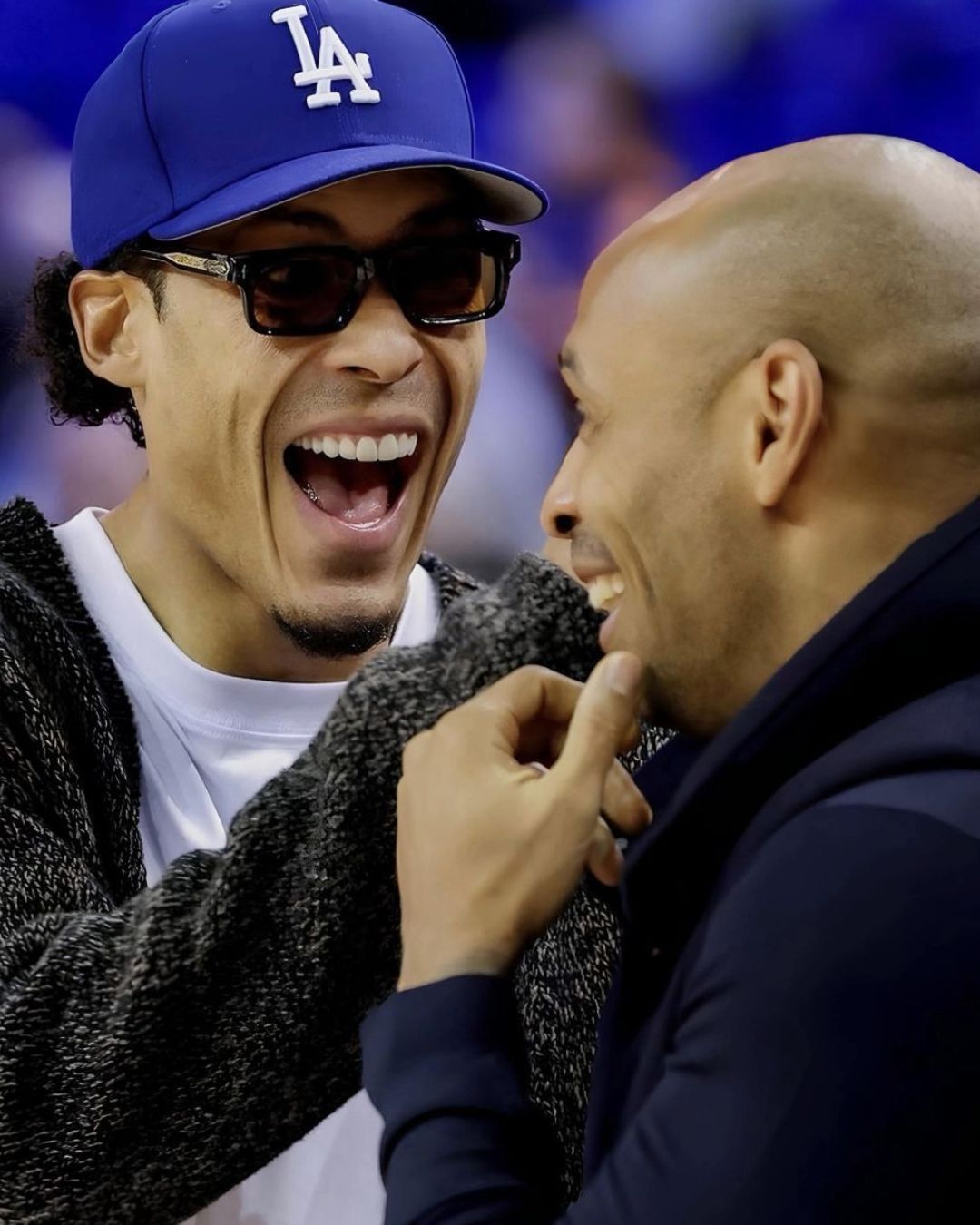
A sort of media “do ut des”, it naturally attracts other basketball powerhouses and, in this case, soccer as well. Viral, for example, was last year’s video of Victor Wembanyama dribbling around the court before the Champions League match between Paris Saint-Germain and Manchester City. In an attempt to replicate similar dynamics, the London appointment was crucial. This year, the Memphis Grizzlies attended a Premier League match between Tottenham Hotspurs and West Ham United as spectators, while numerous soccer stars attended the two NBA games. In Berlin, Jurgen Klopp, Thomas Muller, and Mats Hummels received multiple ovations, often featured courtside; in London, Premier League stars like Liverpool captain Virgil van Dijk, and Arsenal’s Declan Rice and William Saliba attended, along with retired players such as Thierry Henry and Marcelo.
The exchange mechanism also took place practically through jersey swaps, like Destiny Udogie of Tottenham with Jaren Jackson Jr. of the Grizzlies, Ja Morant with Moïse Bombito of Nice, or even an exotic swap between Santi Aldama and Mercedes F1 driver Andrea Kimi Antonelli. Simple but effective in creating a social culture and intertwining sports on the media level. Yet the NBA’s ultimate goal remains selling an entertainment product. This is where Adam Silver’s commercial foresight lies: using a highlights-driven sport to reach a much broader audience than just fans, requiring strategic attention to every detail—including location.
Infrastructure
Exiting Warschauer Straße station and passing the recently opened East Side Mall (2018), one can see on the right the so-called altbau, renovated historical buildings repurposed mainly as hostels. The Michelberger Hotel, occupying a 1903 industrial building that survived World War II bombings, immediately catches the eye thanks to a deliberately scrappy sign reading Waking up is always a good idea. Through its windows, the warm lights of the lobby reflect the reddish brick pillars supporting the elevated S-Bahn tracks. Further along, near the Spree River, these pillars intersect above small quick-service eateries offering döner kebab and schnitzel, decorated with graffiti and dedications from passersby. This is the beating heart of Berlin’s Friedrichshain district, in the eastern part of the city, amidst early 20th-century working-class buildings, near the former East Berlin Wall.
From here, before the river, begins the East Side Gallery, an open-air gallery and street art masterpiece boasting over 100 murals painted since 1990, following the fall of the German Democratic Republic and the Berlin Wall. It is a commemorative monument stretching from Ostbahnhof to Oberbaumbrücke over 1.3 kilometers along the river. Some murals celebrate peace, others global unity, while some remember those who perished trying to cross the Wall. Walking from this historically working-class area to the nearby Uber Platz, home to the modern Uber Arena (approx. 17,000 seats, sold out for the January 15 matchup between Memphis Grizzlies and Orlando Magic) creates a striking contrast. Opened in 2008 and named in 2024 through a deal with AEG Europe, it is home to Alba Berlin, likely to join the NBA-FIBA league.
The arena contrasts aesthetically and architecturally with its surroundings, being private, where a glass of water costs €8.70, just 2.5 km from Karl-Marx-Allee, in a once radically communist area. Moreover, Uber faced a boycott in September by pro-Palestinian protesters over a multimillion-dollar investment in Flytrex, an Israeli drone startup. The proximity of a peace monument, featuring a mural with an Israeli flag inside the German flag, does not go unnoticed.
The Friedrichshain District
Yet, despite these contradictions, it is a perfect location for the NBA. Friedrichshain, dynamic, young, and developing, mirrors the European NBA audience, estimated in 2024 to be predominantly ages 18–34, peaking at 57% in the UK. Using the Uber Arena as a hub allows for a quiet, non-traumatic integration with Berlin’s socio-cultural ecosystem, aided by local heroes Franz and Moritz Wagner, German basketball icons born and raised in Prenzlauer Berg within the Pankow district, and basketball products of Alba Berlin.
The docuseries The Wagner Brothers helped popularize them in Germany, turning them into a cultural phenomenon. Moritz, the older brother, has a mural above a street court in Christburger Straßem wearing his Los Angeles Lakers jersey, the team that drafted him 25th overall in 2018. Next to him, a cartoonish sign reads prepare to fly. Both brothers are also featured together in an adidas ARTvertising installation by German studio Concrete Candy, located across from the East Side Gallery toward Uber Platz.
The NBA is Taking Over the Streets
The street art in front of Berlin’s most famous Wall monument represents a chameleonic and peaceful integration of the NBA into the local urban ecosystem, allowing these two worlds to merge quietly. An iconographic colonization that boosts the American brand’s popularity, as seen in the Visit Orlando–Deutsche Telekom partnership. In London, the scenario is similar: in a city where basketball is less prominent than in Paris or Berlin, the NBA chose the iconic O2 Arena, on the Millennium Dome site in Greenwich Peninsula, near the Prime Meridian. This previously industrial area along the Thames also features an open-air art trail called The Line, connecting the O2 to Queen Elizabeth Olympic Park via the London Underground.
The area provides the perfect development base for the NBA project, again leveraging streets, subways, and railways. Unlike Berlin, where the goal was post-war urban renewal, the Greenwich Peninsula represents gentrification, aiming to emulate New York while creating significant class disparities. Knight Dragon, the developer from Hong Kong, plans to build 17,000 luxury apartments, only a small fraction (estimated 11%) affordable for lower-income residents. The neighborhood is thus wealthy and strategically convenient for the NBA, which does not consider ethical questions in its intercontinental expansion.
Expansion proceeds by conquering European streets—physical ones like Oxford Street, covered in flags for the London Game 2026, or Unter den Linden leading to the Brandenburg Gate, where the Orlando Magic posed upon arriving in Berlin, or Avenue des Champs-Élysées upon Victor Wembanyama’s return. Iconographic streets like the East Side Gallery to Uber Arena, or The Line to the O2. Commercial streets connecting with soccer and global investment funds. But always streets, which the NBA is taking over one by one.
What to read next
LeBron James will commute from New York to Philadelphia by helicopter
And Fanatics probably will pay for it