The long history of Uniqlo in tennis From Shingo Kunieda and Kei Nishikori to Roger Federer and Emma Raducanu
The roots of Uniqlo run deep in the easternmost part of the world. Out of 1,728 stores opened outside Japan, where the clothing brand was founded, as many as 1,119 are located across China, South Korea, Hong Kong, and Taiwan. The number rises to 1,524 when including Southeast Asia, India, and Australia. Yet its sphere of influence has become global, and the brand has reached unprecedented levels of popularity in the world of sports (and beyond).
Uniqlo has been the official sponsor of the Swedish Olympic and Paralympic teams since Beijing 2008, a partnership that later extended to Tokyo 2020 and Paris 2024, up to its most recent appearance in Milan-Cortina. The Japanese company also provided outfits for dancers featured in the choreography during Kendrick Lamar’s performance at the Super Bowl 2025, officially entering the NFL thanks to a recent deal with the Los Angeles Dodgers, allowing the brand to be promoted during the team’s home games. Uniqlo is even explicitly mentioned in the film The Drama, starring Robert Pattinson and Zendaya. However, this global fame stems from a very specific starting point: investment in tennis.
Uniqlo’s first steps in tennis
The International Tennis Federation (ITF) signed an official agreement with the Japanese retailer as early as 2024 for the Paris Games, dressing match officials with items from the LifeWear line. Keen observers may have noticed, during Jannik Sinner’s recent triumph at the Monte Carlo ATP tournament, the chair umpire’s outfit entirely branded Uniqlo in the final against Carlos Alcaraz. This is just the visible outcome of a strategy launched more than fifteen years ago.
Uniqlo’s very first Global Brand Ambassador was Shingo Kunieda, a wheelchair tennis champion signed in 2009. He is a legendary figure and a true pioneer, the first to achieve a Career Golden Slam—winning all four major tournaments and an Olympic gold medal—in the men’s category of the sport. He has 46 Grand Slam titles, 25 of them singles, along with Olympic gold medals in singles at London 2012 and Beijing 2008, where he also won a bronze in doubles. His most iconic victory remains the Tokyo Olympic Games, in front of a home crowd, the ultimate crowning moment of a GOAT-level career.
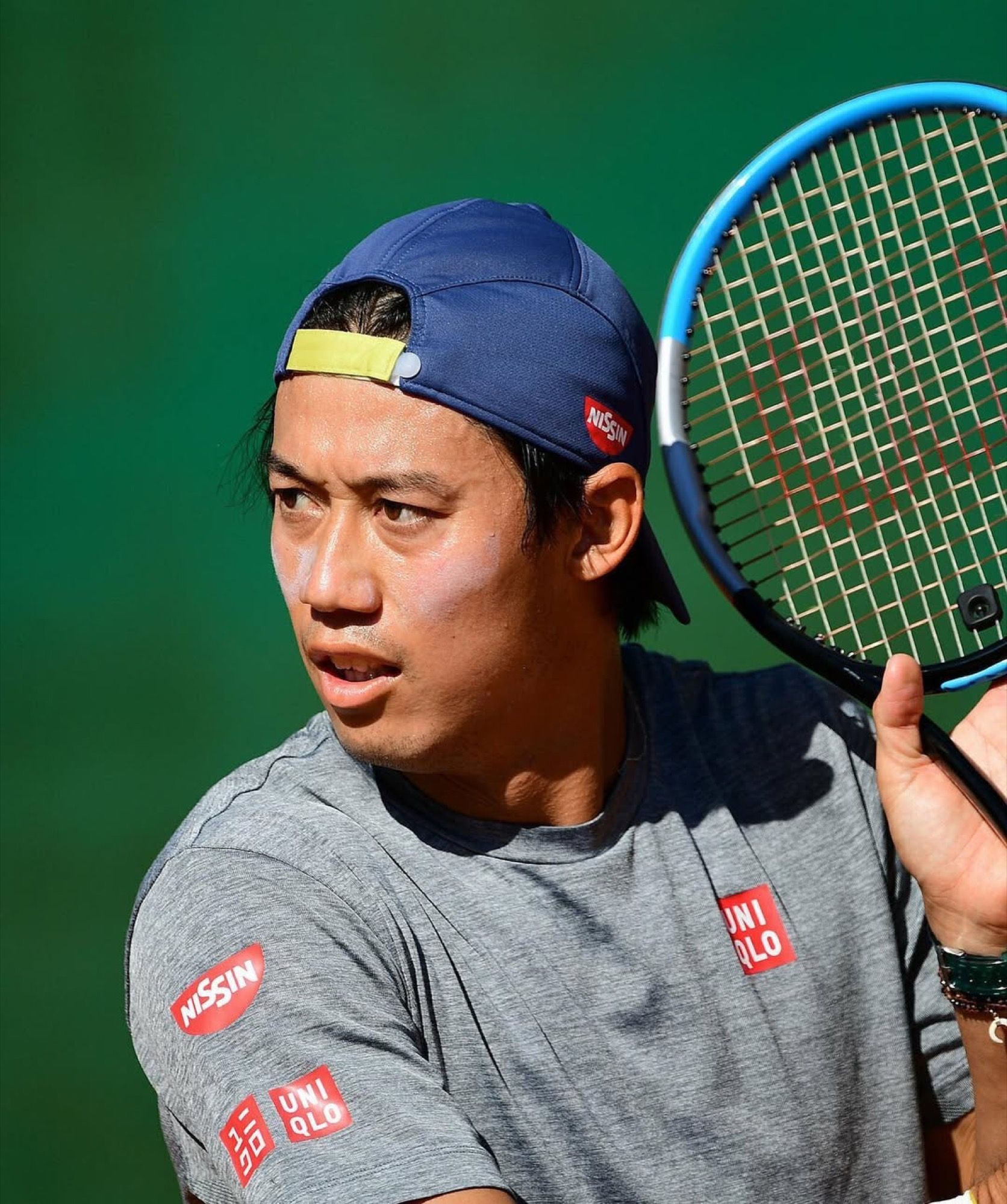
For this reason, it was not difficult for Uniqlo to appoint another Japanese tennis player as Global Brand Ambassador in 2011: Kei Nishikori. In 2015, he became the first Japanese player in history to break into the ATP top four, achieving milestones such as the 2014 US Open final and the Wimbledon quarterfinals in 2018 and 2019. The latter edition was particularly notable for Uniqlo, as Novak Djokovic, then the face of the brand, defeated Roger Federer, the face of its future.
The Novak Djokovic opportunity
Djokovic’s move to Uniqlo was rather sudden and turbulent. In 2009, the Serbian player had signed a ten-year deal with Sergio Tacchini. Less than three seasons later, despite nearly eight years remaining, the partnership ended abruptly by mutual agreement. Officially, the reason was that Djokovic had outgrown the Italian brand, winning more tournaments and earning incentives that became unsustainable for the company.
His search for commercial opportunities led him to choose Uniqlo, largely due to his footwear deal with adidas, which required apparel partnerships with non-competing brands such as Ralph Lauren and Tommy Hilfiger. Uniqlo seized the opportunity, offering the world number one an initial deal worth around six million dollars per year.
Djokovic debuted in Uniqlo apparel on clay at Roland Garros 2012, marking the beginning of a five-year partnership beneficial for both sides. That chapter also ended on clay, at the 2017 Italian Open, when he lost the final to Alexander Zverev. Less than a week later, during a presentation at the Monte Carlo Country Club, his move to Lacoste was officially announced—a brand that still sponsors him today following a contract extension worth over nine million dollars annually.
The record-breaking deal with Roger Federer
While the five-year deal with Djokovic helped boost Uniqlo’s visibility and credibility, true consecration came with the signing of Roger Federer. The Swiss legend had been a Nike athlete since 1994. In 2018, when faced with another proposed ten-year renewal from Nike, Federer instead signed a more lucrative deal with Uniqlo: a ten-year contract reportedly worth around 300 million dollars. His departure from Nike marked a major shift in tennis’ commercial ecosystem, further amplified by his 2019 investment in On, where he acquired a 3% stake and launched his own line, The Roger.
A legal dispute even arose between Nike and Federer over the iconic RF logo, which the company had registered in 2008 and returned to the player only in 2020. This further unlocked his partnership with Uniqlo, where he became the brand’s central figure. In 2019, Federer and Kunieda even teamed up in doubles during a charity match at LifeWear Day, held at Ariake Tennis Park in Tokyo.
24 hours with Roger Federer
This reflects one of Uniqlo’s key strategies: leveraging financial strength to sign major names, while initially investing in figures popular in Japan, and then making their ambassadors recognizable not just as athletes but as personalities. Roger Federer embodies this perfectly—he is seen first as a symbol of elegance and a cultural icon, even before being recognized as a champion. The brand’s goal is to move beyond Sportswear into LifeWear.
To express this concept, Uniqlo created themed content centered around Federer. The video series “24 hours with Roger Federer,” released between March 2023 and August 2024, offers a transparent look into his daily life, focusing on the person rather than the athlete. Alongside this, the brand launched “Around the World with Roger Federer,” part of its Next Generation Development Program, aimed at supporting young communities across global cities.
The collaboration with JW Anderson
The concept involves visiting Federer’s favorite cities—from Tokyo to Paris, via New York, London, and Shanghai—exploring both cultural landmarks and everyday environments. In New York, for instance, he toured MoMA backstage, grabbed a slice at Scarr’s, and played chess with prodigy Tani Adewumi in Columbus Park, all captured on camera.
A December 2023 discussion at JW Anderson’s East London studio perfectly illustrates this approach. The conversation with designer Jonathan Anderson, who created a nine-piece genderless capsule collection for Uniqlo with Federer, represents the blend of commercial promotion and storytelling tailored to the Swiss icon.
The Spring-Summer 2026 collection
The latest collaboration between Uniqlo and Federer is the Spring-Summer 2026 collection, presented last March at Covent Garden and designed by Clare Waight Keller, former Givenchy creative director. The London location nods to Wimbledon, where Federer holds the men’s record with eight titles. The collection introduces green tones inspired by grass courts, alongside classic navy blue and white.
The standout items are two DRY-EX polo shirts featuring breathable mesh inserts in key areas. Other pieces include sports shorts, joggers, a long-sleeve polo, a hoodie in 3D knit, and a DRY Stretch jacket with a thermoplastic-coated chest pocket for improved water resistance.
The addition of Emma Raducanu
Following closely in Federer’s footsteps is Emma Raducanu, the young British tennis player born in 2002. Among her major achievements is winning the 2021 US Open without dropping a set, becoming the first to do so since Serena Williams and the only player ever to win the tournament coming through qualifying. Earlier this year, she reached the Transylvania Open final, losing only to Sorana Cîrstea, and signed a deal with Uniqlo worth nearly four million dollars per year, leaving Nike behind.
Raducanu will collaborate with Federer, Kunieda, and Cate Blanchett to promote Uniqlo’s LifeWear philosophy under Clare Waight Keller’s creative direction. She will also be directly involved in designing her apparel, debuting in a pastel blue outfit with a pleated skirt at Indian Wells. The breathable, stretch fabric offers UV protection—ideal for California’s sun—reflecting the brand’s attention to both performance and style.
What to read next
The ATP's plan for the future of tennis
A letter from Andrea Gaudenzi has outlined several changes that could reshape the tour from 2028