
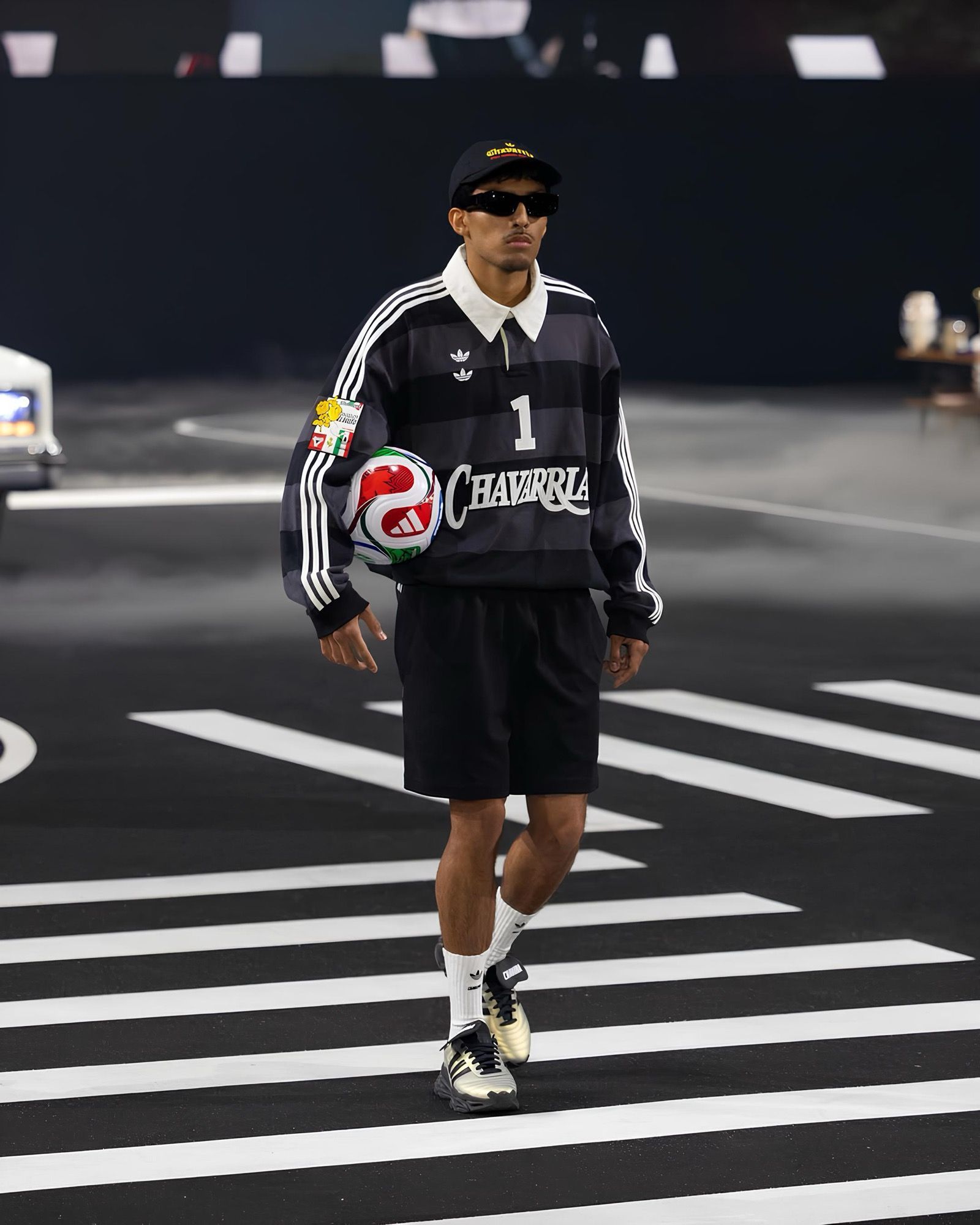
adidas has taken over the Paris runways Yes, you can tell the 2026 World Cup is just around the corner
Paris Fashion Week has just come to an end and, among the major brands one would expect to see dominating the runways amid the highly anticipated buzz of the fashion scene, the undisputed dominance of adidas was, in hindsight, fairly predictable. In fact, both Yohji Yamamoto (naturally through the Y-3 line, which for years has played a leading role in building a connection between fashion and football, from collaborations with Real Madrid to Zinedine Zidane sitting front row at the brand’s shows) and Willy Chavarria (one of adidas’ most prominent collaboration designers at the moment) briefly brought us back to the Gosha Rubchinskiy-era golden age, effectively taking us back almost a decade.
The reference to Gosha Rubchinskiy is by no means accidental: beyond the coincidence of co-branding with adidas, what stands out the most is the similarity between the historical moments. When Gosha Rubchinskiy released his FW17 collection (yes, the one that cemented the sporty post-Soviet aesthetic), a football World Cup was looming on the horizon - just as it is today; back then Russia 2018, now North America 2026. In short, a World Cup represents a massive moment of visibility for everyone, but especially for brands and designers: a huge stage on which to “be seen” and to launch messages. And both Willy Chavarria and Yohji Yamamoto seem to have understood this perfectly.
Older generations of fashion still matter
So, even though this Fashion Week seems to have confirmed the so-called Millennial Optimism, namely a generational shift in fashion (Jonathan Anderson, Grace Wales Bonner, Matthieu Blazy, Rachel Scott), the narrative surrounding the intersection of fashion and sport told a different story: the true standard-bearers were Willy Chavarria and Yohji Yamamoto (aged 58 and 82 respectively). The latter, moreover, did not limit himself solely to football with the reissue of the iconic Beast Pack, but extended his vision to other sporting realms as well, going as far as creating a collection for the Mercedes-AMG Petronas team—something that had already been hinted at through the many recent spoilers. Ultimately, it was two veterans who reminded us that when football is around the corner (especially a World Cup) the world adapts to it, including the world of fashion.
A decade of fashion and football, from Gosha Rubchinskiy to Willy Chavarria
Scrolling through the images of Willy Chavarria’s runway show encapsulates (almost) a decade-long dialogue between football and fashion, one that ideally begins with Gosha Rubchinskiy and continues through the Mexican designer’s brand, which has become the hottest big thing of recent Paris Fashion Weeks. With Marcelo on the runway, adidas Predator boots on the feet of some models and the Trionda football tucked under the arms of others, the distance between these garments, lines and volumes and those of Gosha’s iconic adidas FW17 collaboration appears incredibly slim. A line that, of course, becomes less subtle when cultural contexts are taken into account: Gosha’s collection drew from and was associated with post-Soviet aesthetics, while Willy’s features aesthetic details (colours, fonts) deeply and explicitly tied to the heritage of a country on another continent. Likewise, when Willy Chavarria’s garments are placed within the Latino show he staged, they appear in a context entirely opposite to that of Gosha Rubchinskiy. But when comparing the garments alone, the substantial difference is minimal.
If the 2026 World Cup will be a highly anticipated moment also because of the many political implications we have repeatedly analysed, Willy Chavarria’s message is just as significant: the World Cup (and football in general) should be opportunities and tools to unite. By its very nature, this edition (which will be played across the United States, Canada and Mexico) holds the potential to bring politically distant countries closer together through the world’s most unifying sport.
From the American icon of Black culture Kendrick Lamar to the Brazilian Marcelo, everyone is wearing Willy Chavarria: universal love was the message of the musical that animated Paris Fashion Week and made the wait for the 2026 World Cup sweeter and more compelling.
What to read next

adidas and Willy Chavarria defined the opening of the 2026 World Cup
We already have the most iconic moment of the tournament