
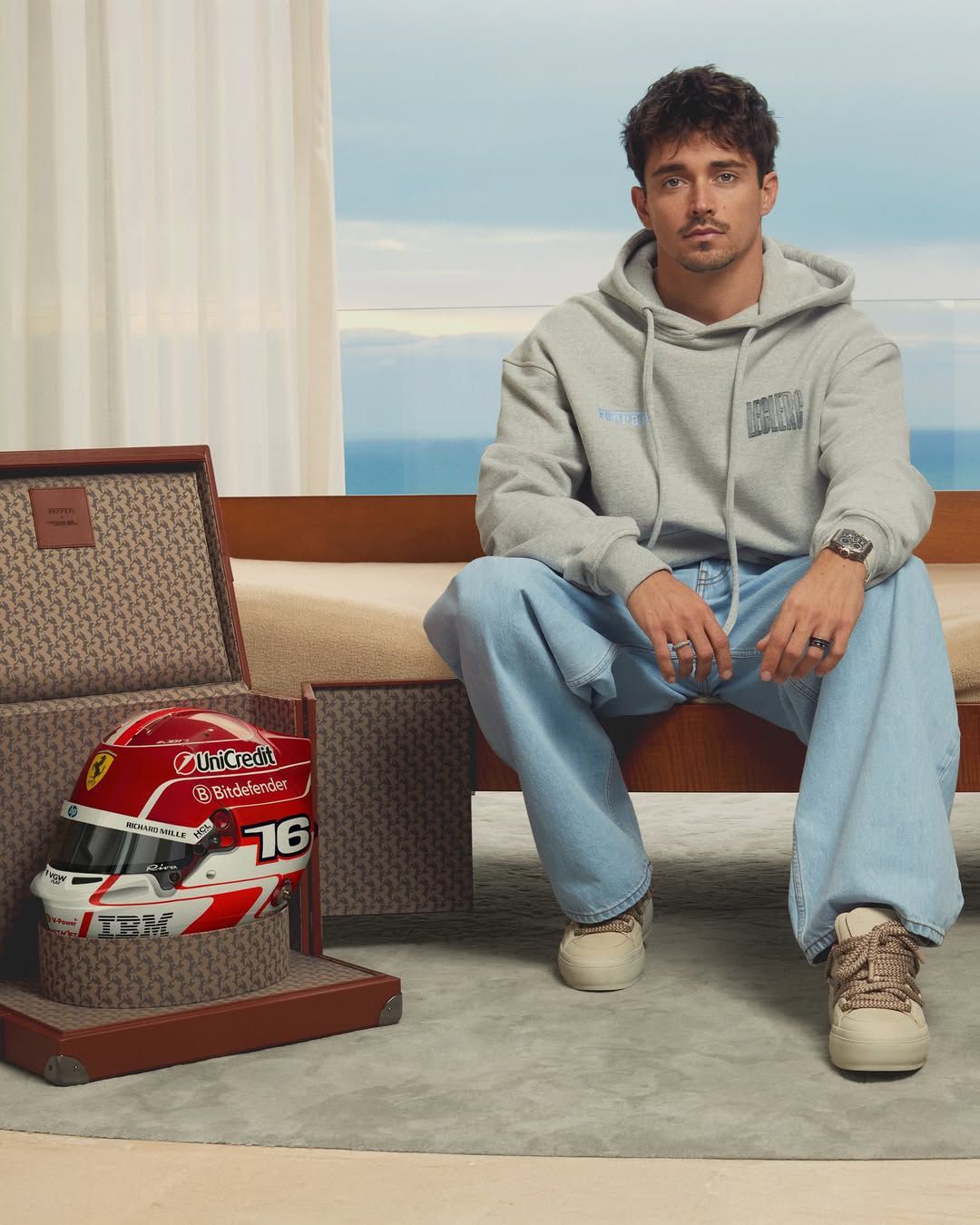
The man behind Charles Leclerc's helmets An exclusive interview with Adrien Paviot
Of all the changes that Formula 1 has undergone, there is one that particularly affecting drivers. You might think it's related to the new regulations and how they're changing their driving styling. No. We're talking about helmets and how they change from season to season — not to mention how often an F1 driver wears a special helmet during the season. They used to be the easiest way to recognise a driver. Once he had picked out a design at the beginning of his career, it was hard, if not impossible, for him to change it. Now the scenario is completely different, with teams and sponsors involved in conversations about how many times a driver should change his helmet. "If there will be eight special helmets a year then it is no longer special - says Adrien Paviot, a French designer based in Paris who has been working with F1 drivers and others for over a decade to create helmets -. They're just another helmet, I think we should make full use of the magical properties of the special helmets".
Who designs Charles Leclerc’s helmet?
Paviot’s career in Formula 1 started in 2012 with Romain Grosjean, a friend of him before then a client. Little did he know, a few years later, as part of his collaboration with Red Bull, he would have found himself to work with a Dutch teenager driving his way through the hierarchies of motorsport that turned into his second client in F1: Max Verstappen. "Red Bull called me to tell me that they had signed a new talent named Max Verstappen in Formula 3, and asked me to design his helmet - recalls Adrien - . Just one year later, he was in Formula 1, making him my second client in the sport. A really big client. At the time, I didn't realize how big it was, but it quickly became pretty significant. He was 16 or 17 years old at the time. I remember meeting him once at Austin in the paddock. He was the third driver at the time. He was there to see how the weekend was going. He first got in the car in Suzuka the week after, or maybe two weeks after. He was really young. I remember coming to talk to him. He was just a kid sitting outside the Red Bull hospitality. In fact, nobody cared about him. It was pretty easy for me as I've made about 50 junior team helmets over the years. For me, he was just one of many. At the time, it wasn't my first time. The crazy thing is, I'll see him later this year because I'm taking part in the 24 Hours of Nürburgring as well as him".
The evolution of Leclerc’s Ferrari helmet
As of today, Adrien worked alongside seven F1 drivers: Romain Grosjean, Max Verstappen, Isack Hadjar, Yuki Tsunoda, Kevin Magnussen, Pierre Gasly and Charles Leclerc. The partnership with the Ferrari driver is the strongest, as they have worked together since the Monégasque made his debut in F1 back in 2018 for Sauber. "Charles has never really known what he wants - explain Adrien -. That was kind of challenging at first. When we tried to find his preferred design style, his first request was for some complex helmets. This is why, in his early years at Ferrari, he had red, black and white helmets covered in patterns. We were trying to find his style. One day, I suggested we try a fully white helmet. He said he didn't think he would like it. It would have been too similar to Sebastian Vettel, his team mate at the time. So, we went in the opposite direction and went for complex helmets. And one day, I'm working and I do this take and by mistake I deleted half of the layers of the design. I thought, 'Not bad.' I took a screenshot and sent it to him asking what he thought about it. He replied 'Wow, I like it!'. It was the exact opposite of what we've been thinking for the previous two years. So, we've gone from very complex helmets to very simple ones."
How Formula 1 helmet design works?
Now that they are on the same page, the two just talk once in November before the season starts, gathering ideas and developing a model for the season. However, the real process begins with Ferrari, who send Adrien all the sponsorship guidelines: how big the patches should be, in which colours they can be applied and where they can be positioned. Then it has to be taken in consideration the colour of visor, of the screws and of the inside pad. Once these guidelines have been established, the drivers are free to express their personalities, until they keep politics, sex and anything else that could be considered controversial out of the picture. It is during these talks that a driver can make requests, such as the one Leclerc made for the 2026 season to add a touch of baby blue. The third step is to decide which Grand Prixs require a special helmet, with requests coming from both Ferrari and Leclerc.
The Monaco Grand Prix is certainly one of these occasions, as it is Leclerc’s home Grand Prix, as explained by Adrien: "In 2022, we made a helmet that was red at the top and white at the bottom to resemble the Monaco flag. I remember thinking that it was the best helmet I had ever made when I made it. It's similar to Senna's helmet. It’s nice. It's iconic. Even an eight-year-old child could draw it. For me, it was a waste to use it only once, even if it was for the Monaco Grand Prix. The following year, I campaigned to make this helmet a regular feature. He held an Instagram poll and this helmet lost by just 1% of more than one million votes, but two years later, Charles decided to adopt that design".
FIA rules for Formula 1 helmets
That's for the artistic side of things. But what's the bureaucratic process for approving or rejecting a helmet? "I only talk to Charles once a year - explain Adrien -. So, what I do is talk to Charles. Then I make the helmet. Then I send it to Olivier, who is Charles's manager. He's the guy under Nicolas Todt. From there, I deal with everything through Olivier. I send the helmet to Olivier and Olivier talks to Charles. Then we get Ferrari's approval. Olivier manages this process with Ferrari. This process never changes. Whether it's a regular helmet or a special one. The only difference with the regular helmet is that I have an initial discussion with Charles. Once the helmet is ready, we don't need to send it to the FIA for approval. We just need to make the number visible. That's it. The first technical regulation has to be passed on at the first Grand Prix of the season. There a Ferrari representative will come to the garage to check the suits and clothes, as well as the helmets. If they are not happy with a helmet, they will talk to the manager, and if they do not want to use it, they won't. And that's it".
Leclerc helmets memorabilia
During our conversation, Adrien showed absolute confidence in his views on two topics. First, when we asked him if he thought helmets were pieces of art: "Yes, definitely. I know how much time I spend on them, and I know how unique each design is. I also know how much time a painter spends on them. So, yes, this is definitely art. There are also a lot of unofficial replicas. For example, I know for a fact that there are only two Lightning McQueen helmets that I created in 2022 for Grosjean: one is at Pixar HQ in San Francisco and the other is in Romain Grosjean's living room for his kids. The same goes for Leclerc, as I’ve come across unofficial replicas of the special helmet he wore for Ferrari's 1,000th Grand Prix or the yellow one he wore in Monza in 2023".
Another thing Adrien knows for sure is that, despite his entrepreneurial and artistic side, Leclerc will never design a helmet himself: "No, the craziest thing is that Charles gets to try a lot of things he loves, like clothing and ice cream. He gets to experience brands and business lifestyle stuff, but when it comes to his helmet, he get lost with just one line. Every time there's an event, he says, 'I don't know, maybe,' but I don't think I'll ever see him design a helmet by himself".