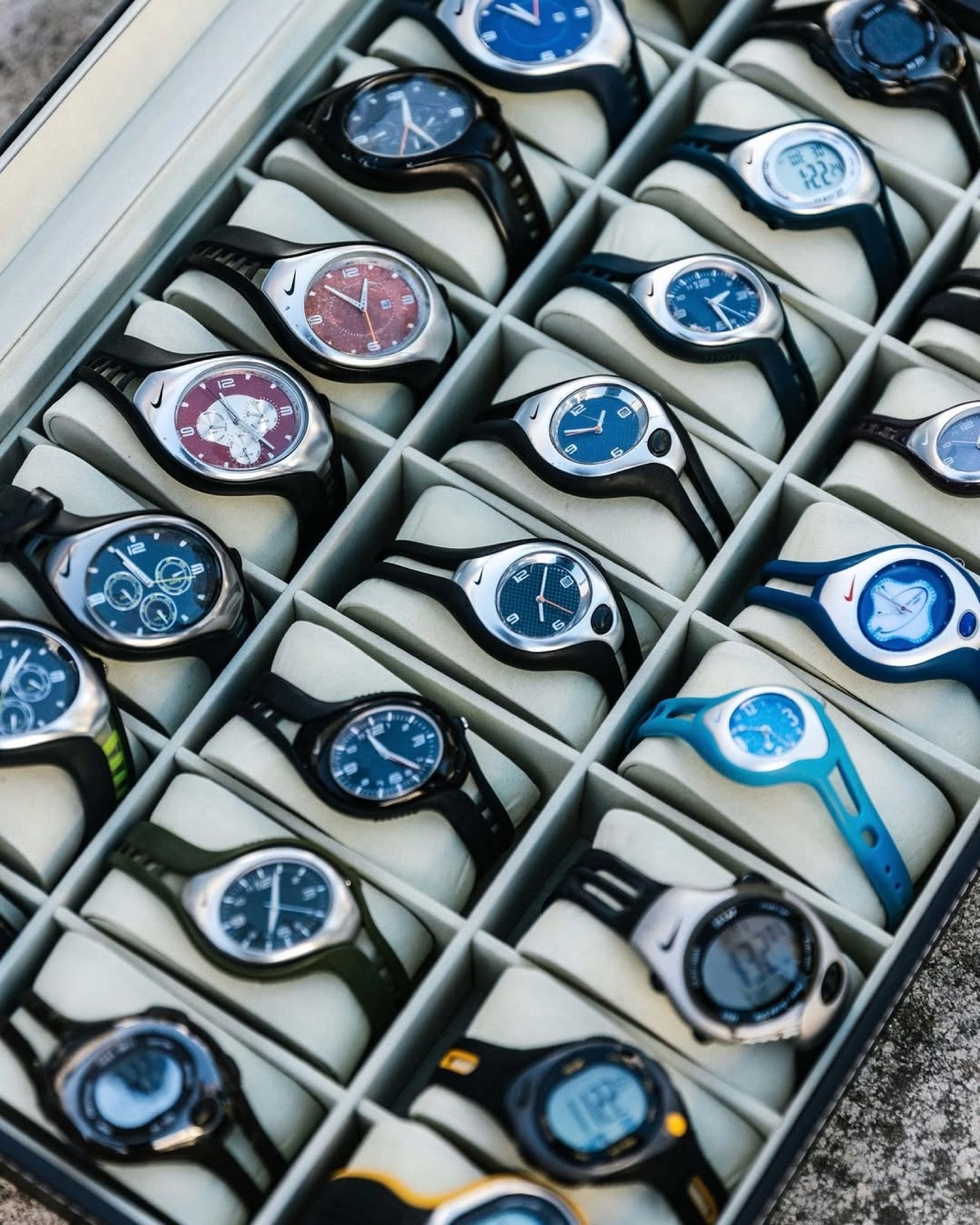
Who remembers Nike Timing? Before Strava was a thing
Until the early 2000s, the wishlists of Nike enthusiasts didn’t include just sneakers or sportswear and lifestyle apparel, but also watches. If, reading this introduction, you frowned trying to figure out where in the remote corners of your memory this recollection was hiding - only to start visualizing images that feel somewhat familiar - you probably belong to Generation Y, or at most the older segment of Gen Z. Nike Timing is in fact one of the most peculiar chapters in the history of the Swoosh: enormous cultural impact, yet surprisingly weak visual memory. On one hand because more than twenty years have passed, on the other because that division disappeared just as long ago, replaced by a myriad of technological devices that make it feel even more distant. But what exactly was the Nike Timing division? And above all: when, how, and why did it manage to take off?
It took the 2000s - more precisely 2002 - to reach Nike’s definitive boom in football. Before that explosion (a sector dominated in the 1990s by adidas and Umbro), Nike was already the leading brand in other sports. Between the late 1980s and early 1990s, running exploded both as an activity and as a cultural phenomenon, and Nike positioned itself perfectly within this space. The brand realized it could leverage its marketing strength to compete with companies specialized in wrist instruments such as Casio and Timex, offering athletes - from jogging to triathlons and city marathons - support to monitor training: heart rate, lap times, and stopwatch functions, all on the wrist.
The Partnership Between Nike & Seiko
Thus, the Nike Timing & Monitoring division was born (later shortened to Nike Timing). Nike managed to stand out thanks to highly effective marketing operations - even without major iconic campaigns - but above all thanks to an ergonomic design that made those models unlike any other watch on the market. Nike handled design, interface, and sport functionality, while production was entrusted to the Japanese giant Seiko Instruments Inc. Through its collaboration with Seiko, which supplied ultra-low power circuits and advanced microelectronics, Nike succeeded in entering athletes’ training processes and daily habits. Technology thus became truly wearable: a sort of ancestor of modern sports smartwatches, from the Apple Watch to Garmin or Suunto.
The Most Famous Models by Nike Timing & Monitoring
Informally, Nike Timing was born between 1989 and 1990: the products were initially sold as Nike Sport Watch. In the timeline of Nike watches, however, there is a real turning point: the Triax line, which inaugurated the second generation of Nike sports watches. Before Triax there were several models: Nike Sport Watch, Nike Running Timer, Nike Triathlon Watch, and finally Nike Coach / Nike Training Watch. The latter was particularly interesting because it introduced interval timers and track repeat functions. However, technological advancement was not Nike’s primary concern: the real issue was ergonomic. Brand researchers noticed that athletes had to rotate their wrist - breaking posture - to read the dial. Observing NCAA runners, designers discovered that many glanced at their watch out of the corner of their eye so as not to interrupt their stride.
The Birth of the Triax Line
In 1998, the Triax was launched, the most famous watch in Nike’s history. The name derives from tri-axial reading angle, meaning readable from three angles while running. It was the first Nike product truly designed around athletic movement. The Triax - the result of a user experience approach developed with runners and coaches, not watchmakers - quickly became a pop icon thanks to its accessible price and its distribution through Nike-sponsored football teams and federations: Inter, Juventus, Manchester United, Arsenal, Barcelona, Boca Juniors, Club América, Portugal, and South Korea. From a technical tool for athletes, it also became a lifestyle object.
The Impact of Nike Timing
The line’s impact extended into industrial design. In 2013, Jony Ive, Apple’s longtime designer, purchased several Nike Timing models - including straps from the Nike Presto Digital (designed by Scott Wilson) and some Oregon Series Alti-Compass pieces - for product study and research. Nike and Apple’s paths would later officially cross, but the influence of the second generation of Nike watches also helped inspire the tech industry.
The Closure of the Division
Nike Timing disappeared when the brand realized that the sports watch was becoming software. Runners’ needs were changing: measuring time was no longer enough - they needed data, history, and analysis. In 2012 the line vanished from catalogs, and in 2014 Nike officially launched its wearable partnerships, choosing to collaborate with Apple rather than compete directly with tech giants. This led to the creation of Nike Run Club and Nike editions of the Apple Watch.
What to read next
The history and future of the relationship between the America’s Cup and Formula 1
Two worlds with much in common, from engineering to their commercial and organisational models