





























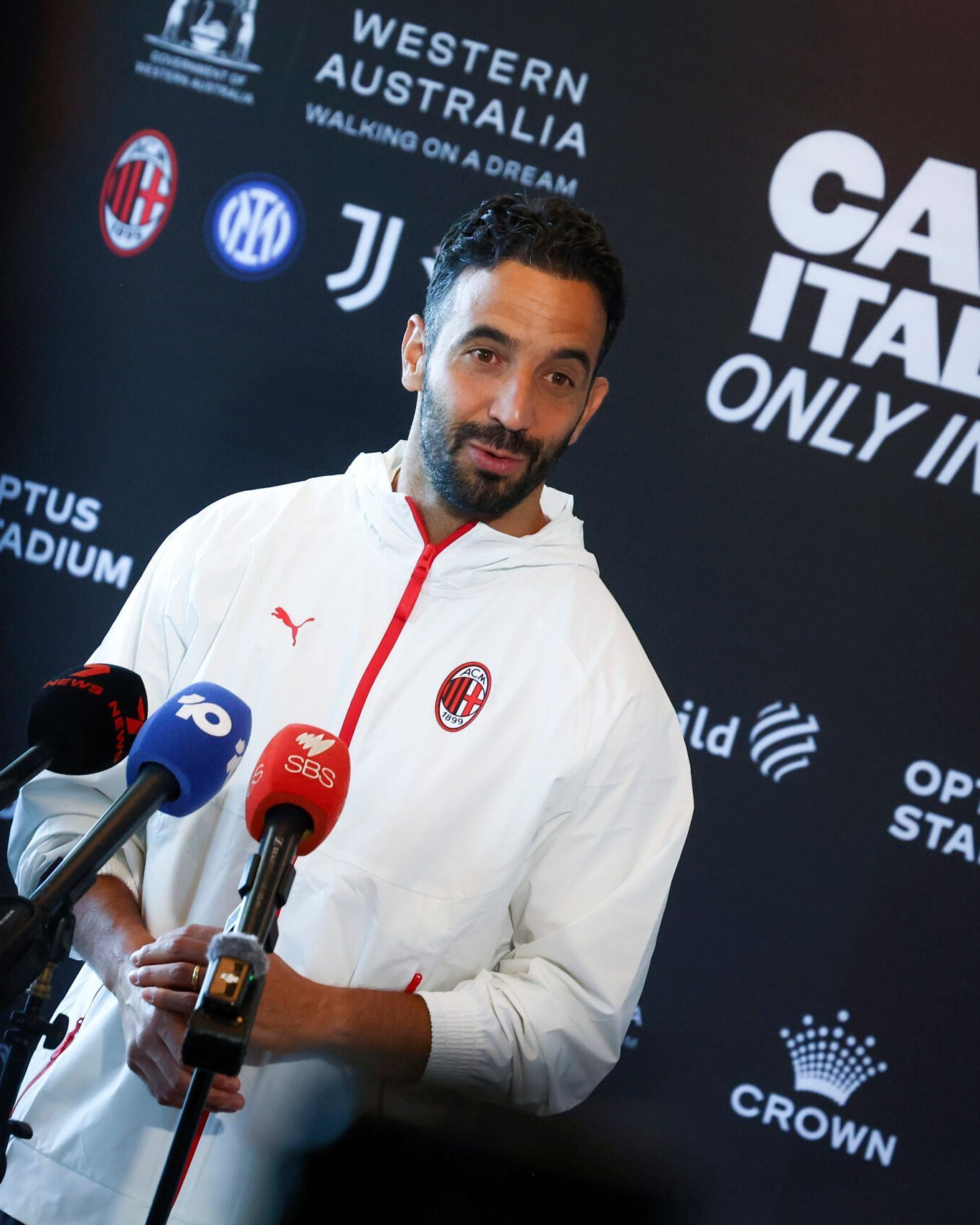
Why Serie A is targeting Australia with Calcio Italiano It explains Serie A's global ambitions
In just a few days, Perth will become football’s very own Little Italy for an entire week. AC Milan, Inter, Juventus and Palermo are all heading to Australia for Calcio Italiano, a festival bringing three matches, open training sessions, meetings with club legends and a wide range of fan experiences to the country. It all kicks off on August 5 with the Derby della Madonnina, followed three days later by the Derby d'Italia, before Juventus face Palermo on August 11, with the Rosanero also taking on Melbourne City in between. "See the giants of Italian football this August" is the event's official tagline. More than a tournament or a pre-season tour, it is an attempt to create a summer showcase for Italian football and everything that surrounds its culture.
The series of friendlies comes just a few months after the proposal to stage the Serie A fixture between Milan and Como in Perth, which would have marked the first regular-season match from a major European league ever played outside the continent. That bridge is now being built in a different way: together with the clubs, during the most suitable moment of the sporting calendar—the pre-season—and in a format that also makes commercial sense. The three matches are the heart of the festival, but far from its only attraction. The programme stretches across several days and is designed to capitalize on the appeal, rivalries and heritage of Italy's traditional powerhouses. Alongside them is Palermo, a club with an increasingly international outlook but also deep historical ties to Perth's Italian community.
Why Perth has become Serie A's new international destination
Australia is hardly uncharted territory for European football. Over the past decade it has welcomed some of the world's biggest clubs, whether facing A-League sides or meeting in high-profile European derbies abroad. Time and again the crowds have highlighted the country's potential: Juventus drew more than 55,000 fans against the A-League All Stars in 2014, Tottenham attracted over 70,000 spectators against Sydney FC the following year, a figure surpassed by Barcelona in 2022 and expected to be broken once again in the coming days when Chelsea face Tottenham.
Italian clubs first travelled to Australia decades ago. Juventus made their debut Down Under in 1984 and have returned on three other occasions. Milan and Roma both toured in the 1960s, the 1990s and the 2000s before meeting each other in Perth in 2024 at Optus Stadium. According to figures released by the Government of Western Australia, that match attracted around 57,000 spectators, including nearly 8,000 visitors from other Australian states, generating an estimated economic impact of €5.5 million. It was a success that firmly established Perth as an attractive destination for Serie A clubs, thanks in part to the region's long-standing Italian community. Italian is the second most spoken language after English in Greater Perth, where around 117,000 people claim Italian ancestry—roughly 5.5% of the population. Across Western Australia the number rises to 137,000 (5.2%), making Italians the state's largest non-Anglo ethnic community, while nationwide more than one million Australians have Italian roots. Beyond local football fans, there is therefore an audience that already feels culturally connected to Italian football. Italian migration has historically shaped the sport in Australia too, with clubs such as Marconi and Perth Azzurri born within migrant communities. That is one of the reasons why Italian football continues to view Australia as a market worth investing in.
The original proposal to play Milan-Como in Perth on February 8 stemmed from the unavailability of San Siro, which was being used for the opening ceremony of the Winter Olympics. The FIGC strongly backed the initiative, while UEFA granted exceptional approval despite reiterating its opposition in principle. Como also defended the proposal publicly, describing it as a necessary sacrifice "for the growth and survival of Serie A". The club pointed to the widening revenue gap with the Premier League, arguing that Italian football cannot afford to protect only its traditional fanbase without engaging new international markets.
The proposal, however, quickly divided both the football industry and public opinion. Adrien Rabiot famously described the idea of playing a Serie A fixture in Australia in the middle of the season as "crazy and absurd", highlighting the enormous travel involved. Unsurprisingly, season-ticket holders also voiced strong opposition, despite Lega Serie A CEO Luigi De Siervo attempting to justify the move by comparing it to the global expansion strategies of the NBA and the NFL, leagues that have successfully built worldwide audiences through international events. In the end, the project never materialised, derailed by logistical complications and internal opposition.
Why Calcio Italiano is more than a pre-season tour
That brings us to Calcio Italiano, the festival taking over Perth this August. The opening match will be the Derby della Madonnina, a fixture with enormous appeal for Australian fans, made possible by what Western Australia Deputy Premier Rita Saffioti—who has Calabrian roots—describes as "the good fortune that both Milan and Inter were already scheduled to tour Southeast Asia." Milan's commitments in Indonesia and Inter's participation in the Hong Kong Football Festival 2026—which also features Juventus—"made it possible to include Perth in the clubs' summer plans," Saffioti explains. Meanwhile, the City Football Group has taken the opportunity to organise the Anglo-Palermitan Trophy on August 7, pitting two clubs from its global network against one another: Palermo and Melbourne City.
Calcio Italiano will not feature a league table or a trophy. Instead, the official website presents it as a "multi-day festival" celebrating both the game and Italian culture through an extensive "Beyond the Game" programme. Alongside the football, fans will find open training sessions, five-a-side tournaments, fan festivals and a fully immersive "Little Italy" experience—food included—set up around the stadium precinct. Club legends will also play a central role: Fabrizio Ravanelli and Giorgio Chiellini for Juventus, Christian Panucci and Serginho for Milan, Javier Zanetti and Christian Vieri for Inter, plus Fabrizio Miccoli and Amauri representing Palermo. The ambition is to create an experience that extends well beyond those attending the matches themselves.
The festival also has significant broadcasting ambitions. In Australia, the matches will air on Seven Network, while international agreements have already been signed with broadcasters in more than twenty countries, including UOL in Brazil, Qiujing in China, DAZN in Japan, L'Équipe in France and RTL in Belgium. In Italy, all three matches will be available on Sky Sport, NOW and DAZN. Organisers estimate that the event could reach an audience of around 500 million viewers worldwide.
Can Australia become Serie A's next strategic market?
For Perth, the primary objective is tourism. The Western Australian Government has described Calcio Italiano as the "crown jewel" of its Winter of Unmissable Sport programme, an initiative that concentrates major sporting events during the country's winter months. Rugby internationals such as the Nations Championship clash between the Wallabies and Italy, NRL fixtures, Australian Rules Football and motorsport events like the Perth Super 440 all form part of the strategy.
The aim is to make a traditionally quieter tourism season more attractive, drawing visitors while contributing to what government documents describe as the state's "economic diversification." Perth's geographical isolation from Australia's eastern cities is usually considered a disadvantage, but in this case it becomes part of the appeal, encouraging travelling supporters to spend several days in Western Australia. The festival's official website offers travel packages combining match tickets, hospitality, hotel stays and local experiences, positioning the event as a genuine football holiday where Italian football provides the reason to travel and Western Australia the reason to stay.
For the clubs, meanwhile, the opportunity lies in a market already shaped by decades of Italian migration. Rita Saffioti has pointed out that "first, second and now even third-generation Italians in Australia continue to pass down their love" for the clubs supported by their grandparents and great-grandparents. AC Milan is making its third consecutive visit after touring Australia in both 2024 and 2025, steadily strengthening its local fanbase. Juventus arrives with its Summer Tour powered by Jeep and can count on three Official Fan Clubs and three academies across the country, including one based in Perth. Inter, by contrast, will be making its Oceania debut but already has four Inter Clubs and two academies in Australia. Palermo, finally, described the trip as "a mission to build a bridge between our city, Sicily and the thousands of people living in Western Australia who continue to maintain a deep connection with their roots (...) the entire Sicilian and Italo-Australian community, migrant families, new generations born in Australia and everyone who still identifies with the values, colours and traditions of Sicily." Many of them will also gather in the coming days at Fremantle's Festa Siciliana, just twenty kilometres from Perth.
More broadly, the conversation extends to the future of Italian football as a whole. European football—and especially the Premier League—already enjoys a rapidly growing following in Australia. Since August 2025, England's top flight has been broadcast by Stan Sport under a deal reportedly worth around £160 million. Serie A, currently available through beIN Sports, Amazon Prime Video and Fetch TV, has yet to establish the same level of popularity. Italian clubs and Lega Serie A have spent years looking for new audiences and commercial opportunities through summer tours across multiple continents and by exporting the Supercoppa Italiana to Saudi Arabia, China, Qatar and even Libya. Against that backdrop, it is hardly surprising that Australia is emerging as an increasingly attractive destination. The crucial difference is that these journeys are taking place in the summer, when they make sporting, commercial and logistical sense.