
























The strange case of Hamburg's new Home jersey adidas surprisingly reintroduced a pattern from 1994
In recent days, Hamburg unveiled their new Home jersey for the 2025/26 season. This is the kit that celebrates the club’s return to the Bundesliga after seven seasons in the second division following their relegation in 2018—the first in the club’s history. Until then, Hamburg had been the only German team never to be relegated to the 2. Bundesliga, a fact the club proudly displayed via a clock installed in one of the stands at the Volksparkstadion, their home ground, which counted the time spent in the top flight. That count stopped on May 12, 2018—the day relegation was confirmed—at 54 years, 261 days, 0 hours, 36 minutes and 2 seconds. The clock was later dismantled, but even that didn’t make the return to the Bundesliga any easier: seven years in purgatory filled with tragicomic failures and even the bitter irony of witnessing the promotion of St. Pauli, Hamburg’s city rivals.
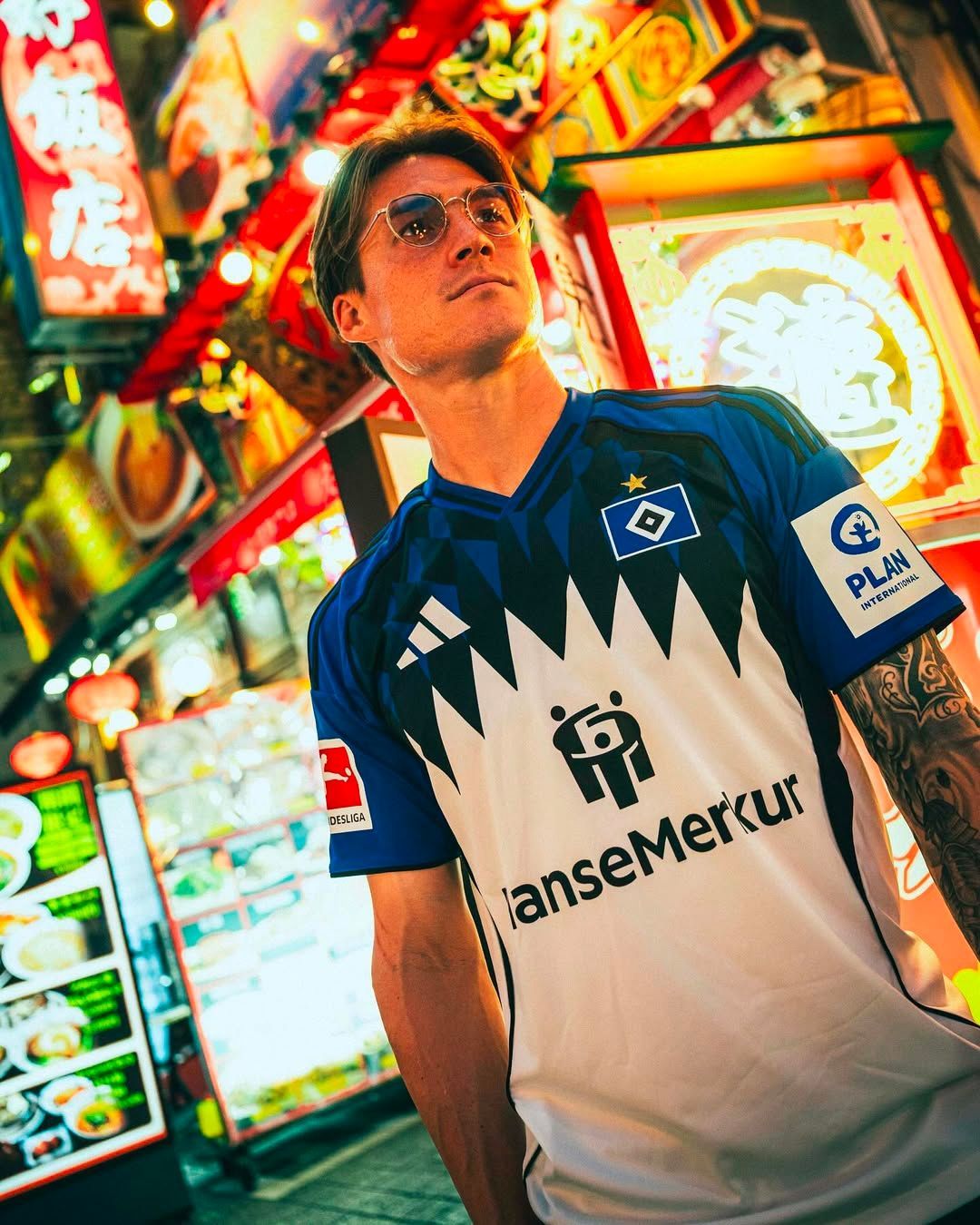
The year 2025 has finally marked Hamburg’s return to the Bundesliga, and for the occasion, adidas, the technical sponsor, has created a striking jersey featuring a geometric pattern on the upper part, composed of diamonds and triangles forming a jagged shape. The kit, completed with red shorts and blue socks, has already made its debut in early preseason friendlies.
Two patterns, one jersey
The uniqueness of this jersey lies precisely in the geometric pattern decorating the front. Not so much for the pattern itself, but for what it represents. It is in fact a tribute to the diamond-shaped design that adidas introduced for Germany’s Home jersey at the 1994 World Cup, which was also used for Hamburg’s Home and Away kits during the 1994/95 season. That design marked the final chapter in adidas' geometric revolution in football aesthetics, which forced other brands to draw inspiration—or even completely copy it. It’s surprising then that the German brand decided to bring back this pattern for a club like Hamburg, which arguably falls into adidas’ lowest tier.
But there are some numbers that help explain this surprising choice. The first is 18—the number of consecutive years of partnership between adidas and Hamburg, a sponsorship that began in 2007 and adds to the 18 years of previous collaboration between 1978 and 1995. Over thirty years of partnership, effectively making Hamburg one of adidas’ most representative clubs. That alone could explain the decision to bring back a cult design for what is globally a niche club—especially in a season where adidas has reintroduced the Teamgeist template across all its teams, Hamburg included.
Then there’s another number that shows why adidas holds Hamburg dear: 126,995, the number of official club members. That’s one of the highest figures in German football. Hamburg remains one of the most followed clubs in the country. After all, it's a historically important Bundesliga club, with six league titles and, more importantly, the 1982/83 Champions League title, won by defeating Juventus in the final in Athens. Their return to the top flight is the single most compelling storyline of the entire season—and it deserved something big to celebrate the moment. So what better way than to revive an iconic design like the Diamond Template? Perhaps even using it as a teaser for a broader comeback.
The derby of nostalgia
Regardless of the numbers and theories, it’s clear that this jersey also represents yet another brand falling into the nostalgia trap. A tempting wildcard that’s bound to receive positive feedback from fans—perhaps less so from collectors, who always hope for new kits, more original patterns, and modern designs. In any case, adidas isn’t alone in this. PUMA, for St. Pauli’s Home jersey, has created a kit featuring the same white and brown vertical stripe pattern last used as the club’s Home jersey in the 2011/12 season.
So basically, on the weekend of August 30–31, when we witness the first Hamburg derby in the Bundesliga since February 16, 2011, we’ll be seeing the derby of nostalgia: on one side, Hamburg wearing a jersey with a pattern from 1994, adapted into a design introduced in 2006; on the other side, St. Pauli wearing a jersey from a brand that decided to replicate a pattern first introduced by another brand in 1968 and which, before this season, had already been revived four times by four different brands.