
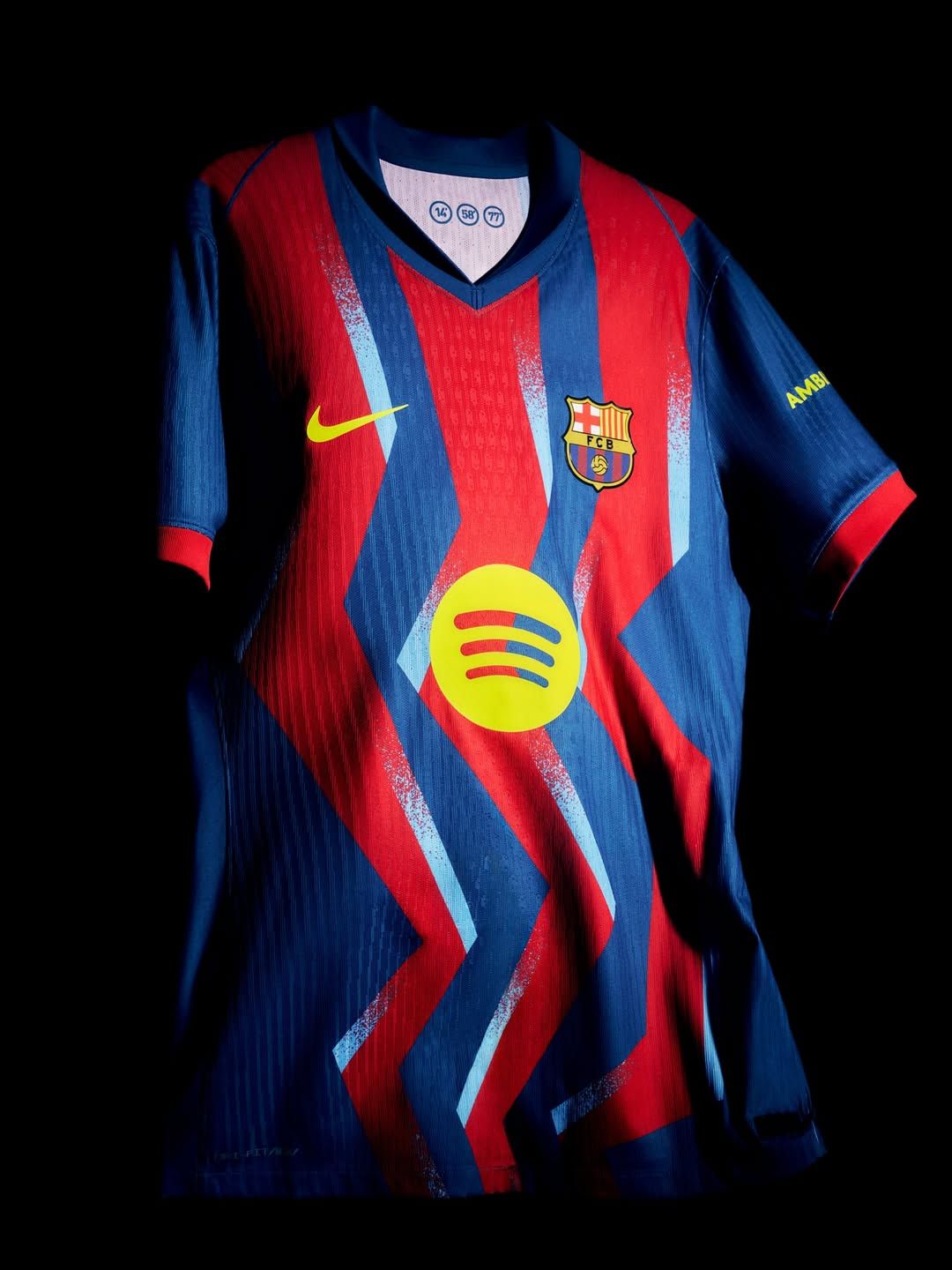
Barcelona's new fourth kit is dedicated to their victory in El Clásico in 2005 Ronaldinho vibes
Following the announcement of their return to the Camp Nou for the upcoming La Liga match against Athletic Club, Barcelona have officially unveiled their new fourth kit for the 2025/26 season. The jersey, once again produced by Nike, marks the 20th anniversary of a defining moment in the club’s history. The design pays tribute to the 0–3 victory at the Bernabéu in one of the most iconic Clásicos ever: the match on 19 November 2005 when even Real Madrid supporters rose to applaud Ronaldinho after his unforgettable brace.
The concept behind the new fourth kit
Visually, the shirt reinterprets the traditional Home jersey concept, featuring alternating red and blue vertical stripes. This time, however, the bars follow an irregular pattern, inspired by the trajectories of the ball leading to the three goals scored that evening. Light-blue detailing completes the look, while inside the collar three circles mark the minutes of those goals: 14th, 58th and 77th. The kit is paired with bright red shorts, in a more vibrant shade than those worn by Ronaldinho and his teammates in 2005.
The “new” Camp Nou
Barcelona will also mark the launch with a long-awaited return to Camp Nou for their league clash with Athletic Club. The last official match at the stadium dates back to 28 May 2023, but 915 days later the club is finally ready to reopen its doors to the Blaugrana faithful—albeit with reduced capacity. Although the €1.5 billion renovation project is still ongoing, Barcelona have received approval to host 45,401 spectators, less than half of what the stadium will hold once completed. The team will also play their next home Champions League fixture against Eintracht Frankfurt at Camp Nou. There is still uncertainty, however, around when the refurbishment will be fully completed. The initial target was the summer of 2026, later pushed to 2027 by club executives. Now, with the installation of the new roof still underway, the end date is increasingly likely to slip to 2028.