Bodø/Glimt brought the Champions League to the north of the Arctic Circle History and aesthetic of Juventus' next opponent
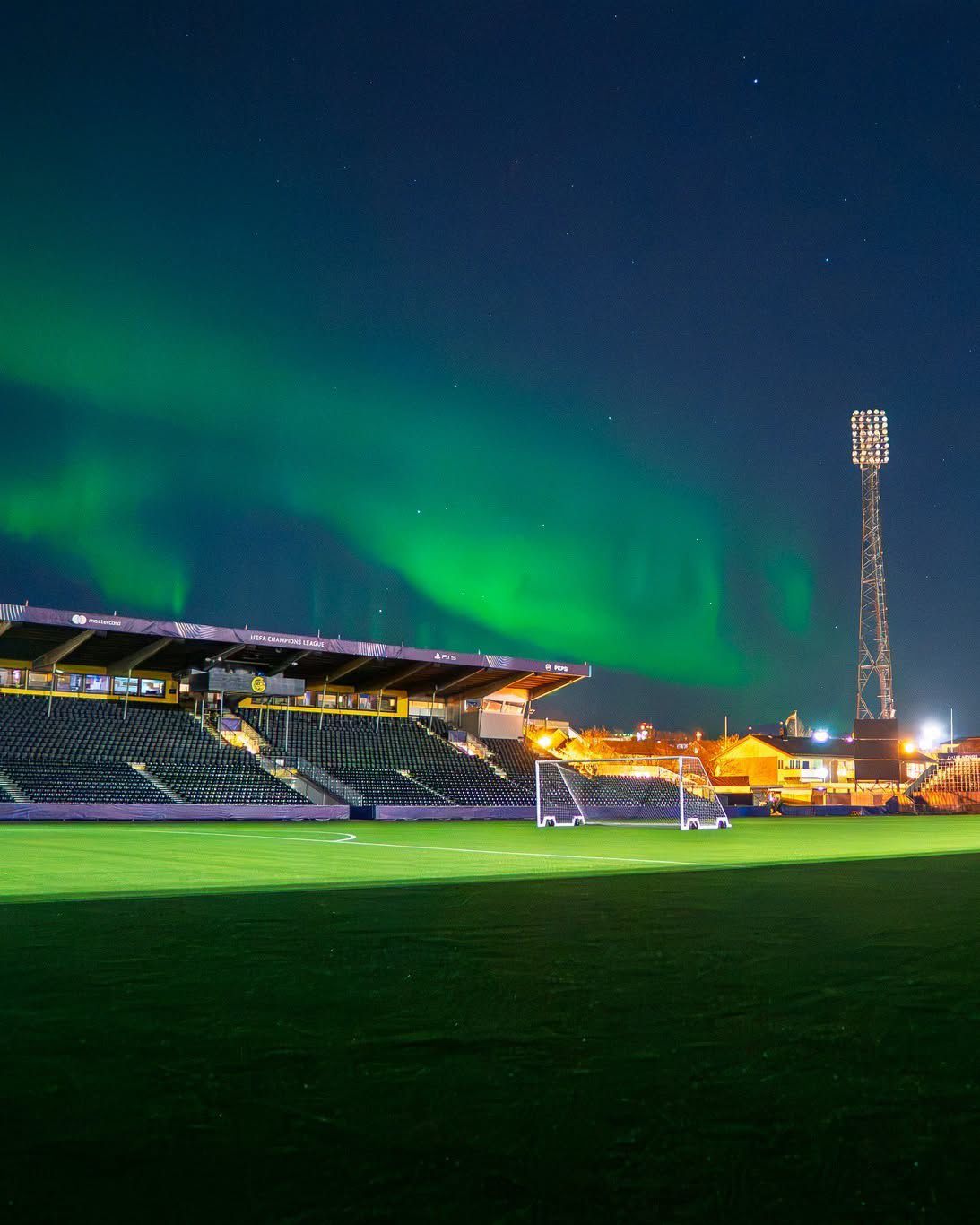
The away trip that Juventus and its supporters will make for a football match north of the Arctic Circle will be unforgettable. A place, Aspmyra Stadion, from which you can sense the cold and the wind simply by watching it on television. A team, Bodø/Glimt, initially a source of pride for northern Norway and now the most representative club in Scandinavia. Never before had the Champions League been played so far north, and probably not even the most devoted fan would have expected it. Now that the dream is reality, Glimt lives the present in its magical home fortress and looks to the future with plans for new infrastructure.
Playing football in Bodø
To understand the exceptionality of what is happening in this part of the world, you have to go back to the roots. Bodø is a Norwegian town of just over 53 thousand inhabitants located in the county of Nordland, Salten district. Famous for herring fishing, it is now increasingly orienting toward the commercial and administrative sectors, trying to emulate the development of the south of the country. The most interesting historical highlight dates back to 1818, when accusations of smuggling against some English ships operating in the area produced a British–Norwegian diplomatic conflict, known as the Bodø Affair.
Football arrived in the city almost a century later, precisely in 1916, with the founding of the football-and-skiing club Glimt, which in Norwegian means "lightning." When it was discovered that another team with the same name already existed, the change to Bodø/Glimt was completely natural and important to distinguish it from Grand Bodø, the other team in the city founded the following year. For almost 50 years Glimt, like all other clubs from northern Norway, was restricted to playing in the regional championship, because the Football Association considered the level of football in these areas too low to be admitted to a national competition. Entry to the Norwegian Cup was opened only from 1963, with Glimt winning the trophy 12 years later. That victory not only helped fight the footballing stigmatization suffered by the North but became the symbol of the social redemption of an entire region, which saw in the team something to be extremely proud of. After establishing itself nationally and going through decades of economic and divisional ups and downs, the club has been experiencing its golden era for the past five years. The first historic league triumph arrived in 2020, followed by three more national titles and unforgettable European runs, culminating in the first participation in the league phase of the Champions League.
Juventus' adidas x Moon Boot collaboration
Juventus is therefore facing harsh weather and for this reason, on the occasion of the trip to Norway, unveiled a surprise collection. A collaboration between adidas and Moon Boot with the Bianconeri players who, departing from Turin, wore padded reflective jackets in two versions, black and silver. Inspired by a space-age aesthetic, the capsule collection, which blends adidas's technical materials with Moon Boot's creativity, evokes a spirit that merges outdoor and urban. In some respects it is the winter evolution of the CLIMACOOL jacket designed for the Mercedes F1 drivers, which guarantees coolness in any hot situation. In this case the jacket is designed to offer the greatest possible protection from the icy cold of the Arctic Circle, without compromising on style.
The home stadium
Since 1966 the home of Bodø/Glimt has been Aspmyra Stadion, named after the area where it was built. Born from a strong push by the citizens who demanded a local reference facility, it was initially a multi-sport structure with a circular track where athletics and speed skating were also practiced. After numerous renovations, today Aspmyra appears as a stadium that in itself has little to say, resembling one of the generic stadiums you might find playing on a PlayStation. The current 8,270 seats are distributed on a rectangular plan made up of two covered stands and two uncovered behind the goals, built gradually to meet growing attendance and UEFA standards. Since 2006 the pitch has been artificial turf with an underground heating system, an inevitable and typical choice for these latitudes, with the club having, for a few matches, been forced to play at Norlandshallen, a covered facility with 5,500 seats now used for winter training. A wooden fence runs around the exterior perimeter, and in the area in front of the main stand there are three bronze statues of players in motion.
What makes this facility special, the beating heart of the community, are the feats of the team and the anecdotes that revolve around it. First of all, on the club's official website there is a section for lost property that gives the possibility of reclaiming forgotten belongings at certain times—a practically unique service. The four floodlights standing on masts at the corners of the pitch, similar to those you can find at any amateur field in Italy, were in 2001 bought second-hand from Oslo's Ullevaal Stadion. These initially caused a complaint from the nearby Bodø Airport, located a 10-minute walk from the stadium, due to the light disturbance they caused to pilots during landing. In 1997 the municipality granted the stadium to Glimt but, after the club received illegal public subsidies, it was resold to the municipality in 2011 to avoid bankruptcy.
Italian precedents at Aspmyra
Juventus will be the fifth Italian team to play in Bodø. Both Sampdoria and Milan faced the Norwegians but not at Aspmyra Stadion: the blucerchiati lost 3-2 in 1994 in Oslo because Glimt’s stadium was not properly equipped to host European matches, while the Rossoneri beat them 3-2 at San Siro in 2021 in a single-leg tie due to anti-COVID measures. The first to reach the town facing the fjords was Napoli, in 1976, after 18 hours of travel with several stops. Arriving to play the first round of the Cup Winners' Cup, the Azzurri won 0-2 against a Bodø/Glimt that had won its first Norwegian Cup while still in the second division. The match between the polar amateurs and Burgnich and Savoldi's team was attended by 7,250 spectators. Two years later, in 1978, it was Inter's turn to come north for the second round of the same competition. Final result 1-2 despite Glimt's fleeting lead, in a two-legged tie that had been decided by the 5-0 result at the Meazza.
The Norwegians at Aspmyra have finally become the nightmare of the two Roman sides, beating them three times out of three in recent years. In the 2021-22 Conference League group stage they thrashed Roma with a historic 6-1 and beat them again 2-1 in the quarter-finals before being eliminated in the return leg. In the 2024/25 season it was then Lazio's turn to fall in the Europa League quarter-finals by 2-0, making the home advantage something decisive that Juve cannot underestimate.
The toothbrush symbol and the future stadium
As recounted, Bodø/Glimt enjoys fervent support across the entire northern region, a support that peaked with the Cup win in 1975. Its fans are known as Den Gule Horde, The Yellow Horde, the color of the team's kits. They are considered among the pioneers of Norwegian fan culture and are famous for an everyday object that became iconic, whose story must be told. Supporters used to gather near the stadium to share a long pre-match ritual. Some therefore carried a toothbrush in their pockets which began to be used by Arnulf Bendixen, leader of the supporters, to orchestrate the chants in the stands. Given the growing popularity of this habit, Jordan Toothbrushes had the idea of making a giant yellow toothbrush to give to the fans. Since then, before every home match, Den Gule Horde hands a yellow toothbrush to the visiting team's captain.
Beyond the loyal hardcore fans, the club's successes have inevitably attracted more people, giving rise to a genuine Glimt-mania. On the occasion of last year's Europa League semi-final reached against Tottenham, the ticket hunt was frantic: for the 480 tickets on general sale there were over 50,000 requests, with some people offering dried fish and reindeer meat in exchange for a historic ticket. Between folklore, bizarre symbols and prestige, Bodø/Glimt gives the impression of being a club that has clearly exceeded its expectations and ambitions, living something bigger than what Aspmyra Stadion can offer. Therefore, the club has long planned a new stadium, with the project approved by the internal council last September. Despite a very discreet communication strategy that raises questions about the source of the funds to be used, the Arctic Arena / Nye Aspmyra will be built in Thalleveiåkeren, just outside the city center, and is expected to be ready by the autumn of 2027.
What to read next

The Champions League was all about elegance last night
Liverpool and PSG debuted their Tommy Hilfiger and Dior looks
Why are Shakhtar Donetsk playing their Champions League games at Stamford Bridge?
They have been forced into footballing exile by Russia’s invasion of Ukraine

Why Barcelona will wear its 2025/26 Third kit against PSG?
It's due to UEFA's kit clash rules