
The greatest Paris–Roubaix ever The 2026 edition made Wout van Aert a cycling legend
A Paris-Roubaix ridden in one breath. One of the most beautiful and thrilling cycling races ever. From 13:40, when Tadej Pogačar’s bike suffered one of the many issues seen yesterday afternoon, to 16:30, when Wout van Aert crowned the best day of his career in the velodrome, the Queen of the Classics built into a crescendo of emotions. Relentless, with twist after twist, in a race that is not called the Hell of the North for nothing—and yesterday it was more than ever. Punctures and crashes tangled the gaps between the favorites for dozens of kilometers—Mathieu van der Poel ahead of Pogačar and van Aert, all with two or more mechanicals along the way—and forced infernal speeds through the narrow cobbled and dirt sectors, with strategies pushed to the extreme early on, all the way to the final sprint inside the Vélodrome André Pétrieux in Roubaix.
All around it, a setting that always delivers its iconic snapshots. The photogenic beauty of Paris-Roubaix—its charm made of myth, aesthetics, and tradition—is no secret. Yesterday, once again, it was captured through stills, drone footage, slow-motion shots on the cobbles—content that invites endless binge scrolling in the hours after the race. From a sporting perspective, this 123rd edition will be remembered through three defining frames, mirroring its contenders: the Arenberg Forest, where van der Poel stepped off one bike, then another, losing the train to the final sprint; the Carrefour de l’Arbre, where Pogačar launched his fiercest attack, with the same look seen last week in Flanders, or at Milano-Sanremo, or in countless other afternoons—though this time it wasn’t enough; and finally, in chronological order, van Aert’s last 300 meters, flawless, both physically and emotionally.
Arenberg Forest - Mathieu van der Poel
"To win here you also need a lot of luck." Van der Poel had said it—unbeaten at Paris-Roubaix since 2022. Three consecutive titles, but not the luck needed for a fourth. His hopes unraveled in the Arenberg Forest, the absolute worst place to puncture—let alone to trigger everything that followed. Far from the team car, van der Poel abandoned his bike and jumped onto teammate Jasper Philipsen’s, which was the wrong size and had incompatible pedals. "Like others, I punctured on the cobbles," VdP said, "and clearly I shouldn’t have taken Jasper’s bike. I wanted to get out of Arenberg, but it wasn’t possible, so I tried to take my own bike again—they gave me another wheel, but still it wasn’t possible." A disaster. Filippo Pozzato once said that "there’s no worse place than Arenberg, but in a good way"—and sometimes, as van der Poel knows well, in a very literal sense.
And just like that, two and a half minutes were gone for the Dutchman—an eternity that usually separates those who can still win the race from those who can’t. Yet Mathieu, seen in every TV close-up from that moment on with the eyes of a man on a mission, refused to give up. He chased flat out for ninety kilometers and crossed the line just 15 seconds down. Heroic—far more than his fourth place suggests.
Carrefour de l’Arbre - Tadej Pogačar
Van der Poel’s delay opened the door to what pre-race predictions had framed as the number two and three favorites: Pogačar and van Aert. The Slovenian was chasing history—Paris-Roubaix is the only Monument missing from his palmarès, following last month’s win at Milano-Sanremo. With no climbs and long cobbled stretches, it is far from his ideal terrain. And yet, he started among the top contenders and fought for victory until the very last meter, finishing second—as he did in 2025 on his debut. One thing is certain: he’ll be back in 2027, knife between his teeth. In his mind, he’ll likely be racing this course every day for a year.
Yesterday, 120 kilometers from the finish, Pogi suffered his first mechanical. Again, far from the team car, he had to ride a bike that wasn’t his size for several kilometers, losing around a minute and a half. A chase that cost him energy and teammates, but ultimately allowed him to lead the group that dropped van der Poel in the forest. From there, despite constant unpredictability, the race increasingly shaped into a two-man battle: Pogačar and van Aert. After shedding the last survivors with a move from the Belgian, the two were alone with just over fifty kilometers to go. Head to head, wheel to wheel. For Pogačar, with van der Poel out of contention, it was a golden opportunity—and he tried everything to seize it, attack after attack. On Mons-en-Pévèle, and even more fiercely on the Carrefour de l’Arbre—but he couldn’t shake van Aert. "I knew I’d have a good chance against Tadej on the road once we were alone," Wout would later say, "the moment I really believed was after the Carrefour de l’Arbre." Resilience. The prelude to triumph.
Vélodrome de Roubaix - Wout van Aert
"This victory means everything to me." The career of Wout van Aert, 31 years old and seven Paris-Roubaix appearances before yesterday, reached its highest point in the most iconic and theatrical venue in cycling: the Roubaix velodrome. He arrived shoulder to shoulder with Pogačar, working together when needed to build the gap, then shifting into defense and withstanding every acceleration—showing peak form and, above all, composure, before delivering the perfect sprint inside the Pétrieux. A victory of mind, legs, and above all, heart. “The masterpiece of my life,” he said at the finish, overwhelmed with emotion. "Beating Pogačar—raise your hand if you thought of the grand finale of the Tour de France 2025—wearing that rainbow jersey: there couldn’t be a better way. It’s truly a dream come true."
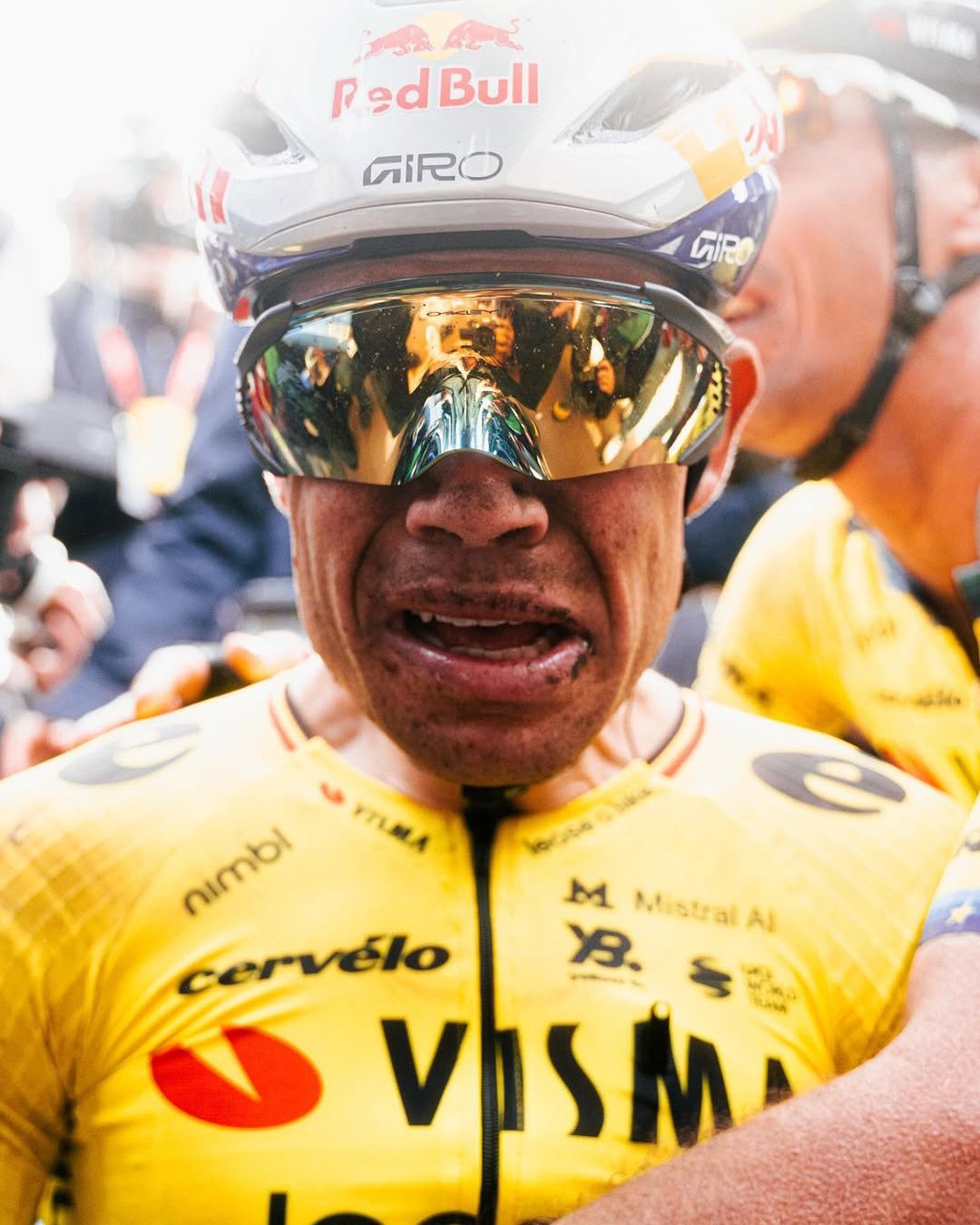
The tears streaming down his face just after crossing the line told the story of release. The weight of a huge career, often defined by near misses, chances lost, and duels against the generational greats. His second Monument, however, wiped it all away. His skyward gesture at the finish carried deep meaning—this was where, in 2018, he lost a friend and teammate, Michael Goolaerts, to cardiac arrest. "The people close to me know how much I had to pick myself up. I always got back up. The first time I raced here, I lost Michael. Since then, my goal was to win and point to the sky—for him and for his family." Mission accomplished, Wout.