
How DAZN broadcasts the 2026 FIFA World Cup in Italy Inside the most complex TV production ever
Over the past few days, the biggest World Cup in history has been unfolding on our screens. A FIFA World Cup expanded in every possible way, with 48 national teams and 104 matches spread across three different countries, but also behind the scenes, in the amount of work required to produce and tell the story of an event on this scale. The expanded footprint of the competition brings with it new complexities for everyone involved and a series of unprecedented challenges for broadcasters and television producers. It could hardly be otherwise for the largest edition ever of the world's biggest sporting event, taking place within a media ecosystem that turns entertainment into spectacle like no other.
The Biggest World Cup Ever Requires a New Broadcasting Model
During a panel organized by Sports Business Journal just a few weeks before the World Cup, Kevin Callahan of Fox Sports described it as "an event unlike anything we've ever done before." Miguel Lorenzo of Telemundo echoed the sentiment, calling it "from a logistical standpoint, the most complex World Cup ever organized." FIFA itself and HBS (Host Broadcast Services), responsible for producing the international broadcast feed, have also spoken about the operational adaptations required. "The difference is that in this edition we need more teams because we have to minimize the risks associated with moving across such enormous countries," explained Oscar Sanchez, Head of FIFA Host Broadcast Production. This has led to the establishment of a media headquarters in Dallas and the creation of 16 operational teams, one for each tournament venue. These are almost inevitable decisions for a World Cup stretching from Vancouver to Mexico City, and fundamentally different from the previous edition in Qatar, where eight stadiums were located within roughly eighty kilometers.
In Italy, the 2026 World Cup is being broadcast in its entirety by DAZN, which also holds the rights to the tournament in Spain and Japan. To understand how coverage of such a massive event is organized, we spoke with Sandeep Tiku, Chief Technology Officer (CTO) of DAZN Group, and Michele Dalai, Senior Vice President (SVP) of Content at DAZN Italy. They took us inside the enormous machine—largely invisible to viewers—that makes it possible to bring the World Cup to millions of screens, explaining both the challenges involved and the "exciting opportunity" it represents from both a technical and editorial perspective.
"We're able to tackle it thanks to an increasingly sophisticated level of technological intelligence at our disposal," begins Sandeep Tiku. "DAZN will manage the feeds from a single centralized hub based in Dallas," and that is precisely where our journey begins. While matches are played across the tournament's 16 venues, another part of the World Cup lives inside the Kay Bailey Hutchison Convention Center in Dallas, transformed for the occasion into the International Broadcast Center (IBC), the operational hub through which signals are received and distributed to broadcasters around the world.
Dallas and the International Broadcast Center: The Operational Heart of the Tournament
This is where broadcasters, technical operators and media partners from around the world work side by side. It is here that match signals are received, verified and distributed to rights-holding broadcasters. As FIFA revealed in the weeks leading up to the tournament, 56 media partners operate inside the facility, connected by nearly 150 kilometers of cabling. "We have to maintain a small city to support the broadcasters," explained John Newkirk, one of the IBC's senior managers.
Within this structure, DAZN, like many other broadcasters, has established its own operational headquarters. "Our center will be located inside the Dallas IBC and will produce all source feeds," explains Tiku, "leveraging a combination of remote production and advanced connectivity solutions—a broadcasting model that is very different from traditional ones." The advantages are immediate. Instead of duplicating infrastructure and personnel at every venue, most operations are centralized in a single hub. "Our primary responsibility is ensuring connectivity between the stadiums and Dallas," says Tiku, and once the signal reaches the Texas hub, much of the production can be managed centrally. "Remote production unlocks new opportunities and gives broadcasters the ability to deploy more innovative solutions. We're not making a compromise—this is a deliberate architectural choice. Most of the events we broadcast are produced remotely, and that's not a limitation but the result of an infrastructure specifically designed to work this way. (...) This is what modern broadcasting looks like."
The operational plan underwent its first large-scale test during the 2025 Club World Cup. As Tiku confirms—and as representatives from Fox Sports and Telemundo had previously explained—it is "a technical architecture that we implemented last year," now adapted and scaled up. "Our teams work with interfaces, systems and architectures they already know, and that familiarity becomes a competitive advantage: fewer errors, faster response times and greater confidence under pressure." Naturally, this also affects the composition of on-site teams. "For every match we'll have around fifteen people on location," explains Tiku, "dedicated to hosting, coverage and capturing the atmosphere." A remarkably lean model considering the scale of the operation. But once this first stage is complete, how do the images continue their journey to our screens?
From the Stadium to Your Screen
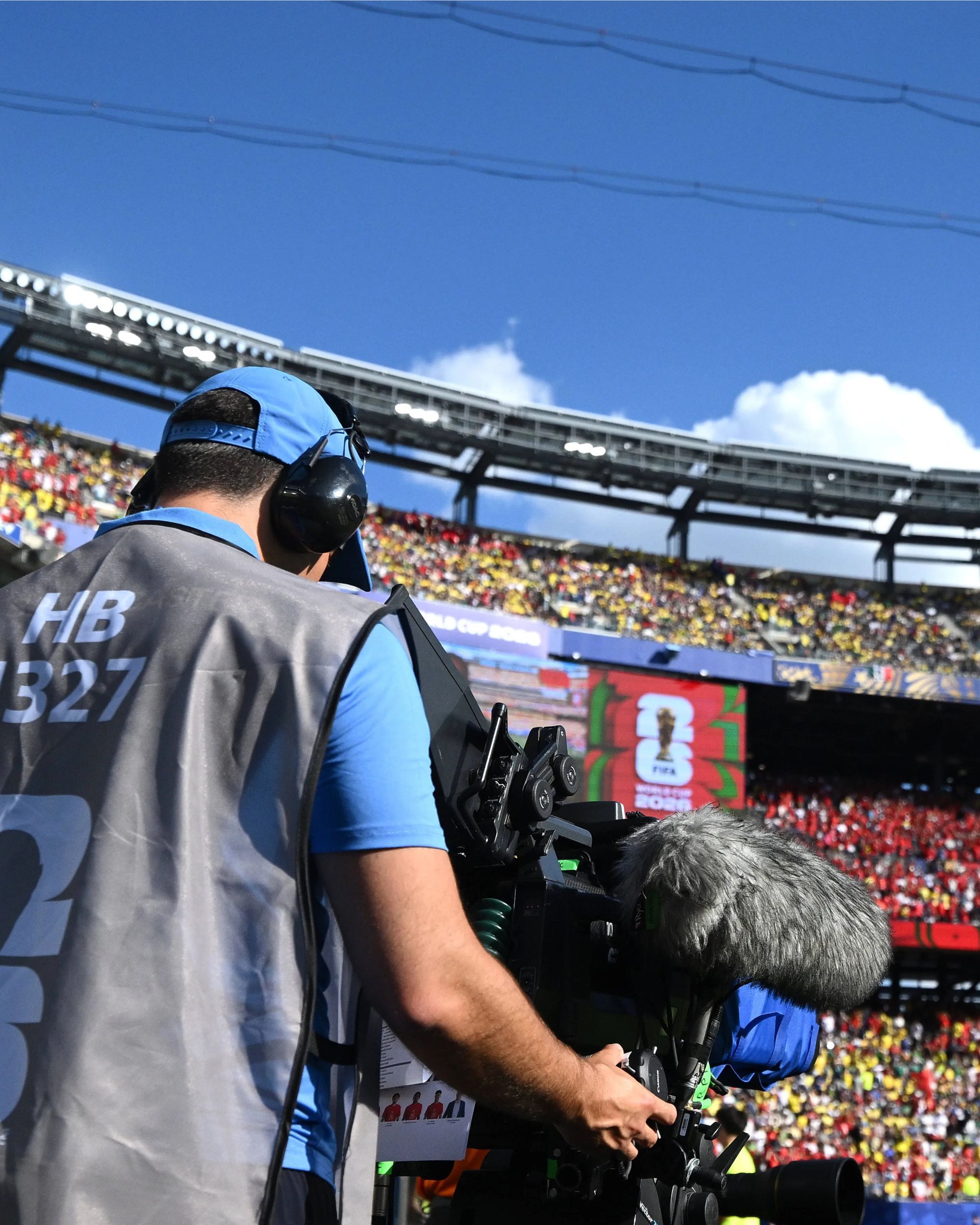
The rest of the process is managed through a network of interconnected hubs and operational centers. The journey begins in the tournament stadiums, passes through the Dallas IBC, and then continues across several additional stages. The amount and variety of material generated at each venue is enormous, with up to 45 cameras deployed for every match, including traditional broadcast cameras, PoleCam, CableCam, RefCam, cinematic cameras and 360-degree systems.
Once collected at the IBC, the feeds are handled by DAZN's own systems, beginning a second phase within the broadcaster's dedicated infrastructure. "From the IBC, the signals cross the Atlantic through a fiber-optic network to our European hubs. Our operational center in the UK is supported by technology partners in the Netherlands and by our innovation hub in Cologno Monzese for Italy," explains Tiku. "In the Netherlands, a crucial part of the process takes place: format conversion, frame-rate management, preparation of distribution feeds and audio signal processing."
After this processing stage, the images are routed to their final destinations, where DAZN's three World Cup markets come into play. "Once they reach the local hubs, the feeds are enriched with commentary, editorial content, graphics and market-specific features," adapting to the needs of each audience. Finally comes the last stage: distribution itself. "The signals return to our streaming hubs, where they are encoded, protected and delivered to end users," explains Tiku. It is the final step in a chain connecting North America, Europe and Asia before the images ultimately reach viewers.
One aspect of this process is often taken for granted, yet remains almost mysterious to non-specialists: despite its complexity, everything happens within just a matter of seconds. While images travel across continents and operational hubs, the match unfolds on viewers' screens almost in real time. The margin for error is virtually nonexistent, and ensuring uninterrupted continuity for more than a month of competition represents one of the greatest technical challenges of all.
The Biggest Technical Challenges of the 2026 World Cup
Looking at the operation as a whole, Sandeep Tiku identifies three major challenges: geographical distribution, operational simultaneity and long-term continuity. The first, already largely introduced, concerns the network connecting stadiums, hubs and operational centers, together with all its potential vulnerabilities. "Any connection could be interrupted by construction work, extraordinary maintenance, weather conditions or other unforeseen circumstances," explains Tiku. To mitigate these risks, DAZN has strengthened the system "by implementing three levels of redundancy: primary lines, backup lines and additional contingency lines within the United States to minimize the possibility that an external event could compromise the live broadcast."
The second challenge is simultaneity and the sheer volume of data it generates. "During peak periods we may be handling multiple live feeds simultaneously, all in HDR with 5.1 audio, including real-time monitoring, routing, format conversion and simultaneous distribution across multiple markets." This requires "an infrastructure sized to absorb additional signals without reconfiguration, allowing us to manage the inevitable unpredictability of live sports broadcasting as effectively as possible."
The third major test concerns operational continuity over time. The fact that this is the largest World Cup ever staged, "rather than a single event or a weekend of league football," means that systems must remain active continuously throughout the competition. This requires "not only technology but also constant operational discipline, centralized monitoring, transmission control and uninterrupted support services to guarantee end-to-end signal integrity."
Beyond the technical challenges lies another equally important one: transforming the images into a narrative capable of speaking to different audiences and platforms across multiple markets and time zones. This is where the editorial dimension of what Michele Dalai describes as "a hybrid and geographically distributed World Cup" comes into play—something with no real precedent. The real challenge, he says, "is combining a global platform with a deeply local point of view."
The Editorial Challenge of a Global World Cup
DAZN broadcasts the 2026 World Cup simultaneously across three very different markets: Italy, Spain and Japan, each with its own audiences, viewing habits, cultural references and expectations. "Editorial formats, commentary, analysis and digital content are adapted locally in each market, always taking cultural context into account," explains Dalai. "At the same time, there is also a virtuous exchange between countries: some projects originate locally and, when successful, are developed and expanded elsewhere. For us in Italy, telling the story of the World Cup still begins with who we are—our passion, our culture and our unique way of experiencing football."
The enormous volume of content produced by DAZN is not used solely for streaming but feeds the company's entire ecosystem. "This content doesn't exist only on the DAZN platform—it lives throughout our ecosystem, including social media, using different languages and formats tailored to different audiences."
Personalization also extends directly to the viewing experience, with several experiments underway during the tournament. "In Japan we're testing remotely controlled robotic cameras for pitch-side production for the first time," says Tiku. "We've created dedicated feeds that allow fans to vote for the player they want to follow and watch the match from that player's perspective. It's a level of personalization that begins at the production stage and directly shapes what viewers see." According to DAZN's CTO, this approach also enables broadcasters to share cameras and infrastructure, reducing duplication and operational inefficiencies.
Beyond the countless technical, organizational and editorial complexities described so far, one fundamental issue remains—perhaps the simplest to describe but the hardest to satisfy: meeting audience expectations. "Fans are no longer satisfied with simply watching football matches," concludes Michele Dalai. "They want to feel at the center of the event, enjoy a personalized experience, interact with it and share their emotions while following everything in almost real time. The real challenge is bringing all of that together in a seamless and natural way that speaks directly to the heart of every fan."