


























Were we too quick to judge the Olympic Village in Milan? The project is focused on the future, not the present
This is not the usual story of Olympics and concrete. In Milan, the Porta Romana Olympic Village was not designed to impress, but to endure. Designed by the American firm Skidmore, Owings & Merrill (SOM), the same behind New York’s Freedom Tower and Dubai’s Burj Khalifa, the project stands as a manifesto for a new way of building: temporary, sustainable, and convertible. An architecture that aims not to celebrate the sporting event, but what comes after. While in the past Olympic villages have turned into ghost towns, as shown by the cases of Athens 2004 and Rio 2016, Milan has chosen the opposite approach, planning its legacy before the event itself.
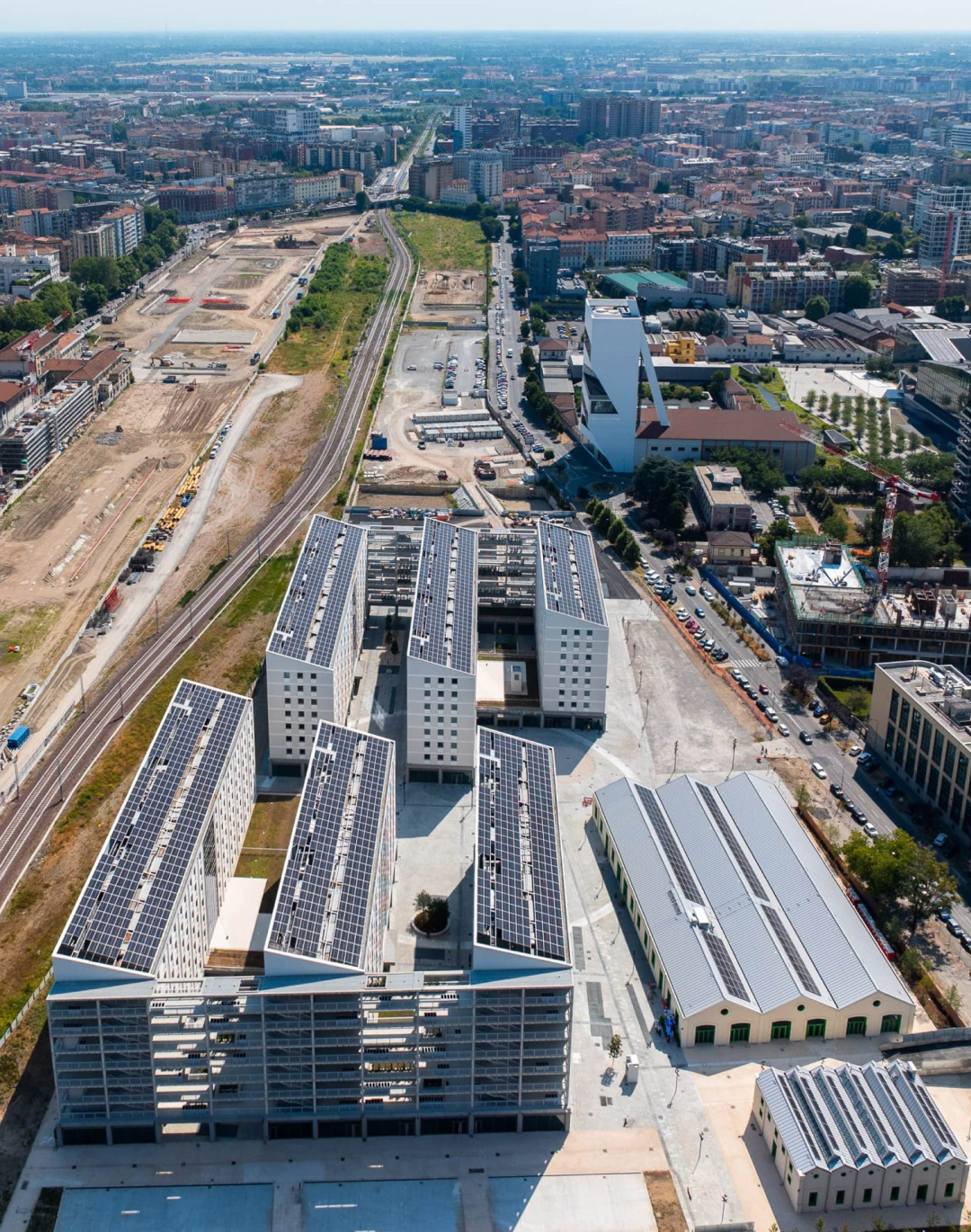
The Porta Romana Village, built on 60,000 square meters of the former railway yard, will house over 1,000 athletes in 2026, but from 2027 it will be transformed into a sustainable student residence for about 1,100 students and young professionals. The project is managed by the COIMA fund, in partnership with Prada Holding and the Fondazione Lombardia per l’Ambiente, designed to meet NZEB (Nearly Zero Energy Building) and LEED Gold standards of excellence. Behind the image of the new wooden and glass buildings lies a deeper reflection: how can a city evolve its purpose without losing meaning?
The design of Milan’s Olympic Village
SOM’s answer lies in modularity and efficiency. The village structures are designed to be dismantled and adaptable, capable of transformation without generating excessive waste. The use of structural timber (such as XLAM or CLT) drastically reduces the building’s carbon footprint while providing a warm and recognizable aesthetic, essential for a co-living environment.
Efficiency is built into the design: ventilated façades reduce energy consumption by 30%, while a greywater recycling system supports the irrigation of internal gardens. Thirty percent of the total area is dedicated to public green space, and rooftop photovoltaic panels will cover most of the energy demand. This model speaks not only of environmental sustainability but also of social sustainability: architecture as a relational infrastructure.
During the Games, it will function as an international campus with a canteen, gym, and communal areas designed as community squares. Afterwards, its conversion into student housing directly addresses the housing crisis affecting Milan, offering flexible co-living spaces (shared laboratories and study areas) that foster dialogue and community life. The comparison with London 2012 is inevitable: the Stratford district, once home to the Olympic Village, is now one of the city’s most dynamic areas thanks to the conversion of its buildings into residences and universities. Milan looks to that same model, with greater attention to its local context and urban design.
The Olympic Village as a co-living model
@dljthomas Stratford is taking off . I went to check out Eastbank, a new £650m cultural development at the heart of Olympic Village. I reckon this will turn Stratford into one of the most significant hub outside of Central London. What do you think? #stratford #eastlondon #iphonevideography #architecture #blackbritish @V&A Museum Mount Shasta - Venna
Porta Romana is in fact one of the symbolic construction sites of Milan’s urban regeneration: by 2030, the area will feature new linear parks, pedestrian and cycling routes, and direct connections to Fondazione Prada and Bocconi University. The village will serve as a connective hub between academia, culture, and living. For SOM, the true goal is to define a new urban typology: «post-event housing», capable of addressing the housing crisis through flexible, sustainable, and shared structures.
From above, the Village appears as a constellation of low-rise volumes with green roofs and inner courtyards evoking Lombard farmsteads reinterpreted in a contemporary key. There is no monumentality, only proportion. Milan, which in recent years has been a laboratory of private and commercial urbanism, now seems eager to show its public side: a city designed for those who live it, not just for those who observe it.
The Olympic Village thus becomes an urban-scale co-living experiment, a model that merges architecture, sustainability, and new forms of sociality. Perhaps the true legacy of the Games will not be a medal or a stadium, but a question more valuable than any podium: how can we learn to live better together, even after the show is over?