















History and aesthetics of curling The coolest discipline at Milano Cortina 2026
When we think of the Winter Olympic Games, our minds immediately jump to speed, sharp turns, jumps, and extreme elevation changes: alpine skiing, snowboarding, biathlon, hockey. And then there is curling, the discipline where athletes armed with brooms and polished stones appear to bow to a noble ancestor of sport—one that, until recently, few would have called cool. Yet in 2026, as the world turns its gaze to Milano Cortina, curling’s blend of history, visual aesthetics, and pop-driven narratives is emerging as perhaps the most unexpectedly compelling and viral sport of the season.
When did curling originate?
Curling was born on the frozen lakes of Scotland in the 16th century, with the first official club dating back to 1716—establishing deep ties with the Nordic culture of ice and strategic play. Two paintings by Pieter Bruegel the Elder from 1565 depict Dutch peasants practicing a form of the game, suggesting its presence across Northern Europe.
This ancient origin is no coincidence. Curling is not merely a sport, but a slow and sophisticated form of strategy. Players slide their stones across icy surfaces with the same mindset used to read a chessboard. Every move carries weight, consequence, and risk. Within today’s Olympic competition format—featuring men’s, women’s, and mixed doubles events—the sport’s complexity and tactical intelligence are increasingly capturing spectators’ attention.
Where are curling stones made?
Curling’s rustic yet refined identity is rooted in a very specific place: Ailsa Craig, a small island off the coast of Scotland. It is here that the two types of granite used to craft Olympic curling stones are sourced. This granite is impermeable and extremely durable, making it ideal for withstanding impact and intense cold. The stones are handcrafted by the historic company Kays of Scotland, which officially supplies them to the World Curling Federation for international and Olympic competitions.
The stones themselves—polished, circular, topped with colored handles—have become visual icons of the sport. An essential design that communicates elegance and function, lightness and power. In an era where aesthetics matter as much as performance, curling boasts an instantly recognizable visual language that sets it apart: its pieces are granite objects with sculptural appeal.
Curling equipment: design and materials
If the stones are curling’s functional sculptures, high-performance shoes and brooms add a layer of contemporary design that nods to technical sports fashion. Curling shoes are far more than simple athletic footwear: they feature asymmetric soles engineered to optimize grip and glide—specifically, a smooth Teflon sole for sliding on ice and a rubber sole for braking. It’s not uncommon to see athletes change shoes mid-match, as if switching musical instruments rather than footwear.
On the ice, curlers are immediately recognizable, often wearing BalancePlus and DK Shoes models with interchangeable soles and custom designs. Technical shoes can reach prices of up to one thousand euros—niche products designed for athletes or teams seeking a unique visual identity and top-tier performance. Beyond purely technical gear, younger players are increasingly turning to outdoor brands such as Ecco, Salomon, Fila, or Italy’s EA7, transforming curling footwear and jackets into true icons of functional fashion on ice.
The brooms—long, slim, yet rigid—resemble tools from a minimalist design studio. Carbon fiber and synthetic materials combine to authoritatively guide the path of a moving stone. Brands like Goldline and Hardline have redefined the concept of the ice brush, merging high-tech materials, minimalist design, and recognizable color palettes that turn a technical gesture into a visual choreography. Synthetic brush heads and carbon fiber shafts don’t just improve glide—they add an aesthetic dimension appreciated by the most attentive viewers.
Visually speaking, curling has become an instantly photogenic and video-friendly sport. A blend of ancient craftsmanship, technical precision, and mental strategy—enhanced by a refined aesthetic that surprises first-time viewers. It’s no longer just “that game with brooms,” but a visual, tactile, almost meditative experience, where every stone tells a story of materials, hands, and ice.
Stars and the surprise effect
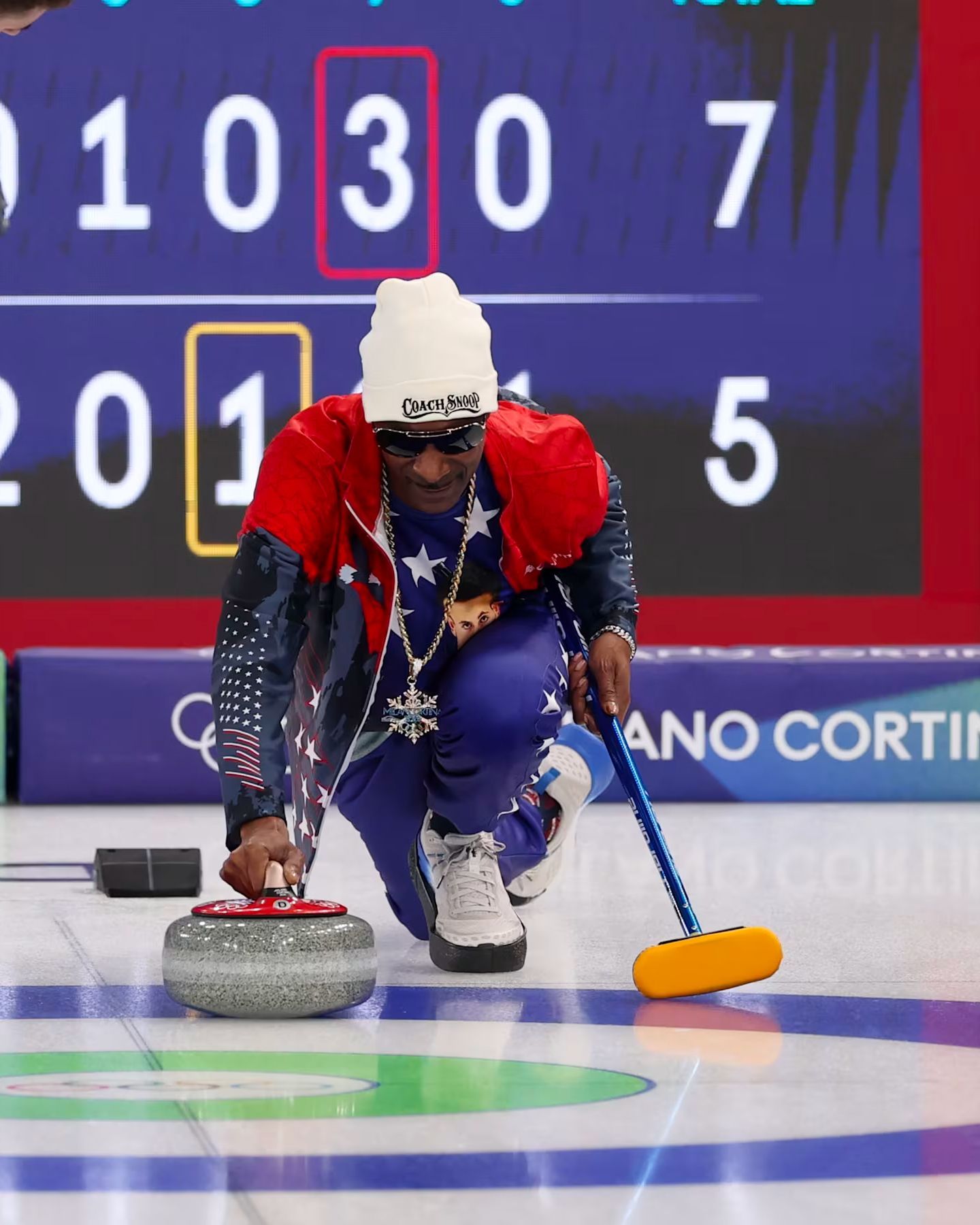
Curling scored another point when Snoop Dogg made a charismatic appearance at the Cortina Olympic Curling Stadium. The rapper stepped onto the Olympic ice wearing a customized Columbia jacket emblazoned with “Coach Snoop,” layered over a tracksuit featuring portraits of U.S. athletes. Yes, you read that right: Snoop Dogg created a collectible capsule collection for his participation in the 2026 Winter Games. The line—developed in collaboration with Barefoot Dreams, Mitchell & Ness, and others—was sold online via the SnooperMarket. His presence at the Games and these marketing moves amplified media attention, with the side effect of drawing in viewers who had never known the rules but stopped to watch, to understand.
This is not an isolated phenomenon. Pop stars, influencers, and celebrities are increasingly bringing niche sports into the global spotlight, and curling has found a perfect crossover between athletic performance and pop aesthetics. VIPs stand alongside elite athletes like Canada’s Brad Gushue, Norway’s Steffen Walstad, and the Swedish women’s team—faces of the sport on ice, wearing uniforms and accessories that play with chromatic details. In Italy, the movement is still small but ambitious: the national teams have begun to make themselves noticed in European competitions. Among young talents blending technique with a curated look, Italian players are proving that curling can be cool without sacrificing elegance of movement. Stefania Constantini and Amos Mosaner are the Italian duo who secured the country’s first-ever Olympic gold in curling.
How much do curling players earn?
Unlike disciplines such as skiing or snowboarding, where major outdoor and tech brands invest heavily, many curlers rely primarily on federation support or technical partnerships tied to specialized equipment. In recent months, Constantini has aligned her image with key Milano Cortina sponsors and previously became an ambassador for brands like Nutripure and Suzuki. Mosaner serves as an ambassador for the Trentino region. This renewed Olympic visibility could attract more traditional sponsors, drawn to a broader outdoor and sports-oriented audience. Notably, the Italian public response has been striking—shifting rapidly from curiosity to genuine enthusiasm for a discipline that, until a few years ago, was reserved for hardcore winter sports aficionados.
How does curling work?
Curling is not about who slides fastest or hits hardest, but about positioning, defending, and anticipating an opponent’s moves within a three-dimensional space of trajectories and pressure. In an era where sports are consumed not only as competitions but as visual content, curling has proven its ability to fit seamlessly into mainstream culture, transforming the mathematics of motion into visual and narrative emotion. Curling in 2026 is no longer a sport for insiders alone—it has become a space where history, design, aesthetics, and shared social experiences intersect, creating storytelling that extends far beyond the ice of Cortina.
If in the most visual sports it’s all about who takes the best photo, here it’s about who makes the best move—and often the two overlap. At a time when audiences seek deeper connections with what they watch, curling has delivered not just a rulebook, but a visual culture to explore and share. In the end, it’s not only about who wins, but who can turn a stone gliding across ice into a small masterpiece shared with the world.