



Athletes are turning into photographers A trend that is picking up speed.
After scoring his first goal for Sampdoria in 2015, Samuel Eto’o asked for a camera from the sidelines and began taking pictures of the crowd at Marassi. Observing and capturing, just like a photographer. It was a fairly isolated gesture at the time, and one that is still remembered precisely because of that — until a few years ago, seeing a footballer holding a camera was a rarity. Today, on the other hand, you can easily expect to spot an analog camera during the parade celebrating a Scudetto or a Premier League title win.
Across the Atlantic, meanwhile, the scene is becoming increasingly familiar even inside arenas and stadiums. Over the span of just a few months, we’ve seen Caitlin Clark, the women’s basketball star, courtside during an NBA game; then skier Mikaela Shiffrin at another basketball matchup; and later gymnasts Simone Biles and Suni Lee on the sidelines of football games. These are not isolated moments, but part of a new trend that sees athletes temporarily stepping away from their role as perpetual subjects of the image in order to become its authors. Sometimes it’s a carefully planned operation — designed for content or brand collaborations — while in other cases it stems from an already existing passion finally finding space to emerge. All the way to stories of those who have turned photography into a second life, both personal and professional.
Caitlin Clark and her photos of LeBron James
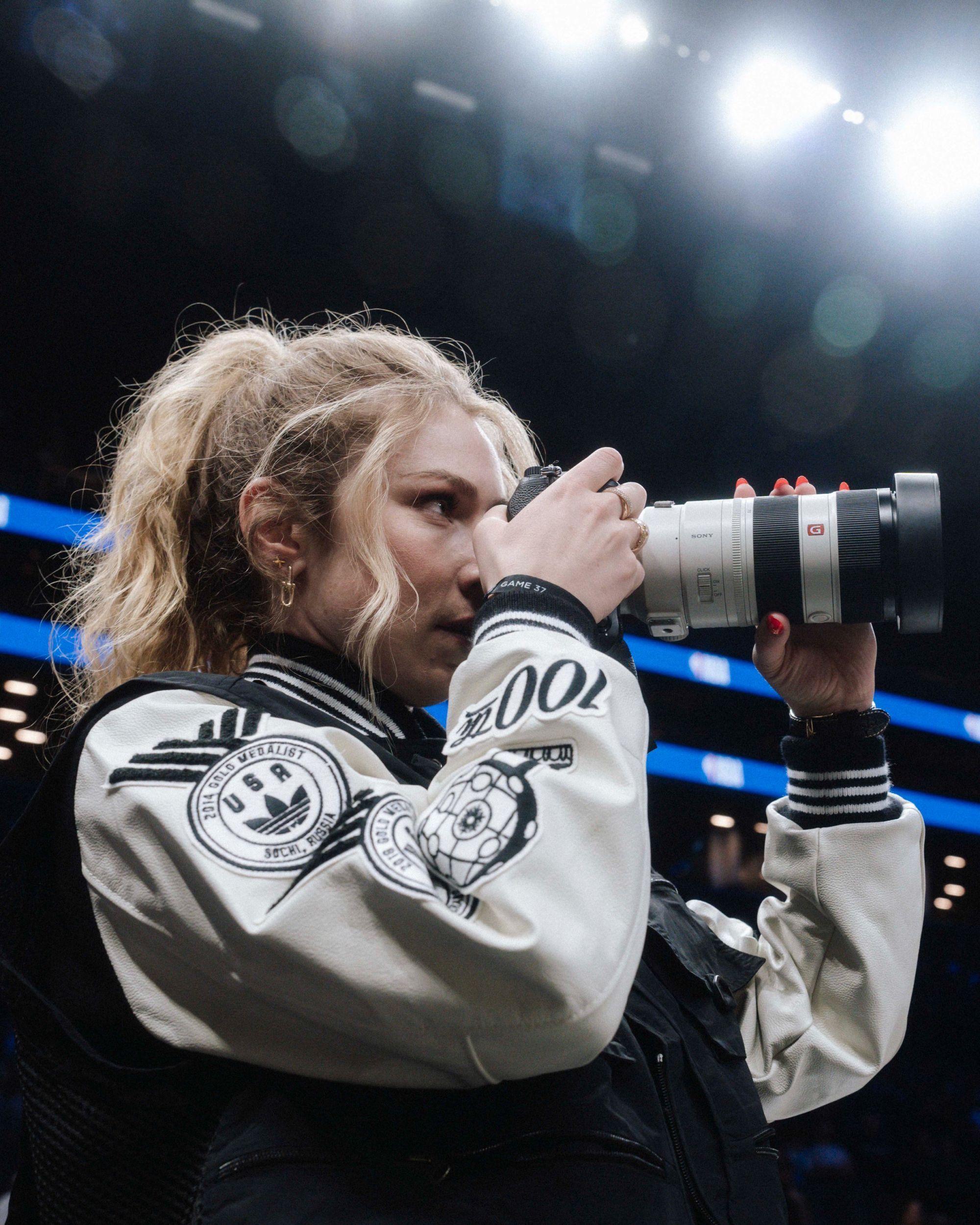
When Caitlin Clark took her place behind the baseline at Gainbridge Fieldhouse in March 2025, during a game between the Indiana Pacers and the Los Angeles Lakers, she wasn’t there simply to get a closer look at LeBron James and company. Wearing a photographer’s credential vest and holding a professional camera, she was shooting pictures like any other courtside photographer. The scene quickly spread across social media, eventually inspiring Megan Harrod, Mikaela Shiffrin’s press officer. "I thought it was the perfect way to highlight an athlete, instead of simply showing her sitting courtside watching the game." And so, during her post-Olympic tour, Mikaela also appeared wearing accredited staff gear and carrying a camera during a game between the Brooklyn Nets and Charlotte Hornets. Then came Simone Biles, equipped with a Sony camera, during a Sunday Night Football game between the Chicago Bears — where her husband plays — and the San Francisco 49ers; and finally Suni Lee on the sidelines on Christmas Day at the Minnesota Vikings stadium.
It’s no coincidence that these appearances often take place in contexts like the NBA or NFL, where the relationship between sports and digital content is pushed to the extreme. They are ideal ecosystems. The photos taken by athletes end up on official team and league channels, are reposted by athletes and media accounts, and become part of the visual storytelling surrounding the event. For leagues, it’s both a narrative and commercial opportunity, while for athletes it’s a way to expand their presence beyond the field of play. And perhaps also a chance to broaden their reach — especially for hugely popular athletes who nonetheless belong to non-mainstream sports, like Shiffrin herself. "Mikaela is the greatest ever, but alpine skiing is still a niche sport," Megan Harrod continued, "so we look for crossover opportunities to introduce her to a wider audience."
Why do so many athletes love photography?
These moments are not just appearances, but a different way of experiencing and narrating the event itself, one that has proven highly appealing to audiences. A photograph taken by an athlete — even if technically less polished — carries a special value precisely because of the unexpected signature behind it. And this is exactly the kind of content that thrives on social media, where audiences crave something that feels authentic rather than constructed — even if that authenticity is only superficial.
Needless to say, the phenomenon has not been free from criticism. Some professionals have pointed out that these operations risk glamorizing, and in some ways diminishing, a profession built on lengthy processes of selection and post-production. After all, Simone Biles herself described it as a "little side gig". For now, though, it remains an almost exclusively American phenomenon, where athletes, teams, and leagues orchestrate content production in a particularly distinctive way. Yet the results — namely the circulation of these images and the ease with which they go viral — suggest it won’t remain confined there for long. Especially because, as several recent cases show, cameras have already been in athletes’ hands for quite some time.
From Virgil van Dijk to Lewis Hamilton
In recent years, the trend has also become increasingly visible in European football. At the end of the 2023/24 season, amid celebrations and title parades, several players were seen carrying analog cameras. For instance, Virgil van Dijk used a Fujifilm X100V to document Jürgen Klopp’s final moments at Anfield. On other occasions — such as title parades — there was Joselu with a disposable camera during Real Madrid’s celebrations, Carlos Augusto photographing the streets of Milan after Inter’s Scudetto, and Juan Cuadrado carrying a Polaroid while collecting snapshots with teammates and fans.
Within this context also sits Héctor Bellerín, probably the most interesting case in football. During his long recovery from a knee injury in 2019, the Spanish player began using photography almost as a form of therapy. He told The Guardian that taking pictures helped him mentally step away from the routine of football: slowing down, observing his surroundings more carefully, and searching for a different way to communicate them. Since then, he has continued shooting with analog cameras, sharing images of travels, backstage moments, and everyday life across his channels. It’s not a structured project or an occasional collaboration, but rather a personal interest running parallel to his football career.
In motorsport, meanwhile, Lewis Hamilton stands out as someone who has long carried photographic projects alongside his work on the track. He has photographed travels, fashion shows, and lifestyle environments, even contributing shoots for magazines like Vogue. "It allows me to see the world from a different, slower perspective," he explained, describing photography as a way to “shift down gears” compared to the relentless pace of Formula 1. It’s a case where the line between personal passion and opportunity becomes thinner, though the starting point remains deeply personal.
Other athletes, even without developing such a defined path, have shown a similar relationship with photography over time. Serena Williams has often shared personal snapshots from travels and moments away from the court; Lindsey Vonn has spoken about appreciating the chance to document places and experiences during the offseason; while the aforementioned Virgil van Dijk, beyond the more publicized episodes, has described photography as a way to disconnect from the routine of football.
When a passion becomes a career
For some, however, the camera doesn’t remain an object to pull out during free time. It becomes something more — eventually transforming into a genuine second career. This transition often involves former athletes, particularly in the United States, where the relationship between sports and the media industry is more direct. In recent years, figures such as Ken Griffey Jr. and Randy Johnson, both former MLB players, have built careers in the field. Johnson in particular had already developed a passion for photography before turning professional, studying photojournalism during his college years at USC, before reconnecting with it after retirement and turning it into a full-time profession. Griffey, meanwhile, has become an increasingly familiar presence on the sidelines of major sporting events, from the NFL to MLS and golf. Then there’s Marshawn Lynch, the former NFL running back, who after retirement began collaborating with the league as a photographer and content creator. During a preseason game between the Raiders and Seahawks — two teams he once played for — fans recognized him on the sidelines, credential vest and camera in hand, bringing his story to a much wider audience.
Cases like these are less common in European football, but they do exist. One example is Spanish coach and former footballer Ernesto Valverde — formerly manager of Barcelona among others — who cultivated photography for years before exhibiting his work in shows such as Suburbia, dedicated to urban life and suburban landscapes. It’s a symbolic transition, as he himself described it: from a coach constantly under observation to an observer behind the lens. Closer to the pitch is the case of Ethan White, former MLS defender, who wrote in The Players’ Tribune about what it means to photograph the sport after having lived it as a player. His aim was not simply to take pictures, but to use his experience to capture details and moments that might escape someone who has never truly lived the game from within.
But the most extreme — and perhaps most meaningful — story is that of Alfie Whiteman. A goalkeeper developed through the Tottenham academy and on the bench for the 2025 Europa League final won in Bilbao, Whiteman decided at just 27 years old to leave professional football behind, despite having several opportunities to continue playing. A decision he himself described as counterintuitive: "At one point I called my agent and told him: stop, I’m not going to that club… I’m done." After retiring, he began working as a photographer and director, collaborating with the production company Somesuch and opening a studio in London. His first exhibition, A Loan, emerged from his experience during a loan spell in Sweden, when he suddenly found himself living by Lake Möckeln, alone and far from home. It was there that he began photographing consistently, pairing the images with personal reflections. "During that period I kept asking myself: what am I doing? Is this really my path?" And within those questions, he found his answer.
For Whiteman, the point wasn’t only photography, but the need to escape a structure he perceived as closed and repetitive. "If you take boys that young and place them inside the bubble of professional football, it’s inevitable they all become products of that environment," he explained. "I felt a little different." Football had become an "endless cycle of season-holiday-season-holiday", preventing him from exploring other possibilities. In that sense, photography wasn’t simply a passion to cultivate in his spare time, but an exit route — one through which Alfie feels he has finally found his true vocation. Among all the possible intersections between athletes and cameras, Whiteman’s story is the most radical and emblematic. Because he didn’t simply change perspective — he changed his entire point of view.