
































Il Mondiale 2026 è diventato anche il Mondiale dei watch party Dall'Anfiteatro Romano di Amman ai kayak di Toronto, passando per Seoul, Gaza e New York
In Italy, unfortunately, it's hard to truly notice it. Without a national team to follow, the World Cup is mostly watched from home, or with a few friends, somewhere between an aperitivo kick-off and another match in the middle of the night. Across the rest of the world, however, the tournament is showcasing another dimension altogether: that of the watch party, or World Cup party, collective screenings in public spaces in front of a giant screen. Sometimes attended by enormous crowds, as we have seen in recent days in Asunción for the Round of 32 clash between Paraguay and Germany, or in Mexico City for the match against Ecuador.
Throughout the group stage, gatherings like these filled and transformed squares, parks and every kind of public space across the globe, from lunchtime to dawn depending on the time zone. That is how the 2026 FIFA World Cup is also becoming the World Cup of watch parties, with remarkable images arriving every day from every corner of the planet.
From thousands of people gathered inside a Roman theatre in Amman, to fans watching from kayaks against Toronto's skyline, passing through the squares of Seoul, Tokyo, Glasgow, Sydney and Dakar, as well as the Fan Festivals in host cities such as New York, Los Angeles and Mexico City. It is precisely from these moments, often thousands of kilometres away from the heart of the action, that some of the most passionate and photogenic images of the 2026 World Cup have emerged.
The magic of a first appearance
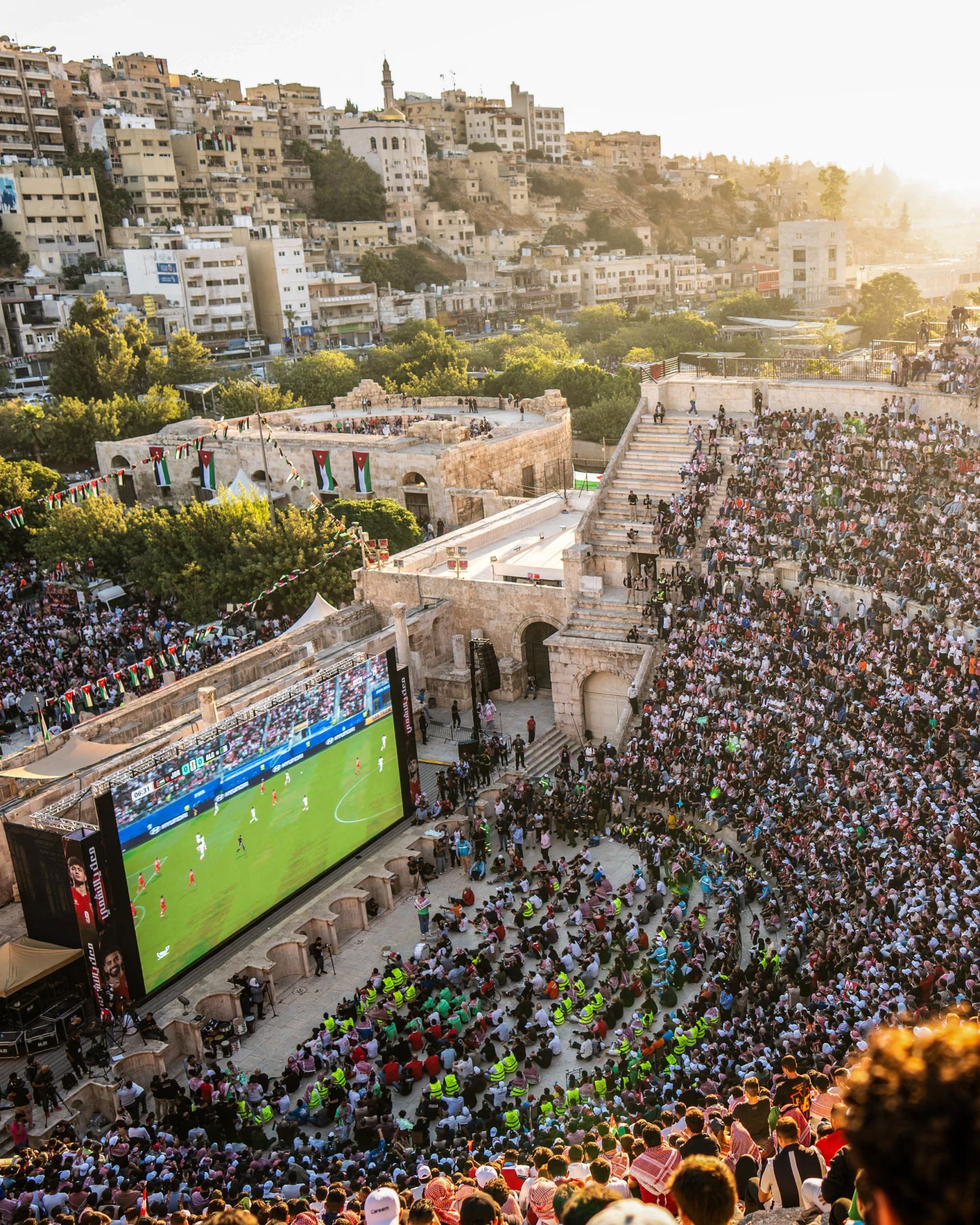
The tournament's most iconic images have come from Amman. To witness Jordan's historic World Cup debut on June 17, thousands of people gathered inside the city's Roman Theatre, built nearly two thousand years ago and transformed into a stadium for one night. It became one of the most spectacular watch parties ever seen, despite an inconvenient kick-off scheduled before sunrise.
Similar scenes unfolded in other nations making their World Cup debut. In Uzbekistan, giant screens and fan zones were set up across several districts of the capital, Tashkent. In Curaçao, supporters gathered in the squares of the capital Willemstad, turning the Punda waterfront into the epicentre of the national team's fairy tale. The same happened in Cape Verde, where the island nation celebrated its first World Cup both at home and through gatherings organised across the United States, particularly in Massachusetts and Connecticut, home to its largest diaspora communities.
Different kinds of watch parties
While the tournament newcomers delivered unforgettable emotions, other national teams showed just how differently watch parties can be experienced from one country to another. In South Korea, for example, thousands once again filled Gwanghwamun Plaza in Seoul, reviving a decades-old tradition. In Japan, alongside the giant screens set up across several cities, viral images came from Shibuya Crossing in central Tokyo. After Japan's 4-0 victory over Tunisia, which secured qualification for the Round of 32, fans flooded the famous intersection to celebrate. They did so, however, with remarkable order: stepping onto the crossing only while traffic lights were red for cars, for just a few seconds at a time, before returning to the sidewalks as soon as vehicles started moving again.
Speaking of unusual venues, in Turkey the World Cup has been watched inside Istanbul's historic Yedikule Fortress, while in Germany, near Stuttgart, one match was screened inside a church. In Toronto, meanwhile, the watch party became a postcard-perfect Canadian scene, with supporters following Germany vs Ivory Coast from kayaks and canoes around the Toronto Islands, a giant screen ahead of them and the city's skyline as a backdrop. In New York, for the Round of 32 match between the United States and Bosnia and Herzegovina on July 2, a watch party was organised at Pier 86 of the Intrepid Museum, beside the historic aircraft carrier permanently moored on the Hudson River.
Then there are the stories that show how football can make distances feel irrelevant. In Dhaka, Bangladesh, thousands gathered to support Argentina and Brazil in scenes resembling a national holiday. In Sydney, Australia, the Algerian community took centre stage, while Moroccan and Iranian diasporas gathered across New Jersey and California.
Far more poignant, and decidedly less festive, were the images that emerged a few days ago from the Gaza Strip. Inside a school in Khan Younis converted into a shelter for displaced families, former Palestinian footballer Fadi Al-Arawi watched several matches alongside other families gathered around a small screen, as documented in a Reuters report. The internet connection constantly dropped, the sound of Israeli drones filled all ninety minutes—and yet, even there, the World Cup managed to carve out a moment of escape. A few days later, elsewhere in Gaza, an improvised watch party brought together hundreds of people to watch Egypt vs New Zealand on a screen erected among destroyed buildings, with tents and rubble forming the backdrop.
Fan Festivals
Last but certainly not least are the host cities themselves, where watch parties have become a central part of the World Cup experience. Alongside the matches, cities across the United States, Canada and Mexico have built an extensive network of FIFA Fan Festivals and public events designed to allow both residents and travelling supporters to experience the tournament even without entering a stadium.
From Mexico City to Toronto, via Los Angeles, Seattle, New York, Vancouver and Monterrey, every host city has created public spaces, giant screens and community events. They have become an ideal alternative for anyone unable to secure a match ticket, while also providing places where diaspora communities across North America could come together. Beyond the Cape Verdean communities in Massachusetts and the Moroccan and Iranian gatherings already mentioned, recent weeks have also seen a sea of Ghanaian supporters filling Sankofa Square in Toronto, English fans gathering in New York, Colombians from Queens and Brazil's community in Miami.
The phenomenon will likely reach its zenith on July 19, the day of the final. While the World Cup trophy is lifted inside MetLife Stadium, just a few kilometres away Central Park will host a massive watch party, as recently announced by New York City mayor Zohran Mamdani. Expected attendance: 50,000 people. It will be the closing chapter—and the exclamation point—of a phenomenon that has already become one of the defining images of this World Cup.