
The unrivalled aesthetics of figure skating at Milano Cortina 2026 An art form, even more so than a sport
Figure skating is the most noble sport at Milano Cortina 2026. It was the first winter discipline ever included in an Olympic program, debuting in London in 1908 and returning in Antwerp in 1920, before establishing itself as a cornerstone of the Winter Olympic Games starting with the very first edition in Chamonix in 1924. The skates themselves, originally made from animal bones, have an ancient origin, linked to the survival of peoples in glacial regions such as Scandinavia, Russia, or the Xinjiang Uyghur Autonomous Region, where archaeological traces dating back as far as 5,000 years have been found. The modern term figure was coined by the Scottish aristocracy in the 18th century, when the first-ever ice skating club, the Skating Club of Edinburgh, created an admission test that required participants to trace a complete circle with both feet, among other geometric shapes.
How are figure skaters judged?
In common parlance, the sport came to be called artistic skating, a term far from arbitrary. First, because over the decades it has also recognized expressive forms such as ice dance as an Olympic specialty, officially starting in Innsbruck 1976, though it had been part of the World Championships since 1952. More importantly, athlete evaluations are divided into two criteria: a purely technical score, based on the execution of required elements specific to each category, and an artistic score, based on the quality of the performance and choreography. The team event, introduced in Sochi 2014, is a complete spectacle showcasing every discipline, from men's and women's singles to pairs and ice dance. It is a true artistic performance, more akin to theater than a sporting competition, where the mechanics of the body are highlighted by the creativity of choreography and the aesthetics of costumes.
Are there rules for costumes in figure skating?
According to the official dress code, sobriety is the main requirement for all competition attire. Strict standards exclude excessive theatricality or nudity, though it is allowed to creatively align costumes with music and choreography. In the men’s category, long pants are mandatory, while for women, although skirts are still common, they have not been required since 2004, a rule introduced at the Olympic level in Torino 2006. Navigating these norms is not easy, and costume complexity lies as much in functionality as in aesthetics. Excessive draping could interfere with skates or restrict movement, and heavy accessories could hinder jumps and spins. Even the weight of jewels, pearls, or necklaces must be precisely calibrated. For this reason, there are true masters of the craft.
Who is Satomi Ito?
Satomi Ito is a Japanese designer with previous aspirations in haute couture. In 2010, she was captivated by the performance of fellow Japanese skater Mao Asada at Vancouver, particularly by the details of her red dress. From that moment, Ito shifted to performing arts, moving from disciplines like rhythmic and artistic gymnastics to dance, and in 2013 she had her first winter sports collaboration with Japanese skater Haruka Imai while still working for the company Chacott. Independent since 2015, Ito has become the most renowned name in the discipline, after her breakthrough at Pyeongchang 2018, when her costumes helped Shoma Uno win silver and Yuzuru Hanyu, still a Japanese TV icon, win gold. Other notable collaborations include Evgenia Medvedeva and Isabeau Levito, now concluded.
Who designed Ilia Malinin’s costumes?
It is no coincidence that for Milano Cortina 2026, the choice fell on her for Ilia Malinin, currently the sport's hottest name, two-time world champion and holder of a streak in International Skating Union competitions over the past three years, with 14 consecutive victories. Ito’s style is recognizable in Powernet fabric, offering a sheer effect while fitting precisely to the athlete’s body, retaining the necessary elasticity to allow free movement. Over the past year, Malinin has worn a vampire-themed costume adorned with teardrop-shaped rhinestones and a skeletal back opening for World competitions, but for the Olympics, a different look was chosen.
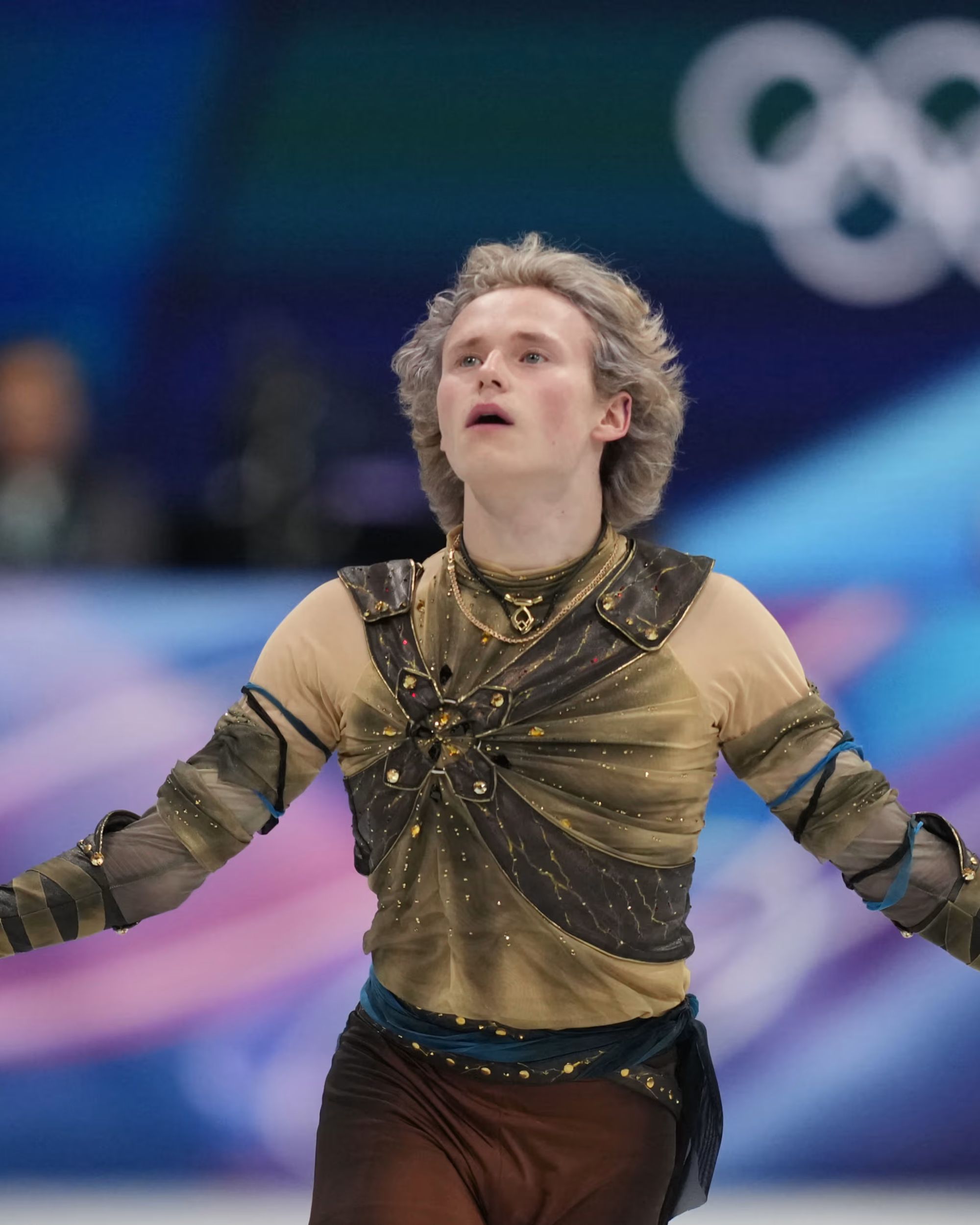
For the short program at the Milano Ice Skating Arena, the costume was inspired by the character Sargon from the video game Prince of Persia: The Lost Crown, made of the familiar mesh fabric in a sand color, with leather strap motifs at the chest, arms, and knees. The free program costume, however, stole the show: an all-black outfit from gloves to skates, highlighting golden extensions from the top to the waistline of the pants, ending with blue jewels on the chest and neck. Stunning, yet unlucky, as Malinin’s winning streak as Quad God ended with unexpected mistakes in the free program, resulting in a noisy eighth place in men’s singles.
Lisa McKinnon
Although Satomi Ito has no equal in her field, a formidable competitor emerged for Milano as well. Lisa McKinnon, born and raised in Sweden, became an independent designer in 2014 with a company based in Los Angeles, USA. She oversees seven skaters at the 2026 Olympics, five from the U.S., especially all female: Alysa Liu, Amber Glenn, and Isabeau Levito, collectively known as the Blade Angels for both short and free programs.
Unlike Ito, McKinnon grew up skating and designed her own costumes from ages twelve to fifteen. She continued designing for peers in her free time, eventually supervising costumes in Las Vegas and Los Angeles, and in 2013 becoming head of costume design at the Wallis Annenberg Center for the Performing Arts in Beverly Hills. Her style emphasizes fabric elasticity, alternating spandex, Powernet, and stretch velvet. She also made a name at Pyeongchang 2018, dressing U.S. skater Karen Chen and German pair champions Aljona Savchenko and Bruno Massot.
Who created Amber Glenn and Alysa Liu’s costumes?
McKinnon’s creations at these Olympics are most visible on two Gen Z icons: Amber Glenn and Alysa Liu, both with over a million Instagram followers. Glenn, the first openly queer U.S. athlete in women’s singles at the Olympics, chose a pop theme for her short program, inspired by Like a Prayer. The burgundy lace costume, with draped shoulders connecting to wide sleeve openings at the wrists, perfectly matched chain necklaces from collarbones to chest. Unfortunately, Glenn placed eighth after a poor short program but received a greeting from Madonna herself.
Alysa Liu fared better, finishing third in the short program, confirming her medal chances. Liu’s journey has been unpredictable: from a top prospect contested by China and the U.S., to retiring at nineteen after a bronze in Beijing 2022, and now returning with wins at the World Championships and Grand Prix before Milano Cortina. Her short program costume featured a white mesh fabric fading to gray layered skirt, accompanying her performance to Promise by Icelandic singer Laufey. Previously, she had worn a metallic silver outfit inspired by Lady Gaga’s Bad Romance.
Japanese dominance
Although the U.S. won the team event, Japan earned silver above Italy, medaling in every figure skating discipline except ice dance. Only the women’s singles remains, with Ami Nakai in first and Kaori Sakamoto in second after the short program. Sakamoto’s free program costume, designed by French brand Astraee Couture, featured an open back with pearl necklace detailing inspired by Edith Piaf’s Non, je ne regrette rien. Japan also claimed gold in pairs, with Miura Riku and Kihara Ryuichi skating their free program to Gladiator. Canadian designer Mathieu Caron created a dual costume, decorating Riku’s top with gold and gray marble motifs, while the female top featured Roman-inspired prints.
Dune takes Milano Cortina
Among the unexpected standout presences in figure skating at Milano Cortina was Dune. The most recent film adaptation by Denis Villeneuve, starring Timothée Chalamet, caught the attention of Kazakh skater Mikhail Shaidorov, who wore a replica of the thermal suit featured in the movie for the men’s singles short program—a suit used in the film to traverse the desert of the planet Arrakis at extremely high temperatures. This choice earned him the gold medal. The contrast between the sweltering desert heat and the icy rink had already been explored by the Spanish duo Olivia Smart and Tim Dieck, who performed their free ice dance program to Dune as the soundtrack. For them, it was an updated take, since they had already used a Dune-themed costume in 2025, adding more polychrome elements compared to previous versions, alternating Smart’s soft beige draping with Dieck’s blue costume.
Couple creativity
Smart and Dieck’s Dune-inspired outfit was designed by Madison Chock, who won team gold and ice dance silver with her husband Evan Bates. Chock designed four total costumes at the event, including her own, in collaboration with Canadian designer Mathieu Caron. Their costume depicts a bullfight scene, with Bates as the bull and Chock as the matador, featuring a red drape lining the female skirt.
Another story involves Christina Carreira and Anthony Ponomarenko, first-time Olympic pair skaters. Their free program costume, designed by McKinnon, was lost in FedEx shipments. After a TikTok appeal by Carreira, the pale pink outfit with red petal tear arrived just in time, inspired by Perfume: The Story of a Murderer.
The most unique piece in ice dance was worn by Canadians Piper Gilles and Paul Poirier in their free program, earning bronze. The costume, a tandem piece inspired by Vincent Van Gogh’s Starry Night, connects their bodies to the music of acoustic duo GOVARDO. Designers Bobby and Sally Ackbarali of Toronto crafted the work, following a performance to a rhythmic program including I'm Too Sexy by Right Said Fred and Supermodel (You Better Work) by RuPaul.
Italy, the true protagonist
Canada’s creative pair blocked Italy’s Charlene Guignard and Marco Fabbri from the podium, finishing fourth in ice dance but securing second in the team event. For free dance, they performed a choreography inspired by Ferzan Özpetek’s Diamanti, with music by Giorgia. The apparent asymmetry—Fabbri in a long-sleeved open shirt, Guignard with covered arms and high collar—creates complementarity, enhanced by cool color choices.
Italian medalists include Matteo Rizzo, who took bronze in the singles team event, his first Olympic medal, after competing in Pyeongchang 2018 and Beijing 2022. He wore a light blue shirt fading to black gloves and pants, with subtle star decorations on his torso and back. Swarovski jewels were omitted as too heavy. His music included Hans Zimmer’s Interstellar and an orchestral adaptation of Silverlines by Damiano David. Other Italian performances included Il Volo’s version of Volare for Rebecca Ghilardi and Filippo Ambrosini, and Lucio Dalla’s Caruso for Sara Conti and Niccolò Macii.
Italy also played an iconic visual role. Tributes included Isabeau Levito’s homage to Sophia Loren in the short program debut, and Svedish ice dancers Milla Ruud Reitan and Nikolaj Majorov performing to Nino Rota’s Un Giorno Per Noi. French skater Adam Siao Him Fa paid tribute to Michelangelo in the long program and Leonardo Da Vinci in the short program, creating a true Vitruvian Man on ice.
Honorable mentions
The figure skating roster is so deep that not all unique costumes can be listed. Individual honors go to Anastasiia Gubanova, whose back featured two faces about to kiss, a black stitch over a transparent base echoing lovers’ silhouettes, matching the music from Ghost. For couples, British duo Lilah Fear and Lewis Gibson embodied the '90s spirit with a dance program inspired by the Spice Girls, including Fear’s Union Jack dress tribute to Geri Halliwell at the 1997 Brit Awards and coordinated red tartans referencing Gibson’s Scottish heritage.