






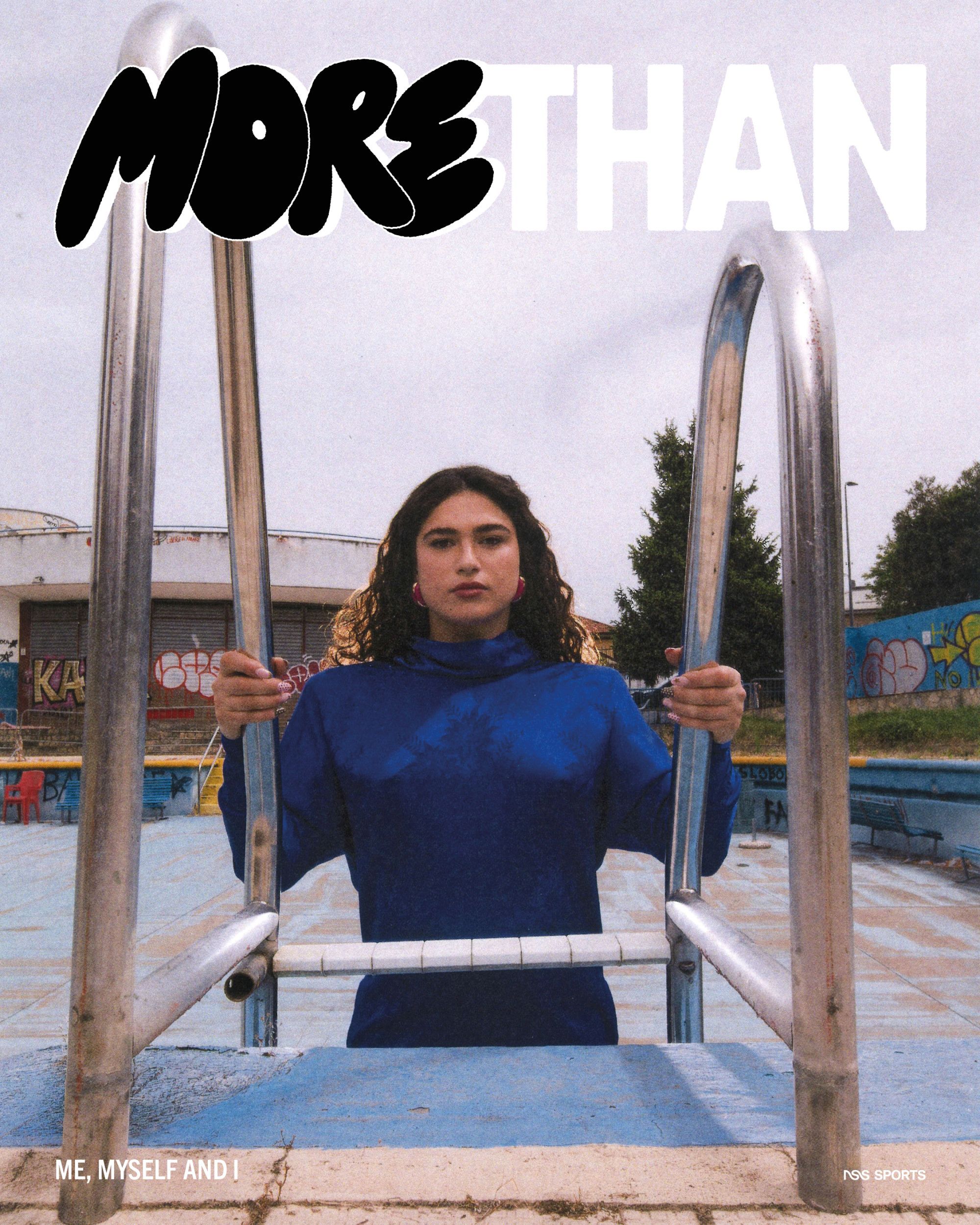
Climbing is an act of freedom Our interview to Wafaa Amer
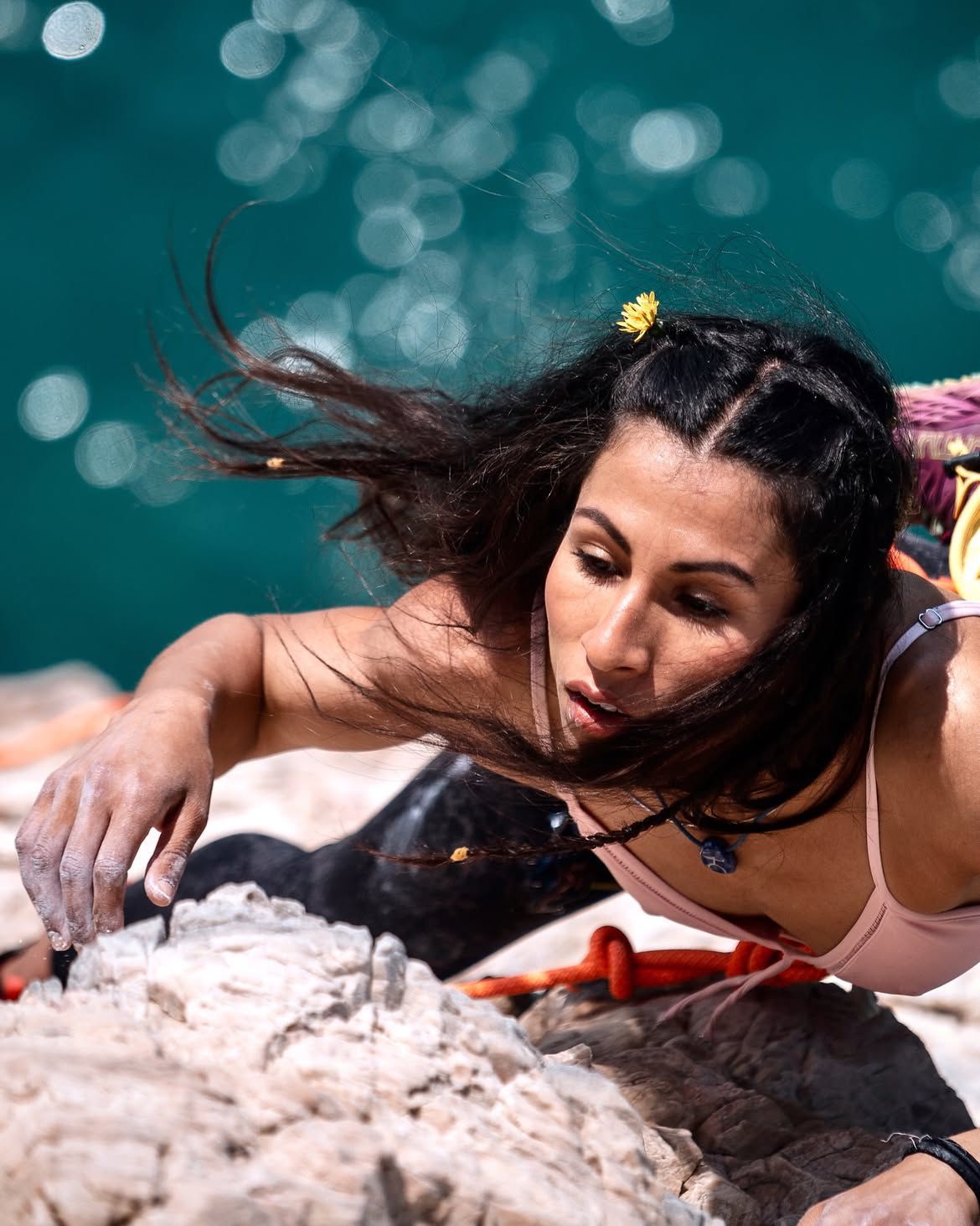
Can you love the mountains and fashion at the same time? Want to be strong and beautiful? Refuse to choose between the different parts of yourself? After years of trying to reconcile her contradictions, Wafaa Amer can say yes. Born in 1996 in the Egyptian village of Aghur and moving to Italy at the age of nine to join her family, Amer discovered climbing one autumn day during a project at middle school.
That day opened up a whole new world: for the first time, Wafaa felt strong, good at something, and realised that her life was not already written for her. Her father believed climbing was not for women, but a friend's family paid for her first course and, by then, there was no turning back. Wafaa began finding ways to climb when her family tried to stop her, travelling, meeting different kinds of families, different ways of being a woman and of looking at life. At 18, she did not get married as tradition would have expected. Instead, she left home and moved to a farm in Finale Ligure, where she climbed her first difficult routes on rock and made the first female ascent of the historic Hyaena route (8b/8b+).
Today, Wafaa still climbs, is interested in fashion, and has learned to navigate both her Egyptian heritage and her experience as a woman in contemporary Italy. Hers is a story about family, contradictions and choices.
Curious, creative, contradictory
When I ask her to describe herself in three words, she immediately comes up with these: curious, creative, contradictory. "I think I've always been curious, even before I knew what to call that part of myself. As a child, I couldn't sit still: I would climb the palm tree in my grandfather's field, put my hands in the soil, watch the animals, try to understand how things worked. Today that curiosity has taken a different shape, but it is still one of the main driving forces in my life," Wafaa says. Her creativity, on the other hand, comes from necessity.
In the village, she learned to make do: she sewed dolls, built mud houses, made kites out of scraps of paper, watched her aunt Sameh make clothes and school uniforms from leftover pieces of fabric. The contradiction emerged when Wafaa arrived in Italy, suddenly finding herself in a reality that was completely different from the village, yet within the same family. "For a long time I tried to make the different parts of myself fit together, whereas today I don't think I need to choose just one version of myself. I can be very strong and very fragile, need freedom and at the same time seek belonging, love the mountains and fashion, feel deeply connected to Egypt and consider Italy home. I can want opposite things at different times, change my mind, be one thing and its opposite."
Inside the contradiction
During her teenage years, it was not only the Italy-versus-Egypt dichotomy that created friction: "My father was very traditional: he couldn't see the freedom he encountered outside our four walls as something he could engage with or integrate into the family; he saw it as a threat and reacted by tightening the rules." Rules that became even stricter than those Wafaa had experienced as a child in Egypt. Her mother did not fully agree with her father's position and helped her however she could: she would arrange cushions under the blankets to make it look as though Wafaa was sleeping when she was out, covering for her with a thousand lies whenever she went out to train or compete in climbing competitions. Her brother would throw her pyjamas out of the window so she could put them on before coming into the house.
The years passed and Wafaa grew up caught between two worlds that seemed unable to communicate with each other. Outside the home, she discovered possibilities, different ways of dressing and people who challenged what she experienced at home, where her path seemed already mapped out and expectations weighed heavily on her shoulders. Her instinct was to blame her origins, culture and religion for the rupture she felt inside. "Only much later did I realise that culture, religion and my family experience were not at all the same thing. That was when I understood that I didn't have to choose between my origins and the country I had learned to call home, between being Egyptian and Italian. The hardest thing was not finding my own path, but accepting that following it would come at a cost: coming into conflict with my family."
Wafaa decided to pay that price, because the alternative was to live a life that felt less and less like her own with every passing day. At 18, Wafaa heard her father say that he would send her back to Egypt to continue her life according to tradition. The decision was immediate: she sold all the prizes she had won and used the money to stay afloat while looking for work. She moved to Finale Ligure, one of Italy's best-known climbing destinations, where she found friends ready to support her on her long journey towards independence.
"During my teenage years I had to lie, hide, feel guilty or fear the consequences of everything I did, even something as simple as climbing, spending time with people outside the family, or trying to build a life of my own. I became a free woman through a series of small ruptures, compromises, fears and decisions. One choice after another, trying to distinguish what I truly wanted from what I was doing simply to obey or, on the contrary, to rebel." When someone else draws the boundaries within which you are allowed to think, even dreaming becomes an exercise in freedom. A muscle that needs to be trained. "It's a question I still ask myself today: how much of what we desire really comes from within us, and how much comes from what we have learned to believe is possible?"
What might have been...
If Wafaa's family had never decided to emigrate, she would probably be a different person today. It would be easy to assume that her life would have been less free, but she does not give in to that temptation. "The truth is that I can't know who I would have become if I had stayed in Egypt. I don't think it's fair to assume that I would have had a predetermined fate simply because I stayed there. I would have met different people, had different opportunities, made different choices. Maybe I would have become a woman very similar to the one I am today, or completely different."
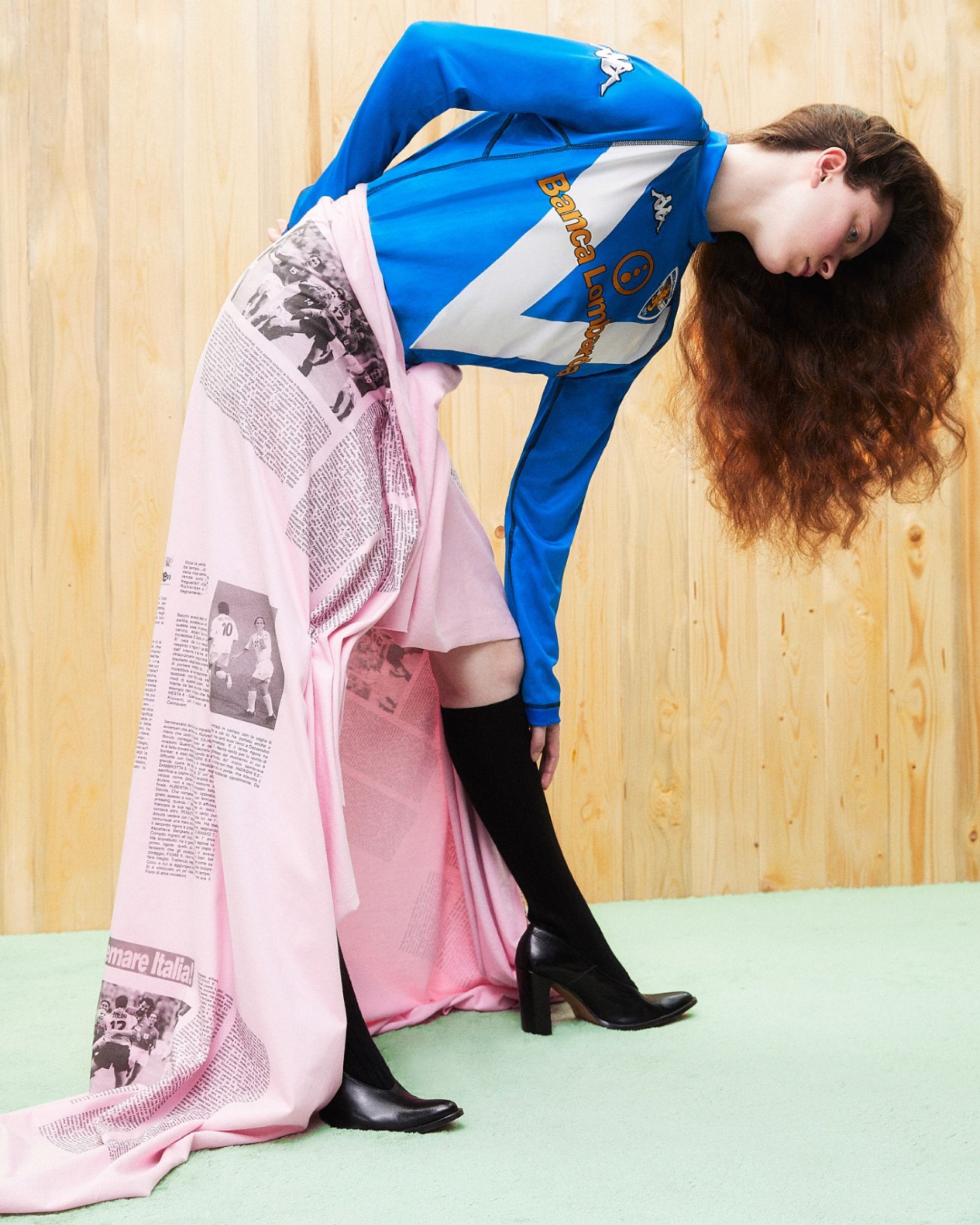
Wafaa grew up with her seamstress aunt as a role model, and soon began drawing figures and clothes of her own invention. "I've always liked the idea of building people's image through clothes, understanding how a garment can completely change the way a person is perceived, or even the way they perceive themselves." As an adult, she studied Fashion in Milan for a year before having to drop out for financial reasons. But university gave her some of the tools to understand what we communicate through what we wear. "Belonging, status, gender, identity, desire, rebellion. But for me, fashion starts with the hands. That's why I don't see it as being so far removed from climbing: both tell us something about people, just through very different languages."
If climbing uses the body, fashion turns it into an object of the gaze. The two come into conflict as soon as there is one muscle too many, a shoulder that is too defined, a proportion that fits the ideal of strength but not that of aesthetics. "Climbing taught me very early on to look at my body for what it was capable of doing. I trained a lot and my body developed along a single trajectory: becoming stronger, being able to execute certain movements, winning competitions. My body was a tool, but also a place of discovery. Fashion looks at that same body, photographs it, dresses it, places it within measurements."
For Wafaa, at times the two worlds represent a contradiction: a trained body is no less feminine, yet it does not always make her feel completely comfortable. "On the wall, my body perfectly matched what I wanted to be; in other circumstances, it didn't fully reflect the image I had of myself. I would have liked to be more delicate, more feminine. At the same time, I think that getting to know my body through sport first gave me a very strong foundation: my body doesn't exist simply to be looked at. I know what it can do, and that awareness comes before the aesthetic gaze for me."
Fashion and climbing
Today, outdoor clothing can be seen on the Navigli too, while gorpcore has taken an aesthetic born out of functionality and stripped it of its original context, reinterpreting it in the process. "But that's what fashion does: it takes codes belonging to subcultures, professions, sports or communities and turns them into a language." Outdoor has thus become a status symbol, finding its way into more mainstream wardrobes. Part of the mountain sports community might move away from it precisely because of this, feeling the need to find a more distinctive aesthetic. "Perhaps you can distinguish between people who wear outdoor clothing because they go to the mountains and those who wear it because it's fashionable. But do we really need to? Outdoor clothing is part of my life and I'll keep wearing it regardless of the meaning it takes on in fashion. What interests me, instead, is seeing how the same object can take on completely different meanings depending on who wears it and the context in which it is used."
If she were to design an outdoor clothing collection herself, Wafaa would put fit first. "I would start with the real body of someone who climbs and with the way that body changes and moves: you need to be able to raise a leg, stretch, curl up, have complete freedom of movement. But I would also be interested in the way the garment fits and enhances an athletic body. I wouldn't want to have to choose between something that works well and something I like seeing myself in. For me, a successful collection should be able to do both."
The Wafaa of today is a woman who makes her own choices, knows how to change her mind, and has learned to preserve certain parts of the culture she grew up in while letting go of others. I imagine her walking down the street and meeting her younger self, newly arrived in Italy. What would she tell her, if she could speak to her? "If your freedom disrupts the order, disrupt the order."
