
















History and aesthetics of Ibrox The cursed house of Rangers FC


Glasgow is one of those British cities that is more a football pilgrimage site than an ordinary tourist destination. That's because the city is famously divided in two. There is the green-and-white side aligned with Celtic and then there's the blue side of the Rangers. The latter faction has its home at Ibrox Stadium. Recognised as one of the temples of Scottish football and beyond, Ibrox has been the Gers's home since 1899. Its history, spanning three centuries, is a mix of triumphant scenes from the 117 official trophies won by the club and other catastrophic events, given the tragic incidents that have occurred. A clear division that splits the stadium's soul in two, reflecting something of Glasgow itself.
A historic ground
The Rangers are a legend of Scottish football, with a trophy cabinet that includes 55 league titles, 34 Scottish Cups, 28 League Cups and a Cup Winners' Cup. The club was founded by four boys who spent their afternoons in what is now Kelvingrove Park, initially choosing sky blue for their kits before switching to royal blue after half a century. The name was chosen after one of the youths, Moses McNeil, read the name of a rugby team called Swindon Rangers in a book. After an initial period using temporary grounds, the club decided to settle in the Ibrox area, now a suburb in the south-west of the city within the Govan district, which at the time was an autonomous burgh from Glasgow. A strong fan base was developing there, so in 1887 the first Ibrox Park was opened. This remained in use for only 12 years due to structural inadequacies and limited capacity, while the Ibrox we know today was built in 1899, partly positioned on the ashes of the old ground.
The project was entrusted to Archibald Leitch, an architect who would become the father of most of the United Kingdom's most iconic stadia. His hand can be seen in the construction of Anfield in Liverpool, Old Trafford in Manchester and many of the major venues in London and Glasgow. Back then Ibrox was oval-shaped, with wooden terraces around a central pavilion. Today, after countless renovations, it looks very different. The current Main Stand dates from 1928 and is the most recognisable, postcard-worthy section of the ground. Listed in 1987 among Britain’s historic buildings, this stand is characterised by a red-brick façade featuring neoclassical arched windows and the inscription “Rangers F.C.”. Internally, the middle tier retains a criss-cross balcony typical of Leitch, while the side stair towers leading to a third tier support what is considered to be the world's longest single-span beam, at 146 metres. The other three stands, built on the stadium’s rectangular footprint, are arranged on two tiers. In 2011 one of the original cast-iron and oak seats was even sold for more than £1,000, attesting to the structure's iconic status.
The tragedies of Ibrox
That Ibrox is both beautiful and cursed is told by its history. The first Ibrox disaster took place on 5 April 1902: during a Scotland-England match, the upper part of the west terrace collapsed, causing about 200–300 people to fall to the ground. Of these, 25 lost their lives. The match, after a short pause, was resumed because there was concern that clearing the crowd would have delayed aid to those involved in the collapse. About 68,000 spectators attended the match, half of them in the ill-fated stand that had previously been reported for excessive oscillation. Causes suggested for the failure ranged from the poor quality of the pine wood used in the construction of the section to heavy rain the day before, and even the idea that the crowd's frantic swaying was triggered by a lost dribble by player Bobby Templeton. This tragic event stained Archibald Leitch’s reputation, and he begged the club to redeem his mistakes by building a new stand. A replay match was instead played at Villa Park, with proceeds donated to the victims’ families.
During the 1960s several incidents foreshadowed an even greater disaster. In 1961 the collapse of a barrier on Stairway 13 caused two deaths by crushing, with similar events repeating in 1967 and 1969 causing injuries. In 1968, two separate fires hit the Main Stand and another stand, burning 200 seats. What happened on January 2nd 1971 remains the worst tragedy in British football since Hillsborough, which occurred 18 years later. The match was an Old Firm against Celtic, drawn at 90 minutes after the Rangers equalised. On Stairway 13, the exit ramp nearest the subway stop, the crowd surged at the final whistle, with two people losing their balance and falling to the ground. This triggered a macabre chain reaction, bodies compressed against one another. The uncontrolled movement and overcrowding caused 66 deaths, half of them under twenty years old. Today a memorial on the stadium perimeter remembers the names of those who died, written on the red brick under the statue of John Greig, the captain at the time. Since then, safety measures have been strict, with a progressive reduction in capacity and terraces replaced by seated, covered stands, following the model of Dortmund’s Westfalenstadion. The last major renovation took place in 1997, which also saw the name change from Ibrox Park to Ibrox Stadium.
There are no Rangers without Celtic
When you think of the Rangers, the first association is with Celtic, the other Glasgow club that together make up the Old Firm. You could say that one cannot exist without the other and in a way that is true. The rivalry began to polarise when Harland & Wolff, a Belfast shipbuilding company, bought three shipyards in Glasgow, providing work for labourers from the Northern Irish capital. Most of them were Protestant, unionist and loyal to the British crown, and they began supporting the Rangers, the team geographically closer to their docks. This stood in contrast to Celtic, a club whose evocative name was already known at the time as Catholic and pro-Irish, therefore anti-monarchist. This so-called political-religious sectarianism is what most characterises the Glasgow derby, transcending football and affecting important life choices. In the eternal struggle between Ireland and the United Kingdom, the Old Firm is thus the footballing representation.
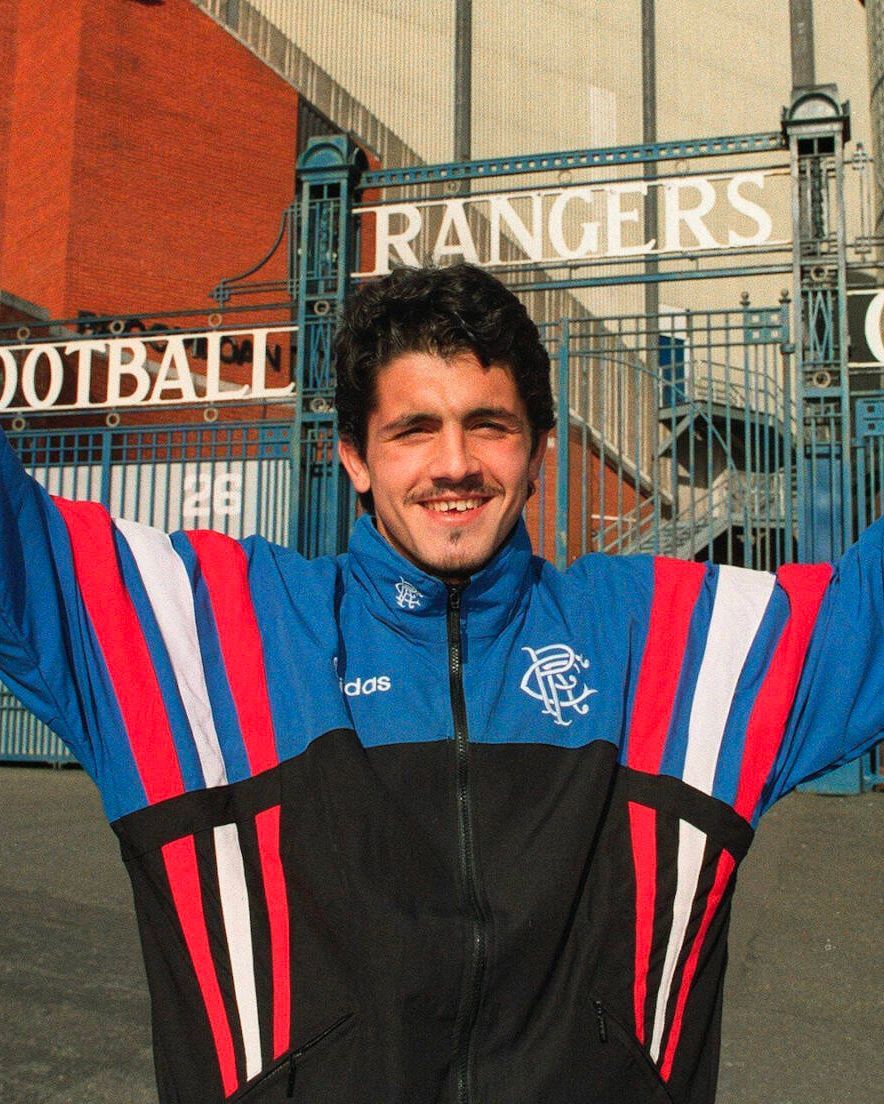
To show how seriously the matter was taken, consider that the Rangers, from the 1930s until the late 1980s, did not sign any player of the Catholic faith, following a well-known unwritten rule, even parodied in the BBC comedy show Scotch and Wry in 1979. This tradition was broken by the signing of Mo Johnston in 1989, a declared Catholic whom the Rangers swooped on from Celtic, the club he had been due to rejoin. The move caused huge uproar, with people gathering angrily outside the Belfast Telegraph, the newspaper that first reported the news, and fans burning their season tickets. Even Gennaro Gattuso, during his time with the Gers, experienced this divide firsthand, being gently advised by teammates to remove the crucifix from around his neck during matches. In the past the club and its members were linked to the Orange Order, a Protestant organisation whose main colour is orange, often reflected today in the Rangers’ away and third kits.
The blue tide of the Gers
Finally, we cannot forget the club’s worldwide popularity. Among its supporters are celebrities such as Sean Connery, the original James Bond, and Gordon Ramsay, the television chef of Hell’s Kitchen. Love for the team knows no category: today Ibrox’s nearly 52,000 seats are regularly filled, but they were even when, about ten years ago, the Rangers were playing in the fourth division after the club went bankrupt, drawing 49,000 spectators to a match — a world record for that level. Another record occurred in 2008, for the UEFA Cup final in Manchester, when an unprecedented exodus brought 200,000 fans in blue shirts to the city, flooding the centre, singing the famous "Follow Follow" chant and waving Union Jacks. Back in 1927 a group of Scottish fans from outside Glasgow organised what is considered the first ever organised supporters’ coach to follow the team at an away game, a testament to what supporting the Gers has meant for 153 years.