





























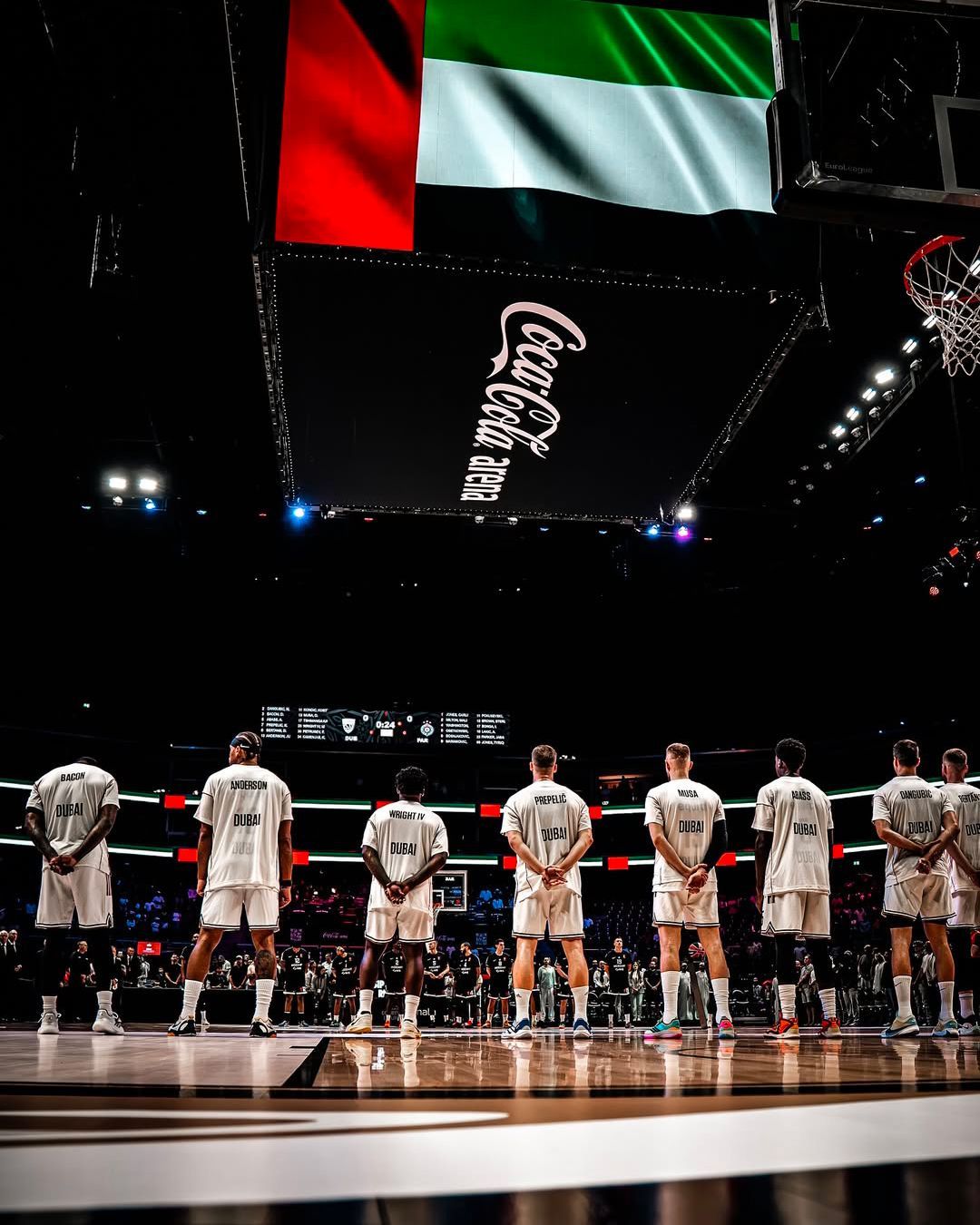
What is Dubai Basketball doing in the Euroleague? European basketball has increasingly deep roots in the Persian Gulf
From this year the EuroLeague is also played in the United Arab Emirates, on the parquet of the Coca-Cola Arena in Dubai. The arrival of a Persian Gulf team in the continent’s top basketball competition is the latest sign of a process already underway, and it does not concern only the EuroLeague nor the very young Emirati club. Dubai Basketball was founded just two years ago with private ownership, but with the national tourism authority as a partner, following the now familiar path of sports diplomacy or sportwashing associated with some governments in the region. However, this is not the only non-European club in the competition, nor is it something perceived as absurd by the international public, now more or less willingly used to considering the Persian Gulf a new home for basketball, similar to other sports.
The escalation has been very rapid. It began in 2024 with the ABA League, in which Dubai regularly faces Balkan teams, and after only twelve months of testing it landed in the EuroLeague. Another extension, then, of the geographic map of European sport, and in basketball’s case a widely anticipated turning point after the recent expansion of the tournament and the 2025 Final Four in Abu Dhabi. In the background, pressure fueled by the NBA’s invasion of the old continent — for which it is only a matter of time. One more push for the EuroLeague beyond any borders, both literal and geographic, in search of new opportunities.
The foundations
Dubai Basketball is based in City Walk, at the Coca-Cola Arena, a 17,000-seat venue that meets the most modern standards, with a project designed by Populous and inaugurated in 2019. At the top of the club sits Abdulla Saeed Al Naboodah, while the managerial structure is in European hands, those of Dejan Kamenjašević and initially Djordje Djokovic, brother of Novak. The technical staff is led by Slovenian Jurica Golemac. The institutional partnerships underpinning the project are explicit, with the DET (Dubai Department of Economy and Tourism) as a founding sponsor and the Visit Dubai logo clearly visible on the jerseys, on the court and in the merchandising. The declared intent from day one: to challenge the continent’s elite in the EuroLeague.
After an initial refusal in 2024, to strengthen its candidacy Dubai chose the more concrete route: to immediately measure itself in a regional championship. Entry into the ABA League, which typically features teams from the former Yugoslavia (with an Israeli exception at the turn of the millennium), was announced in March 2024, thanks to a three-year agreement that also covers the current season and the next. The new route from the Persian Gulf to the Adriatic Sea was made possible by a series of predictably economic incentives. In addition to an entry fee of about €8 million, it also guarantees access to new markets and sponsors, but not only that; Dubai made the proposal attractive to clubs — which initially had ethical, identity and logistical reservations — by covering all travel expenses from the Balkans to the United Arab Emirates.
The first year showed the project had solid foundations. Dubai spent significant amounts but not out of scale, intended to grow gradually over the coming seasons, as often reiterated by the ownership. The team reached the ABA semifinals and proved competitive against established continental clubs such as Partizan and Crvena Zvezda. In the summer, several significant market moves were made, confirming also the ability to attract important technical profiles. In short, Dubai provided the EuroLeague with all the guarantees and the time needed to normalize the process, soon receiving approval for the jump to the top tier starting from the 2025/26 season. Thus came the debut last week, with a victory over Partizan Belgrade at the Coca-Cola Arena.
European perimeter
Entry into the EuroLeague was finalized with a five-year wild card expiring in 2030, an exception to the usual three-year licenses, granted as part of the recent expansion in favor of a 20-team format and 38 rounds on the calendar. The perfect opportunity to further expand the competition’s boundaries, well beyond those of geographic Europe, but even this is not new to the public. The EuroLeague is in fact a semi-private, semi-closed league, and at this point we could say semi-European; independent from FIBA Europe and administered by the ECA (Euroleague Commercial Assets), which awards licenses and wild cards on economic and sporting bases, without strict territorial constraints. That is why the United Arab Emirates, while belonging to the FIBA Asia sphere, were able to enter the tournament, as has been the case for decades with Israel, and not only in basketball. Tel Aviv clubs — this year Maccabi and Hapoel are in the EuroLeague — have long been part of the European basketball calendar, just as in UEFA competitions in football. Historical, political and security reasons — and in the Emirati case, obviously, economic reasons — explain this.
The ECA’s aim is declared: to open new markets wherever travel is not prohibitive and where there are facilities, audiences and partners that can enrich the coffers and broaden the EuroLeague’s horizons. In this framework, Dubai meets at least two out of three requirements very well, with the obvious exception of the audience, which at the debut — as seen — was around 6,000 spectators, not exactly the same as Belgrade, Athens or Istanbul, despite the first ABA season’s figures citing 80,000 total attendances and some sold-outs in the final phases. In any case, the Dubai project presented itself at the right time, as the missing piece to consolidate presence in the region and attract new Gulf investments, after the 2025 Final Four in Abu Dhabi. We are left to see whether the example will soon be followed by other entities, given how rapidly Dubai moved from project foundations to arrival on the big stage.
On the financial side, for the 2025/26 season the club has set its payroll at around €16 million, placing it in the mid-range by continental standards. It is a figure that makes Dubai credible in the short term, but without flooding the system and in line with the progressive salary cap the EuroLeague is integrating, which will be fully in force by 2027. In recent months the roster has been strengthened with high-profile names such as Džanan Musa, who left Real Madrid, Davis Bertans returning from the NBA and former Olympiacos player Filip Petrušev, already key figures in the debut win against Partizan.
For the EuroLeague, beyond the direct return from granting the wild card (for an as-yet unknown but certainly significant amount), many new opportunities have opened up. Eurohoops estimated an immediate revenue of $50 million for Dubai’s entry, to which several complementary revenue sources must be added: from audience figures to TV distribution in the MENA area, as well as establishing a base for future initiatives in the region. For Dubai, meanwhile, all this means positioning itself within the basketball elite circuit, with a calendar and exposure that no other competition currently guarantees. Sponsors — including adidas, Audi, Coca-Cola, Subway and Commercial Bank International — have not hesitated to climb on board the project, and the first internationally appealing players have not shown much reluctance to embark for the Gulf. The taboo, after all, was broken some time ago, and this is how a new stop on the circuit was inserted into the calendar, in Dubai. In the coming months, among others, Barcelona, Olimpia Milano and Fenerbahçe will make a stop there.
Basketball and petrodollars
As anticipated, the 2025 Final Four at the Etihad Arena in Abu Dhabi — the first ever outside geographic Europe — had already clarified the framework of operations. To secure the May weekend, the Department of Culture and Tourism paid about $25 million, the highest amount in the competition’s history. On the media and sponsor side the map updated quickly, with Dubai Media (Dubai Sports TV) acquiring free-to-air rights for five years across the MENA area, while Experience Abu Dhabi and Etihad Airways became main partners of the EuroLeague and EuroCup.
Broadening the perspective, the regional context is moving in the same direction. The FIBA World Cup 2027 is scheduled to take place in Qatar, while the NBA for some years has staged the Abu Dhabi Games as part of preseason activity, simultaneously welcoming Emirates as an official sponsor of the NBA Cup and referee uniforms. The Persian Gulf has thus become, like in football, motorsports and many other sports, a crossroads where European tournaments, local teams, high-end international friendlies and gigantic commercial deals coexist.
Into this background fits a more basketball-specific variable: the NBA-FIBA project for a European league. The plan is still under exploration, but the NBA has gone public and the direction seems clear: sixteen teams of mixed composition, partly fixed and partly via qualification, in a tournament integrated with domestic leagues and likely starting in 2028. "We believe we can further enhance the basketball product on this continent", said commissioner Adam Silver at a press conference last winter, outlining a potential showdown with the EuroLeague. The mere statement of intent is enough to explain why the EuroLeague is accelerating its search for new opportunities: to grow and consolidate now, to be less vulnerable tomorrow.
Tunnel is the weekly newsletter from nss sports that brings together the best of sportainment. Click here to subscribe.